Most small and medium sites never need to think about crawl budget. Large or fast-changing sites do. Here is how Google decides how much to crawl and how to stop wasting it.
This guide explains crawl budget using Google’s documentation and what I see on client sites. It is part of my technical SEO service.
Quick answer
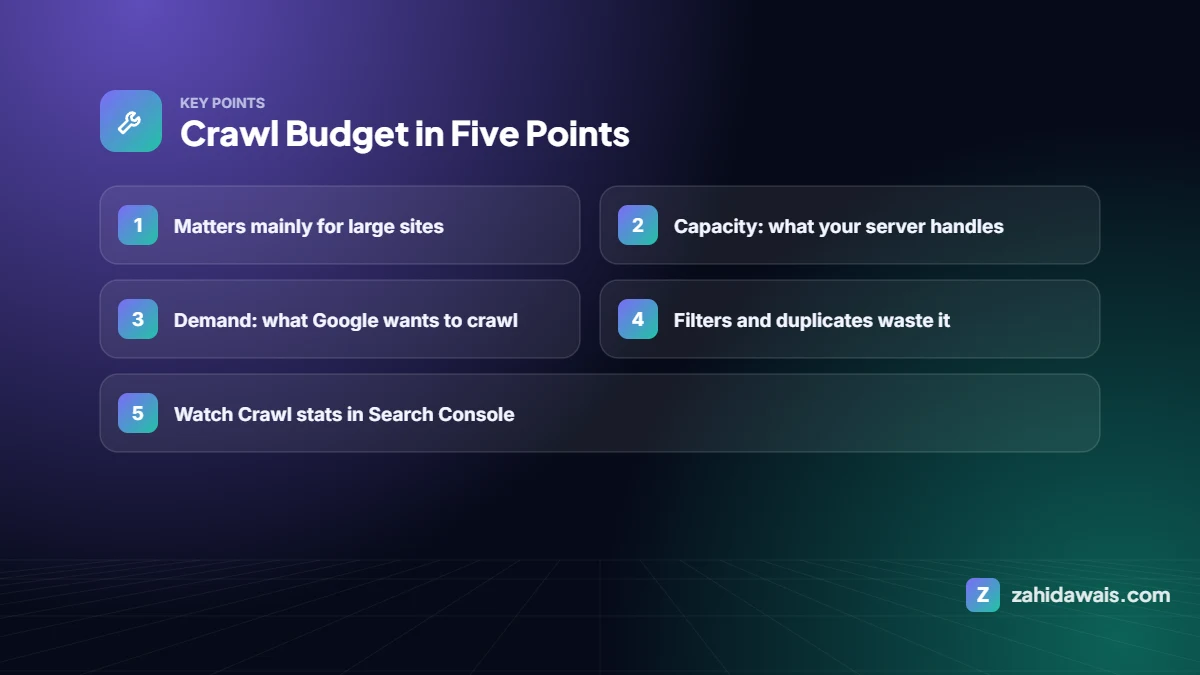
Crawl budget is the number of URLs Googlebot can and wants to crawl on your site. It depends on crawl capacity (how much your server can handle) and crawl demand (how much Google wants your content). Google says it mainly matters for very large sites, sites with fast-changing content, and sites with many pages stuck in “Discovered, currently not indexed”.
Crawl Budget in Five Points
Who needs to care?
Site
Care about crawl budget?
1 million+ unique pages changing about weekly
Yes
10,000+ unique pages changing daily
Yes
Many URLs stuck in “Discovered, currently not indexed”
Yes, investigate
Small or medium site, new pages crawled the same day
Usually no
Google notes these numbers are rough estimates, not exact thresholds.
Crawl capacity vs crawl demand
Crawl capacity limit: how much Google can crawl without overloading your server. It rises when your site responds fast and reliably, and falls with slow responses or server errors.
Crawl demand: how much Google wants to crawl, based on site size, how often content changes, page quality, popularity and staleness. Many duplicate or low value URLs waste it.
What wastes crawl budget
Faceted navigation and filter URLs creating endless combinations.
Session IDs and tracking parameters in internal links.
Update and improve content; quality and freshness raise crawl demand.
How to monitor crawling
In Search Console, open Settings, then Crawl stats. Watch total crawl requests, average response time and the share of responses by type (OK, redirect, not found, server error). A rising response time or many errors are the first things to fix.
Example
An online store with 4,000 products generates 300,000 filter URLs through colour, size and sort parameters. Googlebot spends most of its time on those, while new products wait days to be crawled. Blocking sort and filter parameters, keeping a few useful filtered category pages indexable, and cleaning the sitemap lets Google reach new products much faster.
Done for you
I audit and fix speed, Core Web Vitals, indexing, redirects and schema, and send you a clear report of every change.
A technical SEO audit finds what stops Google from crawling, indexing and understanding your pages. This is the 6-step, 30-check process I use before any other SEO work.
Schema markup tells search engines exactly what a page is about: an article, a product, a business, a person. Here is which types matter, how to add them and the mistakes to avoid.
Core Web Vitals measure how fast your main content loads, how quickly the page reacts and how stable it is. Here are the thresholds and the fixes that work on real sites.