Core Web Vitals measure how fast your main content loads, how quickly the page reacts and how stable it is. Here are the thresholds and the fixes that work on real sites.
This guide explains Core Web Vitals and how to fix each metric. It is part of my technical SEO work for clients.
Quick answer
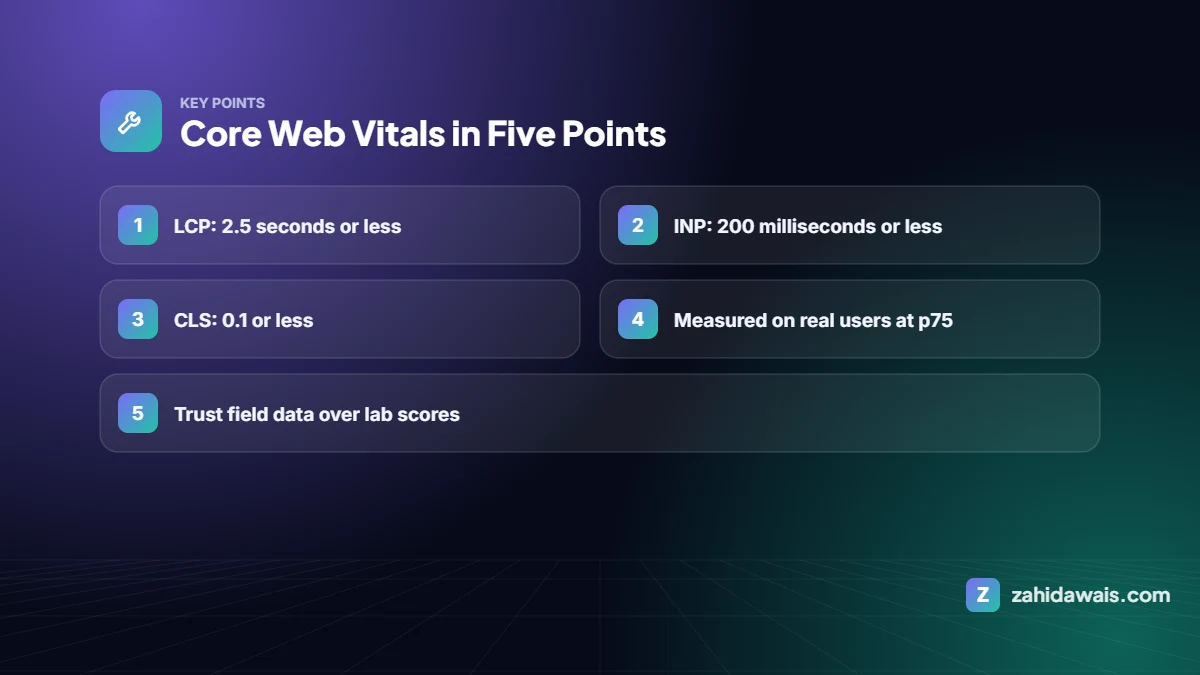
Core Web Vitals are three metrics: Largest Contentful Paint (LCP, loading), Interaction to Next Paint (INP, responsiveness) and Cumulative Layout Shift (CLS, visual stability). A page passes when, at the 75th percentile of real visits, LCP is 2.5 seconds or less, INP is 200 milliseconds or less and CLS is 0.1 or less.
Core Web Vitals in Five Points
The three metrics
Metric
Measures
Good
Poor
LCP
Time until the largest image or text block is visible
2.5 s or less
Over 4 s
INP
Delay between a tap or click and the next screen update
200 ms or less
Over 500 ms
CLS
How much the layout jumps while loading
0.1 or less
Over 0.25
INP replaced First Input Delay (FID) as a Core Web Vital in March 2024.
Do Core Web Vitals affect rankings?
They are part of Google’s page experience signals. Google has said good page experience alone will not make a weak page rank, but between similar pages it helps, and slow pages lose visitors and sales whatever Google does. Google’s AI features documentation also lists good page experience among its recommendations.
How to measure them
Search Console, Core Web Vitals report: real user data grouped by URL type, for mobile and desktop.
PageSpeed Insights: field data (real users, top section) and lab data (Lighthouse, below) for one URL.
Chrome DevTools, Performance panel: find exactly which element is the LCP and which script slows interactions.
Always trust field data first. A perfect Lighthouse score in the lab can still fail for real phone users.
How to fix LCP
Find the LCP element (usually the hero image or H1) and make sure it is in the HTML, not added later by JavaScript.
Compress and resize the hero image, serve WebP or AVIF, and add fetchpriority="high". Never lazy-load the LCP image.
Reduce server response time (TTFB): page caching, a CDN, better hosting, fewer slow plugins.
Remove render-blocking CSS and JavaScript; inline critical CSS and defer the rest.
Preload key fonts and use font-display: swap.
How to fix INP
Remove or delay third-party scripts you do not need: chat widgets, heatmaps, extra trackers.
Break up long JavaScript tasks so the main thread can respond to taps.
Avoid heavy work in click handlers; show visual feedback first, then do the work.
Reduce DOM size on very long pages and complex menus.
How to fix CLS
Set width and height (or aspect-ratio) on every image, video and iframe.
Reserve space for ads, embeds and cookie banners.
Do not insert content above existing content after load.
Use font-display: optional or matched fallback fonts to stop text jumping when web fonts load.
Quick wins for WordPress sites
Fix
Helps
Page caching plugin or server cache (for example LiteSpeed Cache)
LCP
Image optimisation to WebP with width and height
LCP, CLS
Delay non-critical JavaScript until interaction
INP, LCP
Remove unused plugins and page builder add-ons
All three
Host fonts locally, preload one or two
LCP, CLS
Example
A typical failing service page: hero image 1.8 MB PNG loaded by a slider script, three tracking scripts in the head and no image dimensions. Converting the hero to a 120 KB WebP in plain HTML, deferring the trackers and adding dimensions usually moves LCP and CLS into the “good” range on its own.
Done for you
I audit and fix speed, Core Web Vitals, indexing, redirects and schema, and send you a clear report of every change.
Good means LCP of 2.5 seconds or less, INP of 200 milliseconds or less and CLS of 0.1 or less, measured at the 75th percentile of real visits.
Did INP replace FID?
Yes. Interaction to Next Paint replaced First Input Delay as a Core Web Vital in March 2024.
Why does PageSpeed Insights show different scores each time?
Lab scores vary with network and device conditions. Field data from real users is more stable and is what Search Console reports.
Are Core Web Vitals a big ranking factor?
They are one part of page experience. Content relevance matters more, but speed still affects rankings between similar pages and always affects conversions.
How long until Search Console shows improvements?
The report uses 28 days of real-user data, so improvements show gradually over about four weeks.
Sources
Facts checked against these official pages on 10 October 2026. Read my editorial policy.
A technical SEO audit finds what stops Google from crawling, indexing and understanding your pages. This is the 6-step, 30-check process I use before any other SEO work.
Most small and medium sites never need to think about crawl budget. Large or fast-changing sites do. Here is how Google decides how much to crawl and how to stop wasting it.
Schema markup tells search engines exactly what a page is about: an article, a product, a business, a person. Here is which types matter, how to add them and the mistakes to avoid.