
On-page SEO
Does a Table of Contents Help SEO? What Google’s Docs Say
Does a table of contents help SEO? What Google's docs say and do not say about jump links, sitelinks and #fragments, and…
Read article
This guide is for business owners and marketers who pay for SEO and want to know whether the enquiries it brings are worth the money. You will learn how to work out the value of an SEO lead from your own sales figures, how to compare it with what SEO costs per lead, and how to record the value in Google Analytics.
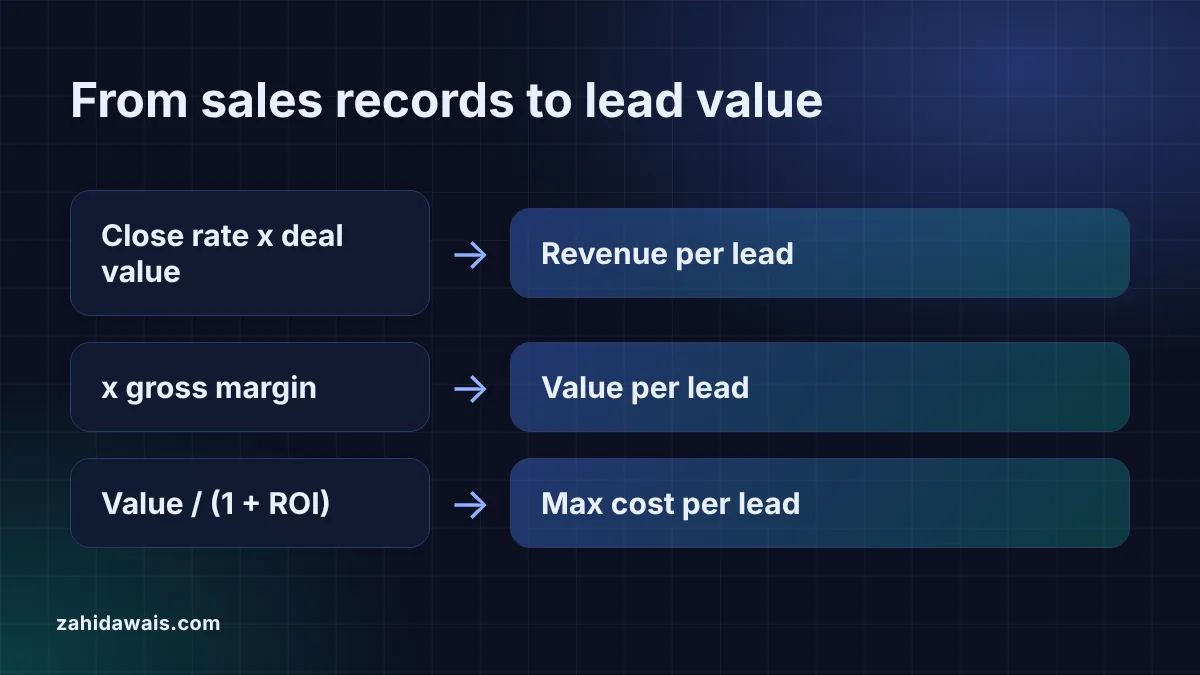
The value of an SEO lead is what an average enquiry from organic search is worth before marketing costs. Multiply the share of organic leads that become customers by the average customer value, then by your gross margin. A 20% close rate, $2,500 first deal and 60% margin make each lead worth $300.
An SEO lead is a person who found your site through unpaid search results and then contacted you, for example by sending a form, booking a call or phoning. Google Analytics counts such a visit in its Organic Search channel when, in Google’s words, the “Source matches a list of search sites” or the “Medium exactly matches organic”, as listed in its default channel group rules.
The lead itself is the action, not the visit. Google’s recommended lead generation events describe generate_lead as a user who “submits a form online or submits information offline”, and add events for later steps such as qualify_lead and close_convert_lead, for a lead that “became a converted lead (a customer)”. Those later steps are what turn a count of leads into a value.
Multiply your close rate by your average customer value, then by your gross margin. Each part comes from your own records, not from an industry average:
The formula is lead value = close rate x customer value x gross margin. The lead value calculator does the sum and shows first deal and lifetime figures side by side. The table shows how the result moves with close rate and deal value at a 60% margin.
| Close rate | Deal value $1,000 | Deal value $2,500 | Deal value $5,000 |
|---|---|---|---|
| 5% | $30 | $75 | $150 |
| 10% | $60 | $150 | $300 |
| 20% | $120 | $300 | $600 |
| 30% | $180 | $450 | $900 |
Divide everything SEO cost in a period by the organic leads in the same period. Include agency or freelancer fees, content, links and tools. If SEO cost $1,500 in a month and organic search brought 60 leads, cost per lead is $25. The cost per lead calculator puts SEO next to paid channels, so you see each channel’s CPL and the blended figure in one table.
Use a fair time window. SEO costs are paid every month, but the leads arrive later and keep arriving after the work is done. I tell clients that SEO results usually take 3 to 6 months, so a CPL measured in the first months looks worse than the same work measured over a year.
SEO pays back when the value of a lead is higher than what a lead costs, and the gap between the two is your return. Divide the lead value by 1 plus your target ROI to get the most you can pay per lead. A lead worth $900 in lifetime gross profit allows up to $450 per lead for a 100% return. At $25 per lead, the SEO channel in the example sits far below that limit.
For a view of the whole investment rather than a single lead, the SEO ROI calculator compares monthly SEO cost with the revenue the extra traffic brings. If you buy SEO as a service, the SEO pricing guide explains what drives the monthly fee you divide by.
Send a lead event when a form is submitted, mark it as a key event and give it a value. Google defines a key event as “an event that measures an action that’s particularly important to the success of your business”. For the value, Google lets you set a default key event value: “the default value will become the monetary value of the key event” when the event has no value of its own.
Use your value per lead from the calculator as that default, then filter the key event by the Organic Search channel. Google adds that sending the lead generation events “populates the Lead acquisition report”. If you also want to see leads from AI assistants, the guide on tracking ChatGPT traffic in GA4 shows how to separate them.
Example: a B2B service firm pays $1,500 a month for SEO, and organic search brings 60 leads that month, a cost per lead of $25.00. Its records show that 20% of leads become clients, a first project averages $2,500, a client spends $7,500 over the relationship and the gross margin is 60%. Each lead is worth $300 in first deal gross profit and $900 in lifetime gross profit, so at a 100% target ROI the firm can pay up to $450 per lead. The 60 leads should bring about 12 clients, $18,000 of first deal gross profit and $54,000 of lifetime gross profit. These are the default inputs of both calculators, with 60 leads per month in the lead value calculator.
There is no general figure, because it depends on your prices, close rate and margin. A lead is worth what your own numbers say. Work it out from your sales records and compare it with your SEO cost per lead.
It can be. Organic and paid leads may close at different rates or buy different services. If you track close rate by channel, calculate a separate value for each. If you do not yet, start with one shared value.
Use lifetime value when customers clearly come back and you can wait for the money. Use first deal value when cash flow is tight or repeat business is rare. Showing both, as the lead value calculator does, makes the decision visible.
The more leads in your close rate, the steadier the figure. A handful of leads can swing the rate a lot. Use the longest period your records cover and update the value as more leads close.
Yes. Google Ads can create conversions from Google Analytics key events, so a valued lead event can feed both. Google suggests value based bidding when you can assign different values to leads.
SEO work is paid every month, but organic leads build up over time and keep coming after the work is done. Measure cost per lead over a longer period, such as a year, to see the real figure.
This guide is part of my SEO guides.
Checked 23 Oct 2026. Facts checked against these official pages. Read how I check facts in my editorial policy.
Want more leads from organic search? See my SEO services.
Does a table of contents help SEO? What Google's docs say and do not say about jump links, sitelinks and #fragments, and…
Read article
When removing words like a, the and of makes a slug better, when it does not, and how to change old URLs safely.
Read article
Why Google swaps your meta description for page text, how to diagnose it, and the fixes I use on client pages.
Read articleSend your website and I will reply with a free audit.