Conversion Rate Calculator
A conversion rate calculator is a tool that shows what percentage of visitors complete a goal such as a sale,…
Find out what an average customer is worth over time, in revenue and in gross profit.
No lifespan data? Use 1 ÷ yearly churn rate. 25% churn gives about 4 years.
Results are estimates from the averages you enter.
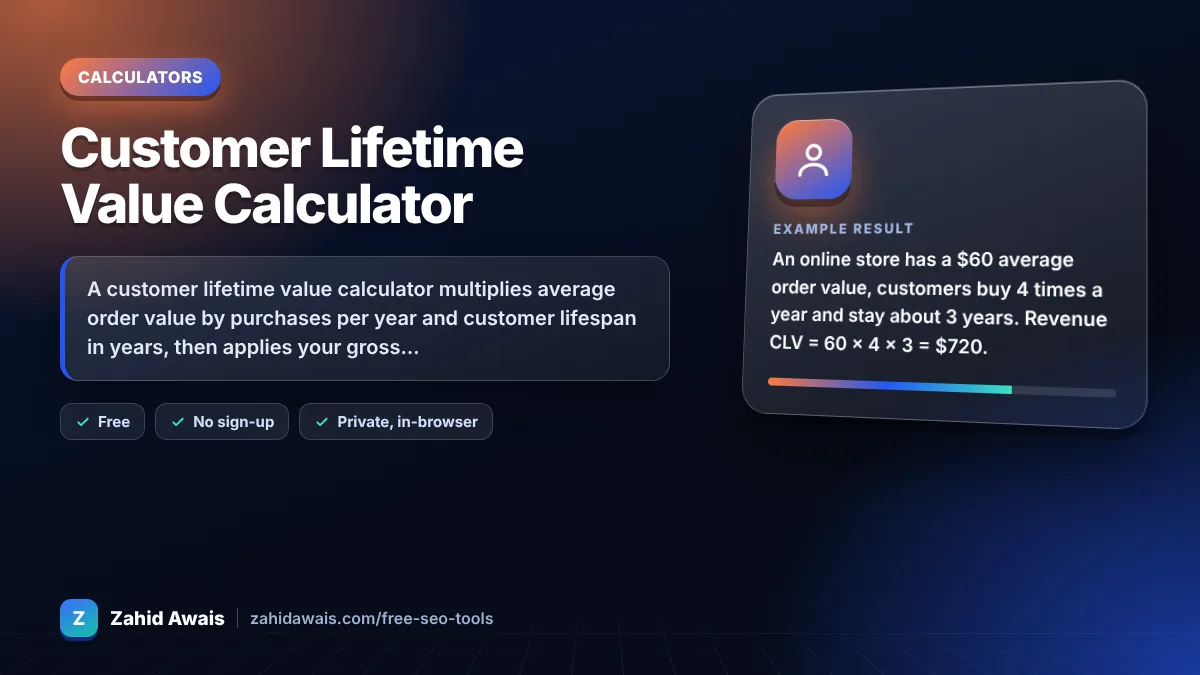
The free customer lifetime value calculator runs in your browser, needs no sign-up and never sends what you type anywhere.
A customer lifetime value calculator multiplies average order value by purchases per year and customer lifespan in years, then applies your gross margin. A $60 order, 4 times a year for 3 years, is $720 in revenue and $360 profit at 50% margin. Keep customer acquisition cost well below that profit figure.
A customer lifetime value calculator is a tool that estimates the total value one customer brings during the relationship. CLV (revenue) = average order value × purchases per year × lifespan in years; CLV (profit) = revenue CLV × gross margin.
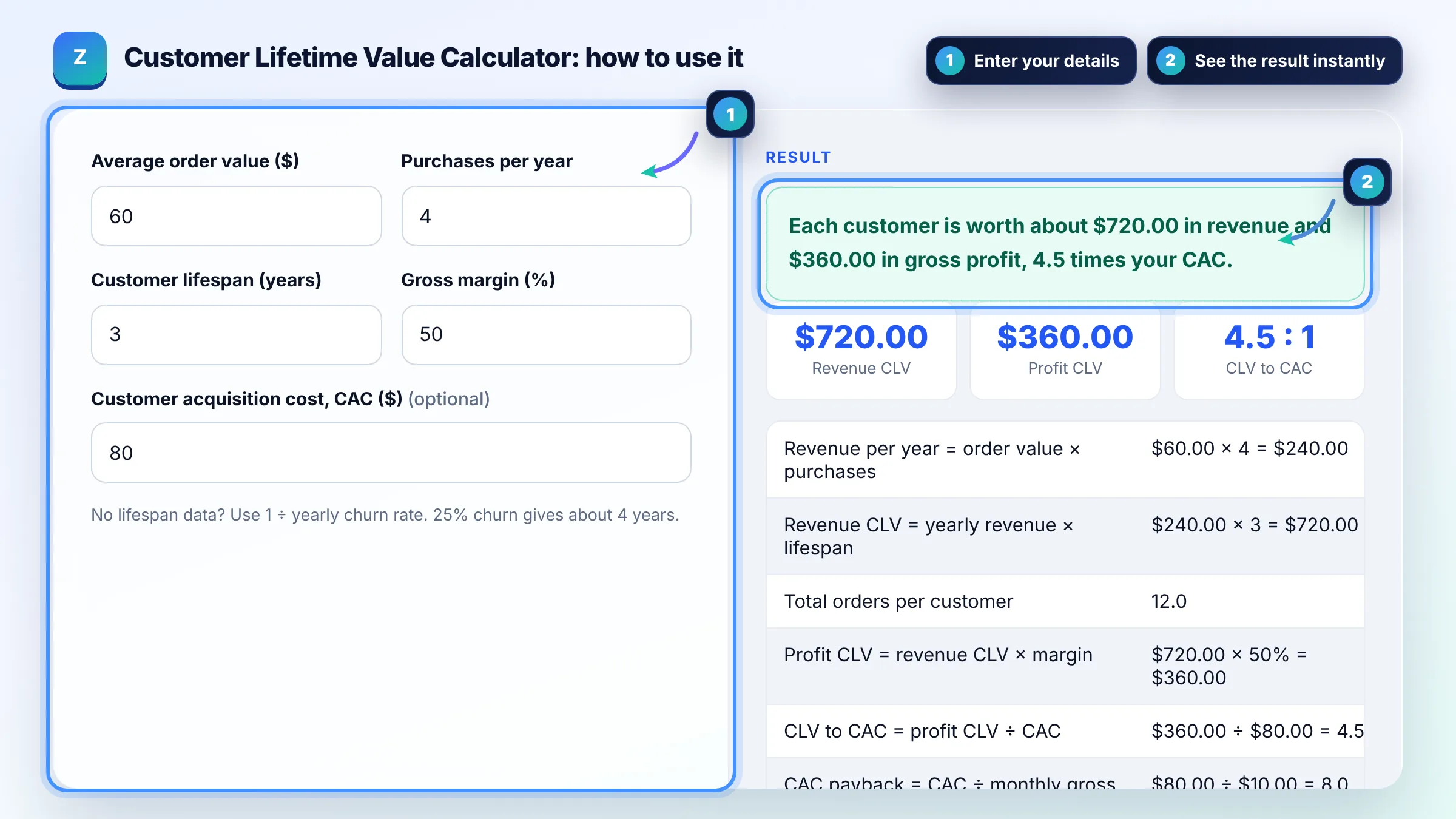
Multiply average order value by purchases per year and by lifespan in years, then multiply by gross margin for a profit view. For example, $60 × 4 × 3 = $720 revenue CLV, and at a 50% margin that is $360 of gross profit per customer. Use averages from the same period and customer group.
CLV (customer lifetime value) and LTV (lifetime value) usually mean the same thing: the value of a customer over the whole relationship. Google Analytics uses the term lifetime value in its User lifetime report, which tracks revenue per user over time.
A ratio above 1 means a customer's gross profit pays back what you spent to win them; below 1 you lose money on each new customer. How high is enough depends on your other costs and cash flow, so compare the ratio across channels and over time rather than chasing one universal target.
| Business example | Inputs | Revenue CLV |
|---|---|---|
| Coffee subscription | $25 × 12 per year × 2 years | $600 |
| Online fashion store | $60 × 4 per year × 3 years | $720 |
| Hair salon | $45 × 6 per year × 4 years | $1,080 |
| SaaS tool | $49 × 12 per year × 2.5 years | $1,470 |
| Dental practice | $120 × 2 per year × 6 years | $1,440 |
Example: an online store has a $60 average order value, customers buy 4 times a year and stay about 3 years. Revenue CLV = 60 × 4 × 3 = $720. With a 50% gross margin, profit CLV is $360, or $10 of gross profit per month. If Google Ads and Meta Ads cost $80 per new customer, the CLV to CAC ratio is 4.5 and the $80 is paid back after 8 months.
Divide the number of orders in a year by the number of unique customers who ordered that year. For example, 8,000 orders from 2,000 customers is 4 purchases per customer per year. Use your store, CRM or analytics data for the same period.
A simple estimate is 1 ÷ yearly churn rate. If 25% of customers stop buying each year, the average lifespan is about 4 years. For a young business without history, use a cautious guess and update it as real data comes in.
Use profit when you compare CLV with acquisition cost, because revenue ignores the cost of products, delivery and fees. Revenue CLV is still useful for forecasting sales, but profit CLV tells you how much you can safely spend to win a customer.
CAC, customer acquisition cost, is your total sales and marketing spend for a period divided by the number of new customers won in that period. Include ad spend, agency or freelancer fees and tools, so the comparison with CLV is honest.
Raise order value with bundles and relevant add ons, raise frequency with follow up emails and reminders, and extend lifespan with better service and onboarding. Small gains in each multiply together, so a 10% lift in all three adds about 33% to CLV.
It gives a simple historic estimate, which is fine for planning budgets and comparing channels. It ignores discounting of future cash and changes in behaviour over time, so treat results as estimates and recheck them with real cohort data.
Facts checked against these official pages. Read how I check facts in my editorial policy.
A conversion rate calculator is a tool that shows what percentage of visitors complete a goal such as a sale,…
A ROAS calculator is a tool that measures how much revenue each unit of ad spend brings back. ROAS = ad…
A customer acquisition cost calculator is a tool that adds every cost of winning customers (ad spend, SEO and…
Coming 25 OctSend your website and I will check it for you, free.