CPC Calculator
A CPC calculator is a tool that measures the average cost of each ad click. It uses CPC = spend ÷ clicks,…
Work out return on ad spend, break-even ROAS and real profit from one campaign.
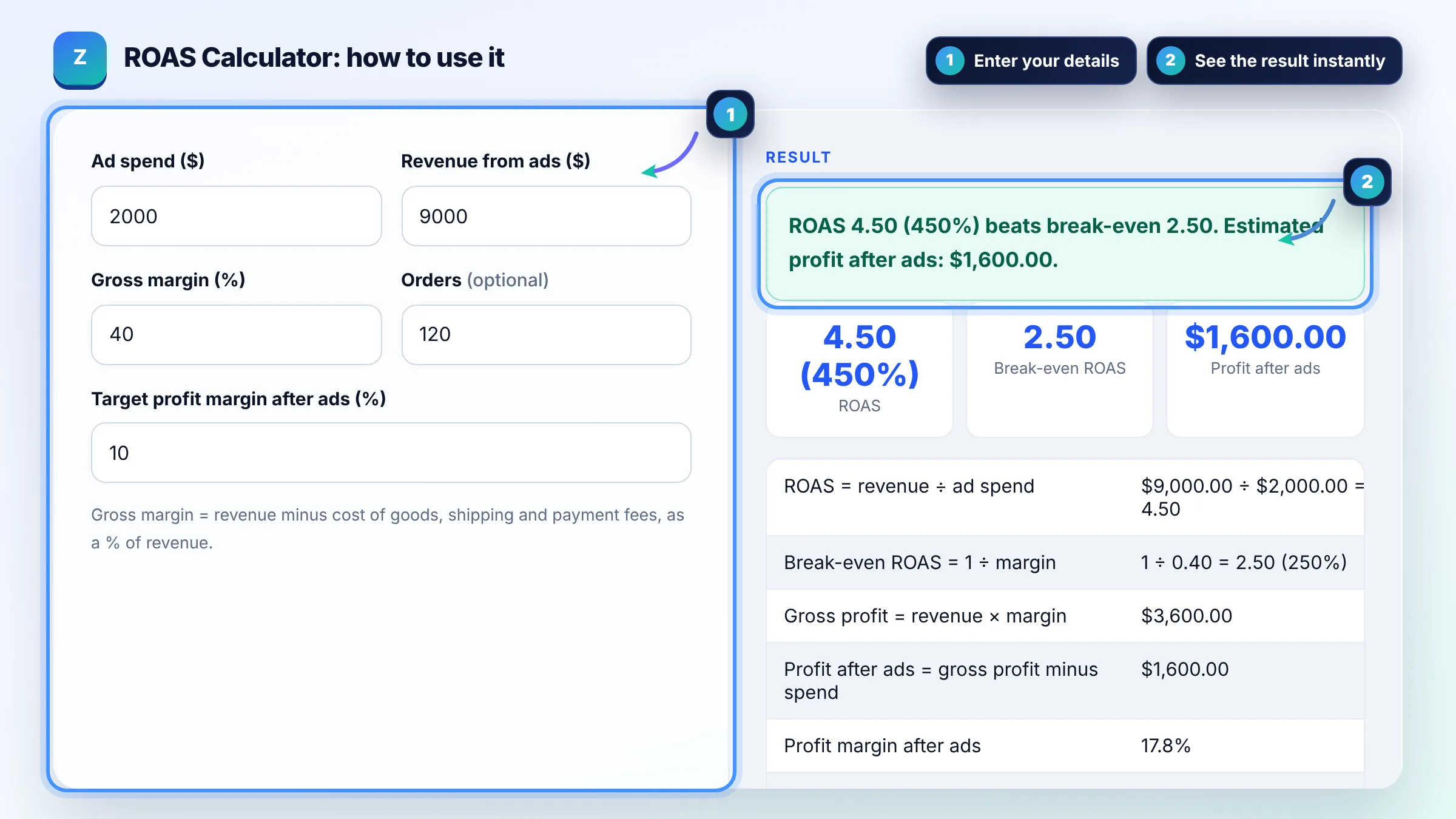
Gross margin = revenue minus cost of goods, shipping and payment fees, as a % of revenue.
Results are estimates based on the numbers you enter.
The free roas calculator runs in your browser, needs no sign-up and never sends what you type anywhere.
A ROAS calculator divides revenue from ads by ad spend. $9,000 revenue from $2,000 spend is a 4.5 ROAS, or 450%. To know if that is profitable, compare it with break-even ROAS, which is 1 ÷ gross margin: at a 40% margin you need at least 2.5 just to cover product costs and ads.
A ROAS calculator is a tool that measures how much revenue each unit of ad spend brings back. ROAS = ad revenue ÷ ad spend; break-even ROAS = 1 ÷ gross margin; profit after ads = revenue × gross margin minus ad spend.
Divide the revenue from ads by the ad spend: $9,000 ÷ $2,000 = 4.5, which Google Ads shows as 450%. Google uses the same logic for Target ROAS bidding, where $5 in sales for $1 of spend is a 500% ROAS. Use one date range and one attribution setting for both numbers.
A good ROAS is any ROAS above your break-even ROAS with room for profit, so it depends on margin. A store with a 25% margin needs at least 4.0 to break even, while a digital product with an 80% margin breaks even at 1.25. Work out your own break-even before comparing campaigns.
ROAS compares revenue with ad spend only, while ROI compares profit with every cost, including products, staff and tools. A campaign can show a 3.0 ROAS and still lose money when margins are thin, which is why this calculator also shows profit after ad costs.
| Gross margin | Break-even ROAS | Break-even ROAS % |
|---|---|---|
| 20% | 5.00 | 500% |
| 30% | 3.33 | 333% |
| 40% | 2.50 | 250% |
| 50% | 2.00 | 200% |
| 70% | 1.43 | 143% |
| 90% | 1.11 | 111% |
Example: a store spends $2,000 on Google Ads and Meta Ads in a month and tracks $9,000 in revenue from 120 orders. ROAS = 9,000 ÷ 2,000 = 4.5 (450%). With a 40% gross margin, gross profit is $3,600, so profit after ads is $1,600 and break-even ROAS is 2.5. CPA is $16.67 against a break-even CPA of $30.00.
Both are common. A ratio of 4.5 (often written 4.5:1 or 4.5x) means the same as 450%. Google Ads uses percentages for Target ROAS, while many ecommerce reports use the ratio, so check which one a report uses before comparing.
Break-even ROAS is the ROAS at which gross profit from ad sales exactly pays for the ads. The formula is 1 ÷ gross margin, so a 40% margin gives 2.5. Below that number the campaign loses money on each sale, even if revenue looks high.
Standard ROAS uses revenue, which is what ad platforms report as conversion value. If you want a profit view, report conversion values as gross profit instead, or use this calculator to turn revenue ROAS into profit after ad costs using your margin.
Each platform uses its own attribution window and model, and several can claim the same sale. Analytics tools also miss visits blocked by consent banners. Pick one source of truth, such as your store's orders, and compare platforms using the same date range.
No. Very high ROAS often comes from small budgets aimed at brand searches and returning buyers. Scaling the budget usually lowers ROAS but can still raise total profit, so judge campaigns on profit after ad costs, not on ROAS alone.
The ROAS needed for a target profit is 1 ÷ (gross margin minus target margin). With a 40% gross margin and a 10% target profit, you need 1 ÷ 0.30 = 3.33. If the target is higher than the gross margin, no ROAS can reach it.
Facts checked against these official pages. Read how I check facts in my editorial policy.
A CPC calculator is a tool that measures the average cost of each ad click. It uses CPC = spend ÷ clicks,…
A PPC budget calculator is a tool that turns traffic goals into an ad budget. Monthly budget = target clicks…
A customer lifetime value calculator is a tool that estimates the total value one customer brings during the…
Coming 23 OctSend your website and I will check it for you, free.