Cost Per Lead Calculator
CPL for each channel, totals, blended CPL and cost per customer from your close rate.
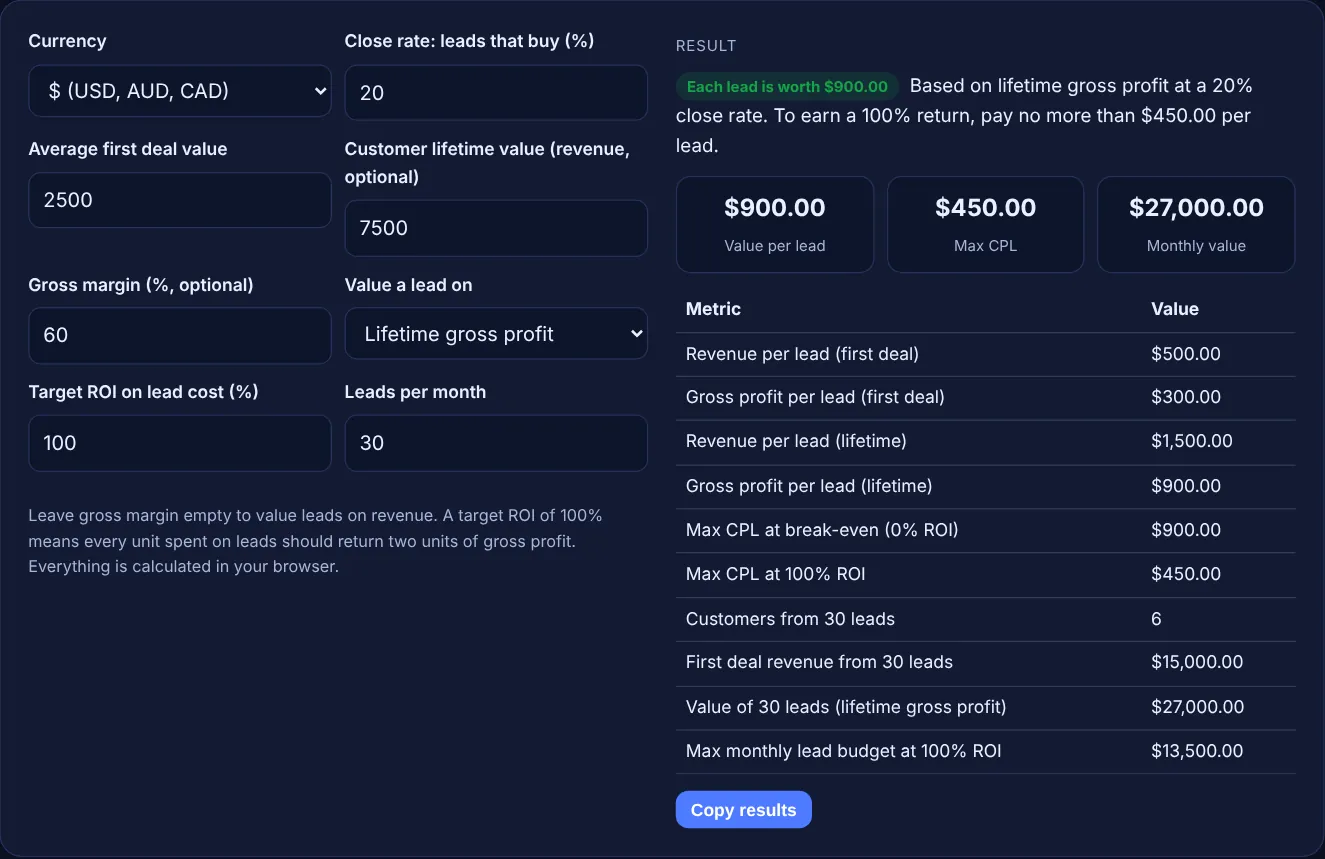
Enter your close rate, deal value and margin to see what one lead is worth, the highest cost per lead you can afford and the value of a month of leads.
Leave gross margin empty to value leads on revenue. A target ROI of 100% means every unit spent on leads should return two units of gross profit. Everything is calculated in your browser.
| Metric | Value |
|---|
The free lead value calculator shows what one lead is worth to your business, based on how many leads become customers, what a customer spends and how much of that is profit. It then works out the most you can pay per lead for the return you want, and what a month of leads is worth.
Lead value is what an average lead is worth before any marketing cost. Multiply your close rate by the average deal value, then by your gross margin to value it on profit. With a 20% close rate, a $2,500 deal and a 60% margin, each lead is worth $300 on the first deal alone.
A lead value calculator is a tool that converts sales figures into the average value of a single enquiry. Most leads never buy, so a lead is worth only a share of a sale: the close rate times what a customer brings in. Using lifetime value instead of the first deal includes repeat business, and applying your gross margin turns revenue into the profit that can pay for marketing.
The number is useful in two places. In budgeting, it sets the highest cost per lead a channel can have and still pay back. In analytics, it gives your lead events a value: Google Analytics lets you set a default key event value, and Google says "the default value will become the monetary value of the key event" when the event itself has no value.
Multiply your close rate by the average value of a customer, then by your gross margin. If 20% of leads buy, the first deal averages $2,500 and the margin is 60%, one lead is worth 0.20 x $2,500 x 0.60 = $300 in gross profit. If customers spend $7,500 over their lifetime, the same lead is worth 0.20 x $7,500 x 0.60 = $900.
Divide the value of a lead by 1 plus your target ROI as a decimal. A lead worth $900 in lifetime gross profit breaks even at a cost of $900. For a 100% return, where each $1 spent brings back $2 of gross profit, pay no more than $900 / 2 = $450. Use first deal profit instead of lifetime profit if you cannot wait long to earn the money back.
Value leads on gross profit when you use the figure to set a budget, because marketing is paid from profit, not revenue. Revenue per lead is still useful for reports and for comparing with ad platforms that track revenue. Revenue always gives a bigger number, so a cost per lead that looks safe against revenue can lose money once costs of delivery are taken out.
| Metric | Formula | Example result |
|---|---|---|
| Revenue per lead | Close rate x first deal value | 0.20 x $2,500 = $500 |
| Gross profit per lead | Revenue per lead x gross margin | $500 x 0.60 = $300 |
| Lifetime profit per lead | Close rate x lifetime value x margin | 0.20 x $7,500 x 0.60 = $900 |
| Max CPL at break-even | Value per lead | $900 |
| Max CPL at target ROI | Value per lead / (1 + ROI) | $900 / 2 = $450 |
| Value of a month of leads | Value per lead x leads | $900 x 30 = $27,000 |
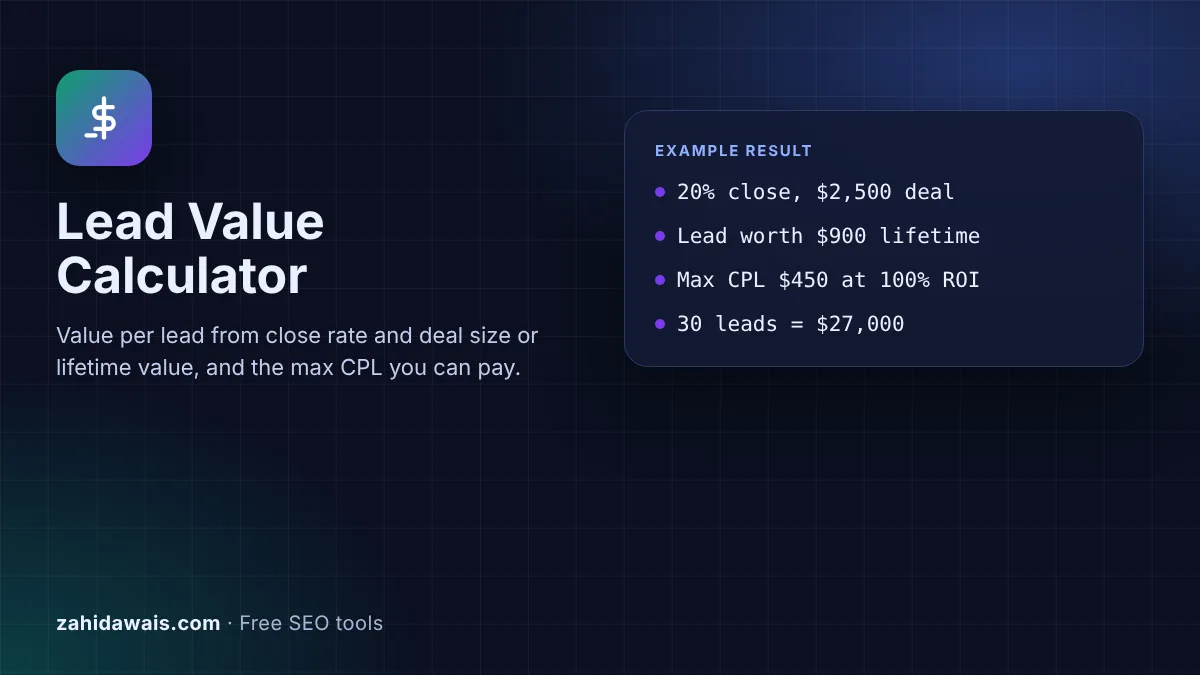
Example: a web design studio closes 20% of its leads. A first project averages $2,500, a client spends $7,500 over the relationship and the gross margin is 60%. Each lead is worth $500 in first deal revenue, $300 in first deal gross profit and $900 in lifetime gross profit. For a 100% ROI, the studio can pay up to $450 per lead. Thirty leads a month should bring about 6 clients, $15,000 of first deal revenue and $27,000 of lifetime gross profit.
Count the leads from a past period, then count how many of them became paying customers. Divide customers by leads and multiply by 100. Use a period long enough for most deals to close, such as three to six months.
Deal value is what a customer pays for the first sale. Lifetime value is the total they pay over the whole relationship, including repeat orders and renewals. Lifetime value always includes the first deal, so it should be equal or higher.
Because most leads do not buy. If one lead in five closes, each lead carries one fifth of a sale. Applying your gross margin lowers it again, since part of every sale pays for delivering the work.
Mark your lead form submission as a key event and give it your value per lead, either through the event's value and currency parameters or with a default key event value. Reports then show the estimated value of leads by channel.
Use the close rate and deal value of each channel if you track them, since lead quality can differ by source. If you do not have separate figures yet, start with one value for all leads and refine it later.
No. The calculator runs entirely in your browser with JavaScript. Your close rate, deal values and margins are never uploaded or stored, so you can use real sales figures safely.
Checked 23 Oct 2026. Facts checked against these official pages. Read how I check facts in my editorial policy.
CPL for each channel, totals, blended CPL and cost per customer from your close rate.
A customer lifetime value calculator is a tool that estimates the total value one customer brings during the…
An SEO ROI calculator is a tool that estimates the return on your SEO investment. It multiplies extra organic…
A customer acquisition cost calculator is a tool that adds every cost of winning customers (ad spend, SEO and…
Send your website and I will check it for you, free.
One short email when something new goes live: articles, free SEO tools, package updates, discounts and price alerts. No spam, unsubscribe in one click.