SEO ROI Calculator
An SEO ROI calculator is a tool that estimates the return on your SEO investment. It multiplies extra organic…
Add your marketing and sales costs and new customers to get CAC, LTV to CAC and payback time.
Optional: lifetime value
The target ratio is your own assumption. 3 to 1 is a common rule of thumb, not a standard.
The free customer acquisition cost calculator runs in your browser, needs no sign-up and never sends what you type anywhere.
Customer acquisition cost (CAC) is total marketing and sales spend for a period divided by the new customers won in that period. For example, $12,000 spend and 80 new customers is a $150 CAC. Compare it with customer lifetime value: if gross profit per customer does not clearly exceed CAC, growth loses money.
A customer acquisition cost calculator is a tool that adds every cost of winning customers (ad spend, SEO and content, sales salaries, tools and agency fees) and divides it by the number of new paying customers. The formula is CAC = (marketing costs + sales costs) / new customers, and LTV to CAC = lifetime gross profit per customer / CAC.
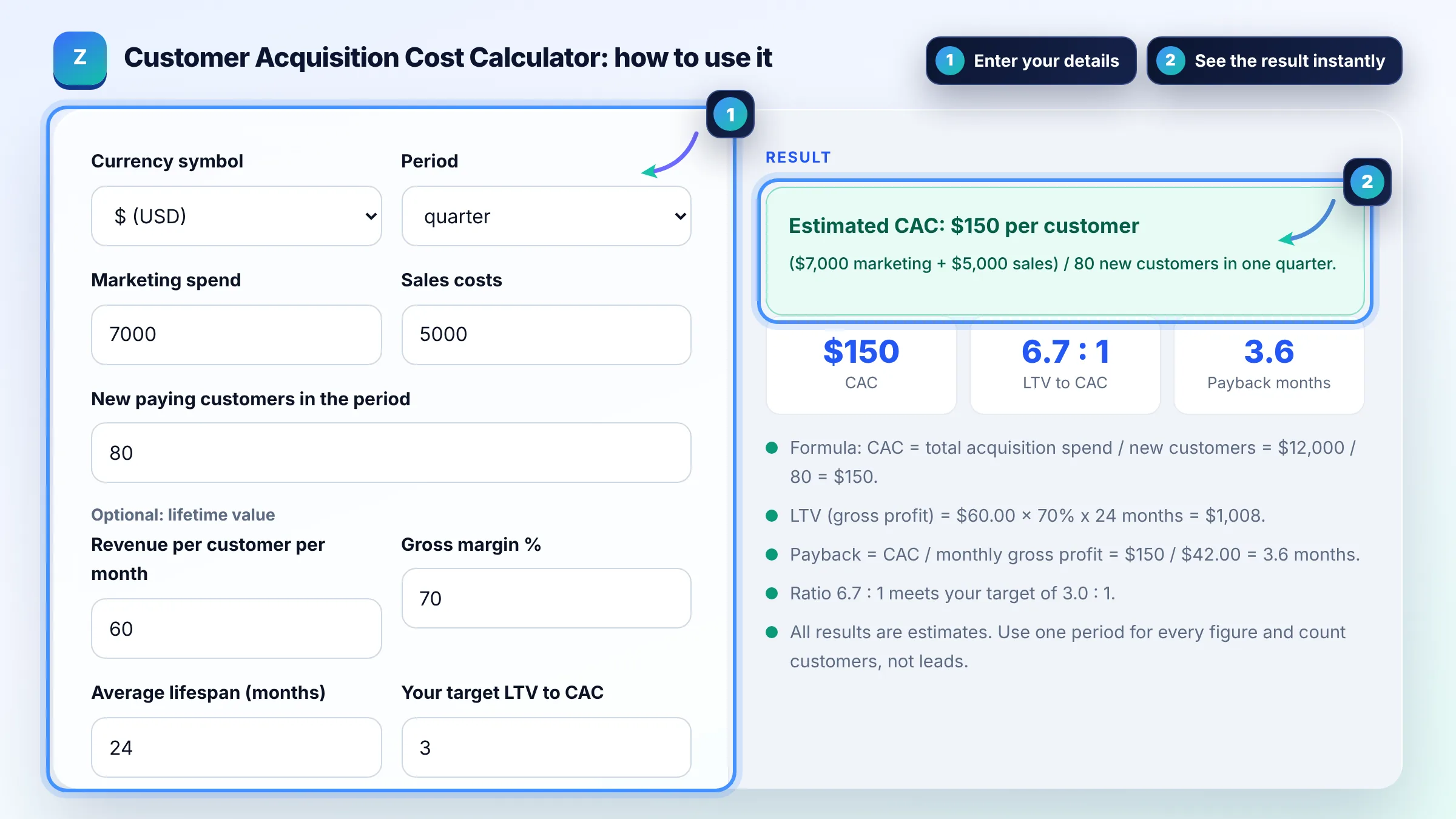
Divide total marketing and sales costs by the number of new customers in the same period: $12,000 divided by 80 customers is a $150 CAC. Include ad spend, SEO and content costs, agency fees, tools and the share of salaries spent on acquisition, or your CAC will look lower than it really is.
A ratio of about 3 to 1 is a widely quoted rule of thumb, especially among SaaS investors, but it is a convention, not a standard. Below 1 to 1 you lose money on every customer; far above 5 to 1 you may be under investing in growth. Set your own target from your margins and cash flow.
CAC counts the full cost of winning a new paying customer across all channels, while CPA (cost per action or acquisition) usually measures ad cost per conversion in one platform. Google Ads defines average CPA as cost divided by conversions, as its Average CPA help page explains. A conversion may be a lead, not a customer.
| Marketing + sales spend | New customers | CAC |
|---|---|---|
| $2,000 | 20 | $100 |
| $5,000 | 25 | $200 |
| $12,000 | 80 | $150 |
| $30,000 | 120 | $250 |
| $50,000 | 100 | $500 |
Example: a business spends $7,000 on marketing and $5,000 on sales in a quarter and wins 80 new customers, so CAC = $12,000 / 80 = $150. Each customer pays $60 a month at a 70% gross margin and stays 24 months on average, so LTV = 60 x 0.70 x 24 = $1,008 and LTV to CAC is about 6.7 to 1. Payback takes $150 / $42 = about 3.6 months.
Include everything spent to win new customers: paid ads, SEO and content, agency and freelancer fees, marketing tools, sales salaries and commissions, and sales software. Leave out costs that serve existing customers, such as support and account management, so the number reflects acquisition only.
Use new paying customers. Leads, trials and sign ups are earlier funnel steps and give a much lower, misleading number. If you want a cost per lead, calculate it separately and track the lead to customer rate next to it.
Add the SEO costs for the period, such as content, link building, tools and agency or in house time, and divide by new customers whose first visit came from organic search. SEO costs often pay off over months, so compare longer periods such as 6 or 12 months.
CAC payback is the number of months a customer needs to repay their acquisition cost from gross profit. Formula: CAC divided by monthly revenue per customer times gross margin. A shorter payback means faster cash recovery and less funding needed to grow.
Blended CAC divides all acquisition costs by all new customers, including those who came from referrals, brand searches or word of mouth. Channel CAC only counts one channel's spend and customers. Track both, because blended CAC hides channels that are too expensive.
No. The results are estimates based on the numbers you enter. Attribution, refunds, churn and changing margins all affect the real values. Use the calculator for planning and comparisons, and check figures with your accounting data.
Facts checked against these official pages. Read how I check facts in my editorial policy.
An SEO ROI calculator is a tool that estimates the return on your SEO investment. It multiplies extra organic…
A ROAS calculator is a tool that measures how much revenue each unit of ad spend brings back. ROAS = ad…
A customer lifetime value calculator is a tool that estimates the total value one customer brings during the…
Send your website and I will check it for you, free.
One short email when something new goes live: articles, free SEO tools, package updates, discounts and price alerts. No spam, unsubscribe in one click.