URL List Cleaner
Normalises, dedupes and strips tracking parameters from a list of URLs, with a change log.
Paste a list of URLs and see how long each one is as typed and as sent, how deep it sits and which ones pass your length limit.
100 is an editorial default for short, readable URLs, not a Google rule: Google sets no URL length limit. The 2,048 flag comes from the sitemaps.org protocol. Everything runs in your browser.
| URL | Chars | Bytes | Depth | Folders | Params | Slug words | Flags |
|---|
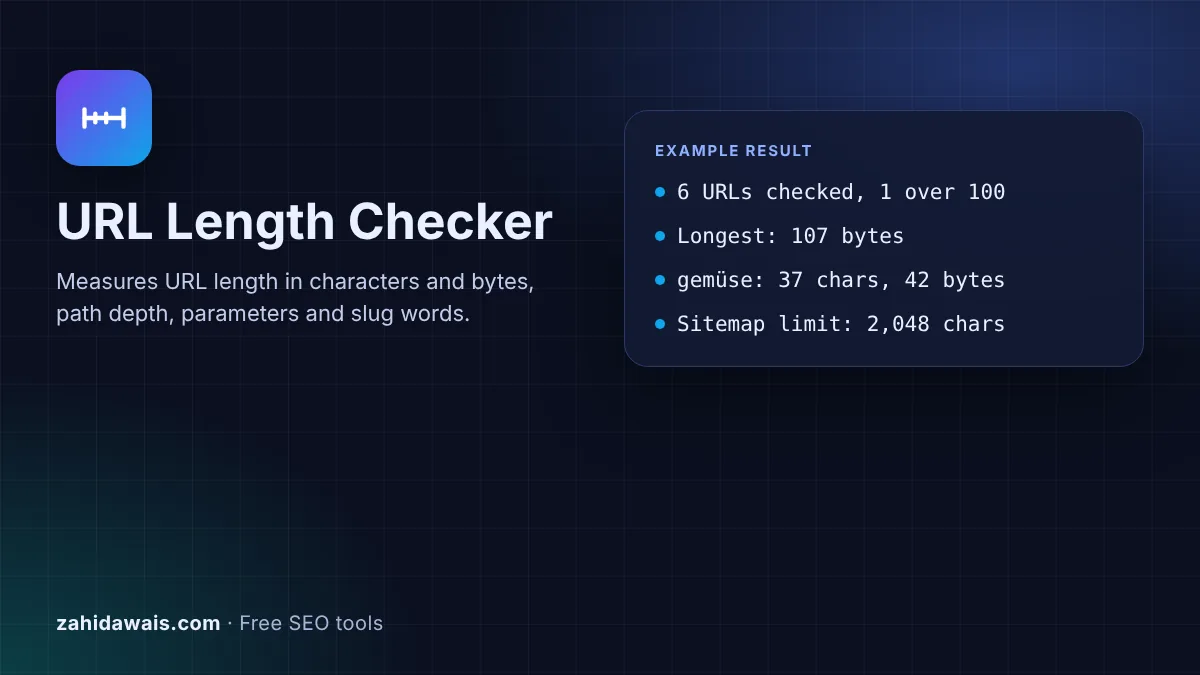
The free URL length checker measures every URL in a list: characters as typed, bytes after percent encoding, path depth, folders, query parameters and words in the slug. It flags URLs above a limit you choose and marks uppercase letters, underscores and non-ASCII characters.
A URL length checker counts the characters in each URL and the bytes it takes once non-ASCII characters are percent encoded, and shows path depth, parameters and slug words. Google sets no URL length limit for ranking. Shorter, readable URLs are easier to share, and sitemap URLs must stay under 2,048 characters.
A URL length checker reports how long each URL is and what makes it long. The character count is the URL as you typed it. The byte count is the URL as a browser sends it, after non-ASCII letters are percent encoded: Google's URL structure guidelines show "gemüse" becoming "gem%C3%BCse", so one ü costs 6 characters. Depth, folders, parameters and slug words show where the length comes from.
Google's guidance is about readability, not a number. It recommends "readable words rather than long ID numbers" and hyphens instead of underscores, and it warns that "Overly complex URLs, especially those containing multiple parameters, can cause problems for crawlers". The tool flags the patterns those lines describe.
No. Google's URL structure documentation gives no length limit and does not treat length as a ranking rule. The firm limits come from other places. The sitemaps protocol says a URL in a sitemap "must be less than 2,048 characters", and servers can refuse URLs longer than they accept with a 414 URI Too Long status. Below those limits, shorter is mainly about readability and sharing.
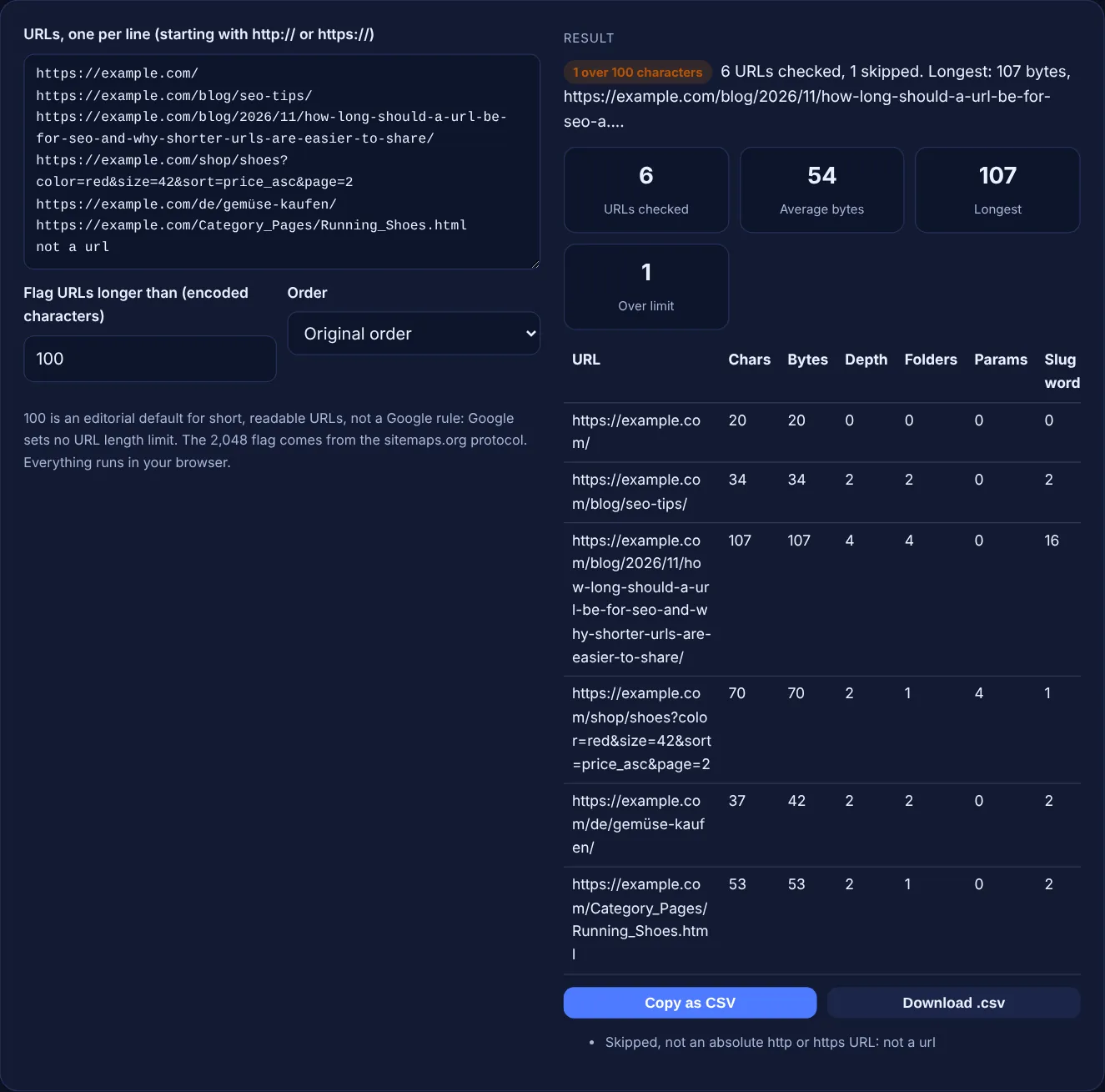
Characters count what you typed. Bytes count what is sent, because letters outside ASCII must be percent encoded as UTF-8 bytes. Google's guidelines say "characters in the non-ASCII range should be percent encoded." So https://example.com/de/gemüse-kaufen/ is 37 characters as typed but 42 once ü becomes %C3%BC. Host names with such letters are converted to an xn-- form, which also changes the count. Plain English slugs have the same count both ways.
Path depth is the number of segments between slashes in the path, so /blog/2026/11/post/ has a depth of 4. Folders are the segments followed by a slash, so /blog/post has 1 folder and /blog/post/ has 2. Deep date folders add length without helping readers. If your blog uses them, my guide to the best WordPress permalink structure covers the options, and removing filler words, as explained in stop words in URL slugs, shortens slugs further.
| Limit or guideline | Value | Source |
|---|---|---|
| Ranking limit on URL length | None stated | Google URL structure guidelines |
| URL inside a sitemap | Less than 2,048 characters | sitemaps.org protocol |
| URL too long for a server | Set by each server (414 URI Too Long) | MDN, HTTP 414 |
| Flag in this tool | 100 characters by default, change it | Editorial default |
| Word separator | Hyphens, not underscores | Google URL structure guidelines |
| Non-ASCII characters | Percent encoded in links | Google URL structure guidelines |
Example: the default list has 7 lines. "not a url" is skipped, so 6 URLs are checked with an average of 54 bytes. Only the dated blog post goes over 100: it is 107 bytes, with a depth of 4 and 16 words in its slug. The shop URL has 4 parameters. /de/gemüse-kaufen/ is 37 characters but 42 bytes once encoded. /Category_Pages/Running_Shoes.html is flagged for uppercase letters and underscores, with 2 slug words because the .html extension is ignored.
There is no official number. Many SEOs aim for short slugs of a few words, and this tool flags anything over 100 characters by default. Use a limit that keeps URLs readable for your site, not a target to hit.
Google does not list URL length as a ranking factor or give a limit. Long URLs are harder to read, share and remember, and long parameter strings can create crawl problems, so shorten them when you create pages rather than redirecting old ones.
Usually not just for length. Changing a URL needs a 301 redirect and updated internal links, and it takes time for search engines to process. Shorten URLs when you create new pages or rebuild a section anyway.
Yes. The tool measures the full URL, including https:// and the host. A long domain adds the same length to every URL, so compare slugs on the same site rather than across different domains.
The home page has no path segments, so it has no slug. The tool takes the last segment of the path, drops a file extension such as .html and counts the words between hyphens or underscores.
No. The checker runs entirely in your browser with JavaScript. The CSV download is created on your device, and nothing is uploaded or stored, so unpublished URLs stay private.
Checked 23 Oct 2026. Facts checked against these official pages. Read how I check facts in my editorial policy.
Normalises, dedupes and strips tracking parameters from a list of URLs, with a change log.
A slug generator is a tool that converts a page title into the last readable part of a URL. It lowercases the…
A URL encoder decoder is a tool that applies percent encoding, where each byte of a character's UTF-8 form is…
A URL parser is a tool that reads a URL according to the URL standard and separates it into components. This…
Send your website and I will check it for you, free.
One short email when something new goes live: articles, free SEO tools, package updates, discounts and price alerts. No spam, unsubscribe in one click.