UTM Builder
A UTM builder is a tool that appends tracking parameters to a landing page URL. It takes the base URL, keeps…
Break any URL into its parts, decode every query parameter and strip tracking tags in one click.
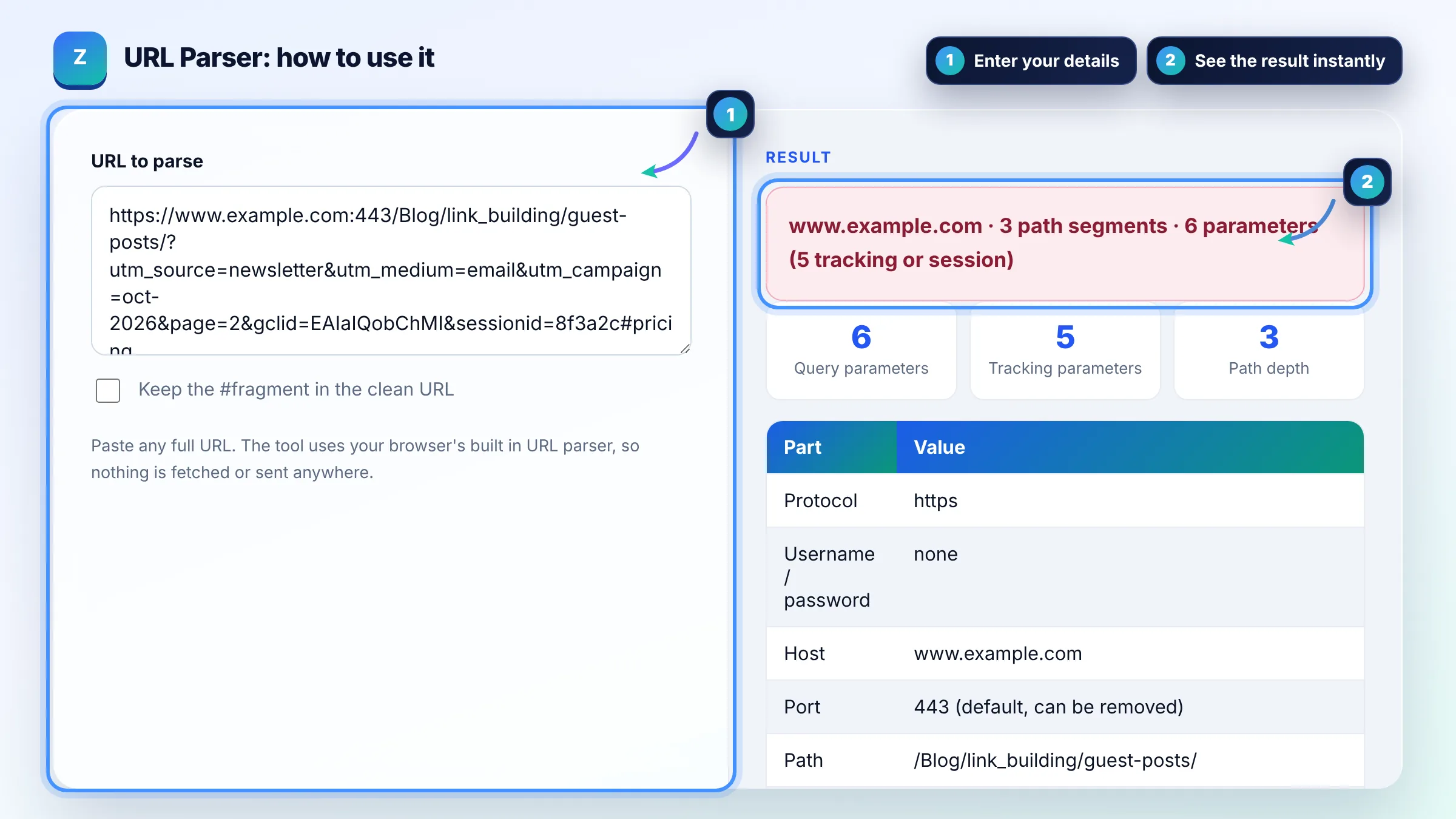
Paste any full URL. The tool uses your browser's built in URL parser, so nothing is fetched or sent anywhere.
| Part | Value |
|---|
| Parameter | Decoded value | Type |
|---|
The free url parser runs in your browser, needs no sign-up and never sends what you type anywhere.
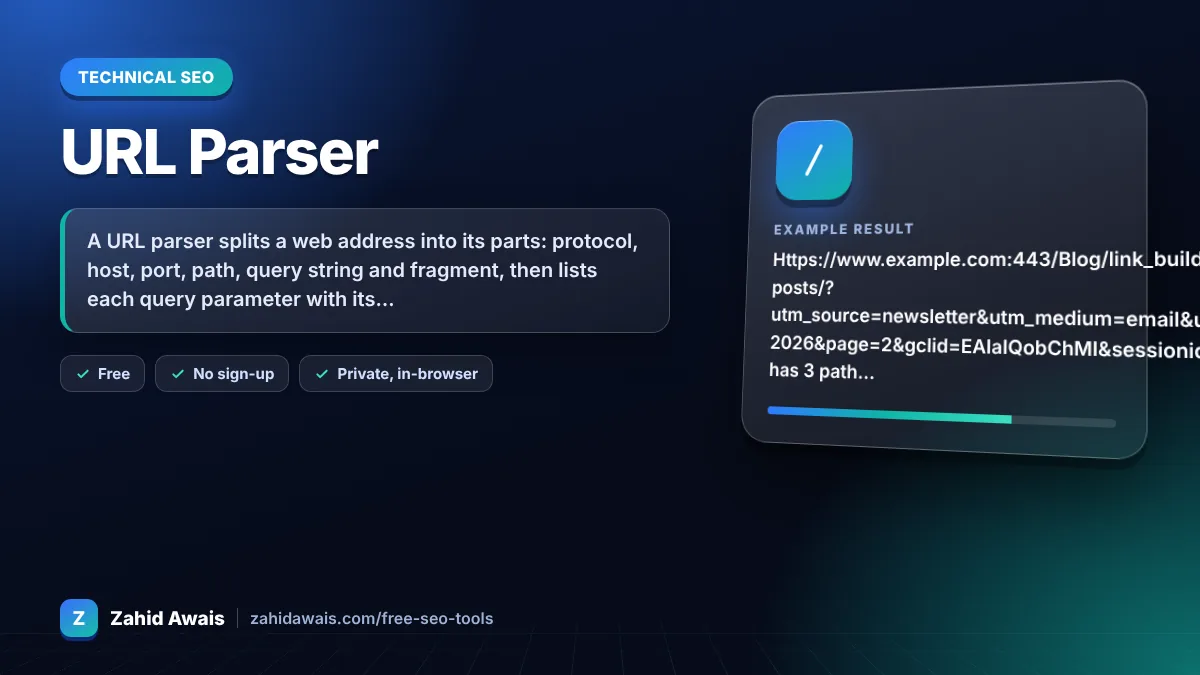
A URL parser splits a web address into its parts: protocol, host, port, path, query string and fragment, then lists each query parameter with its decoded value. This one also flags tracking parameters such as utm_source, gclid and fbclid and session IDs, and builds a clean URL to use in links, canonicals and sitemaps.
A URL parser is a tool that reads a URL according to the URL standard and separates it into components. This one uses the browser's built in URL and URLSearchParams interfaces, then classifies each parameter as tracking, session or content and rebuilds the URL without the tracking and session ones.
A URL has up to 6 main parts: protocol (https), host (www.example.com), optional port (:443), path (/blog/post/), query string (?page=2) and fragment (#comments). MDN's URL reference lists the same parts as properties such as protocol, hostname, pathname, search and hash.
Parameters do not hurt SEO by themselves, but tracking and session parameters create many URLs for the same content. Google's guidance says to consolidate such duplicates with redirects or rel="canonical" and to link internally only to the clean version. Content parameters like ?page=2 or ?color=red are fine when they change the page.
No. Google generally ignores everything after the # when indexing, so /guide/#pricing and /guide/ are the same URL to Google. Google's URL structure guide says not to use fragments to change page content; use separate URLs or the History API for JavaScript driven content.
| Parameter | Set by | Keep in canonical URL? |
|---|---|---|
| utm_source, utm_medium, utm_campaign | You (campaign tagging) | No |
| gclid, gbraid, wbraid | Google Ads auto tagging | No |
| fbclid | Meta link clicks | No |
| msclkid | Microsoft Ads auto tagging | No |
| sessionid, PHPSESSID, jsessionid | Your server | No, use cookies instead |
| page, color, size | Your site (content or filter) | Only if it changes the content |
Example: https://www.example.com:443/Blog/link_building/guest-posts/?utm_source=newsletter&utm_medium=email&utm_campaign=oct-2026&page=2&gclid=EAIaIQobChMI&sessionid=8f3a2c#pricing has 3 path segments and 6 parameters, 5 of them tracking or session. The clean URL is https://www.example.com/Blog/link_building/guest-posts/?page=2, and the tips flag the capital B, the underscore and the default port 443.
No. The parser runs in your browser using the built in URL interface. Nothing is fetched, uploaded or stored, so you can safely paste private URLs such as staging links or URLs that contain email tracking IDs.
The host is the domain plus any port, such as www.example.com:8080. The origin adds the protocol, such as https://www.example.com:8080. Browsers use the origin for security rules such as CORS and storage, so http and https versions count as different origins.
These click IDs are added automatically by ad platforms to measure clicks. They are useful in the landing URL but should never appear in internal links, canonical tags or sitemaps, because every click creates a new duplicate URL.
The scheme and host are not, but the path and query usually are. Google treats /Blog/ and /blog/ as different URLs. Use lowercase paths and redirect any uppercase variants to them so links and signals are not split.
Use hyphens. Google's URL structure guidance recommends hyphens to separate words, such as /guest-posts/ rather than /guest_posts/. Changing existing URLs is rarely worth it unless you are already migrating, and then each old URL needs a 301 redirect.
Yes. It shows each path segment and parameter value decoded, so %20 becomes a space and %C3%A9 becomes é. For converting whole strings back and forth, use the URL encoder decoder tool on this site.
Facts checked against these official pages. Read how I check facts in my editorial policy.
A UTM builder is a tool that appends tracking parameters to a landing page URL. It takes the base URL, keeps…
A canonical tag generator is a tool that builds the link rel="canonical" element telling search engines which…
A URL encoder decoder is a tool that applies percent encoding, where each byte of a character's UTF-8 form is…
Send your website and I will check it for you, free.
One short email when something new goes live: articles, free SEO tools, package updates, discounts and price alerts. No spam, unsubscribe in one click.