Hreflang Tag Generator
A hreflang tag generator is a tool that writes rel="alternate" hreflang annotations so search engines can…
Clean up any page URL and get a correct rel canonical tag or HTTP header in one click.
The free canonical tag generator runs in your browser, needs no sign-up and never sends what you type anywhere.
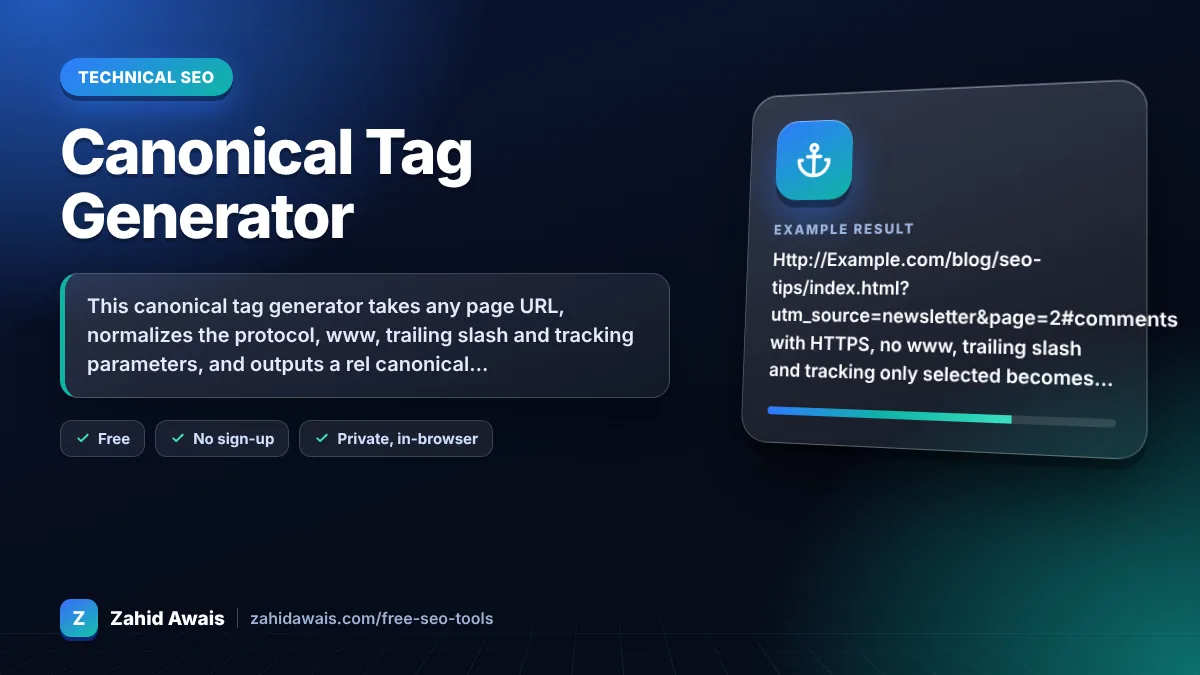
This canonical tag generator takes any page URL, normalizes the protocol, www, trailing slash and tracking parameters, and outputs a rel canonical link tag or HTTP Link header. Rule of thumb: use one absolute HTTPS URL that returns 200, matches your internal links and sitemap, and place the tag in the head of every duplicate and the canonical page.
A canonical tag generator is a tool that builds the link rel="canonical" element telling search engines which URL is the preferred version of a page. It rewrites the URL you enter into one consistent form (protocol, host, path and needed parameters only) and wraps it in the HTML tag or the HTTP header used for PDFs.
Yes, adding a canonical tag that points to the page itself is recommended. It protects against duplicates created by tracking parameters, session IDs or mixed case URLs, because every variant then points back to one clean URL. Google suggests it in its guide to specifying a canonical URL.
No, rel canonical is a strong signal, not a directive, so Google can pick a different canonical if other signals disagree. Redirects are the strongest signal, canonical tags next, and sitemap inclusion weaker. Make internal links, sitemaps, hreflang and redirects all point to the same URL so the signals agree.
Use absolute URLs such as https://example.com/page/. Relative paths can be misread when pages are copied to staging or served on another host, which can point Google at the wrong site. This tool always outputs a full URL.
| URL variant | Example | Typical canonical choice |
|---|---|---|
| Protocol | http:// and https:// | https:// |
| Host | example.com and www.example.com | One version, matching your redirects |
| Trailing slash | /blog/seo and /blog/seo/ | One version, matching your internal links |
| Tracking parameters | ?utm_source=newsletter | Removed |
| Content parameters | ?page=2 or ?color=red | Often kept when the content differs |
| Index file | /blog/index.html | /blog/ |
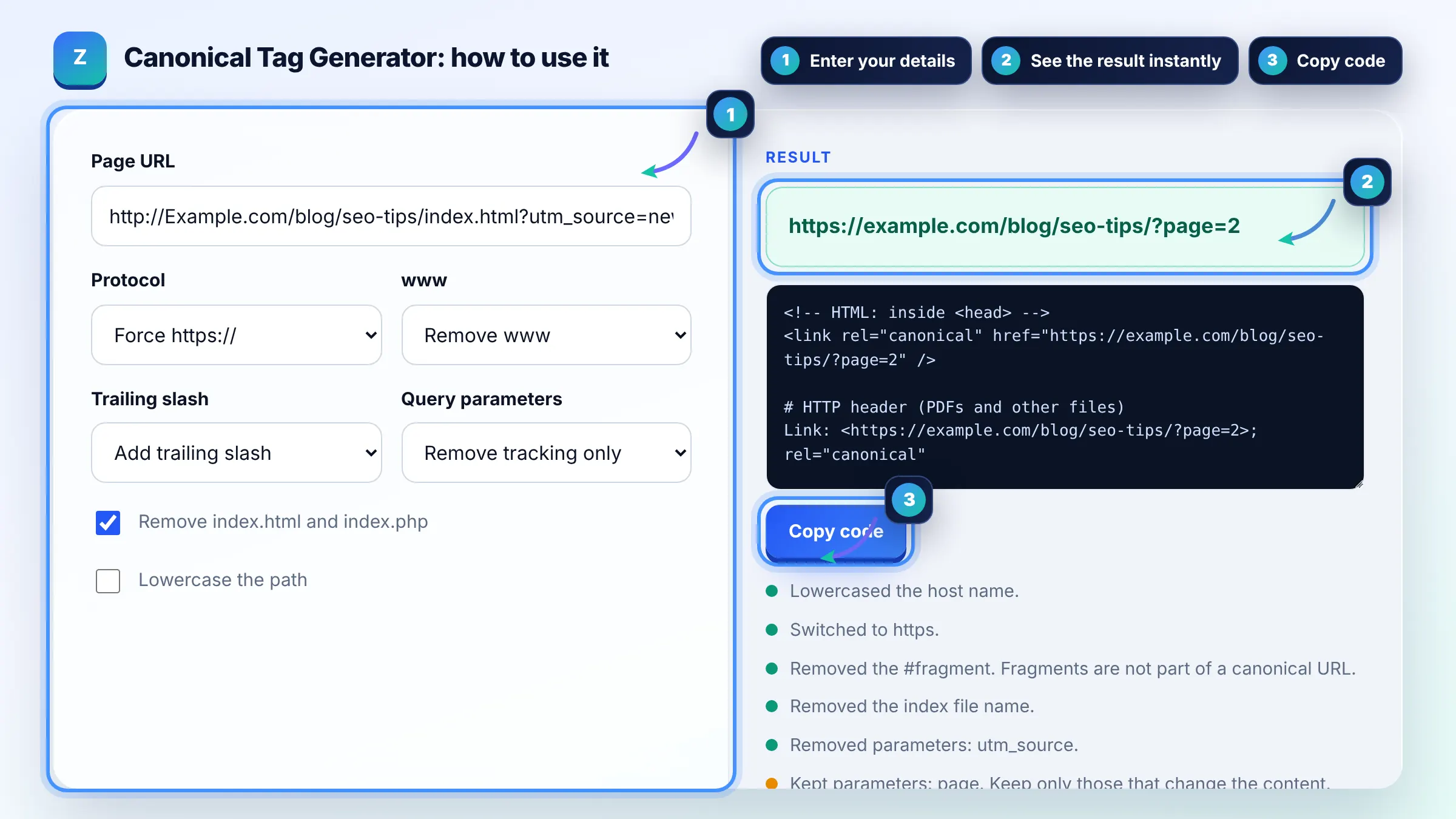
Example: http://Example.com/blog/seo-tips/index.html?utm_source=newsletter&page=2#comments with HTTPS, no www, trailing slash and tracking only selected becomes https://example.com/blog/seo-tips/?page=2. The tool drops utm_source and the fragment, lowercases the host, removes index.html and keeps page=2 because it changes the content.
Place the link rel="canonical" element inside the head section of the HTML. Google ignores canonical links found in the body, and invalid HTML earlier in the head can push it out. For PDFs and other non-HTML files, send the canonical as a Link HTTP header instead.
Yes. A cross-domain canonical is useful when the same article is syndicated to another site. The partner page points its canonical to your original URL. Google treats it as a hint, so the original should be the most complete version and linked from the copy.
No. Each paginated page, such as ?page=2, usually has different content and should have a self-referencing canonical. Pointing every page to page 1 can stop Google from finding products or articles linked only from deeper pages.
Avoid it. Noindex says do not index this page, while canonical says another page is the main version, so the signals conflict. Pick one: canonical for duplicates you want consolidated, or noindex for pages you never want in search.
The host name is not case sensitive, but the path usually is, so /Blog/ and /blog/ can be different URLs. This tool always lowercases the host and only lowercases the path if you tick the option. Match the exact case your server uses.
Yes. The URL you type is processed only in your browser with JavaScript and is never sent to a server. The tool checks format only, so also confirm with the URL Inspection tool in Search Console which canonical Google selected.
Facts checked against these official pages. Read how I check facts in my editorial policy.
A hreflang tag generator is a tool that writes rel="alternate" hreflang annotations so search engines can…
A redirect map generator is a tool that builds the old URL to new URL table you need before a site migration.…
A meta robots tag generator is a tool that writes the meta name="robots" element and the equivalent…
Coming 12 OctSend your website and I will check it for you, free.
One short email when something new goes live: articles, free SEO tools, package updates, discounts and price alerts. No spam, unsubscribe in one click.