Not every 404 in Search Console is a problem. Some pages should be gone. Here is how to tell which 404s need a redirect, which need a fix, and which you can safely ignore.
This guide explains the Not found (404) status in Google Search Console and what to do about it. It is part of my Search Console errors hub.
Quick answer
A 404 means the URL does not exist on your server. Google removes previously indexed 404 URLs from the index and crawls them less over time. 404s for pages that never existed or were removed on purpose are normal and harmless. Fix the ones that matter: important pages deleted by mistake, moved pages without redirects, and broken internal links.
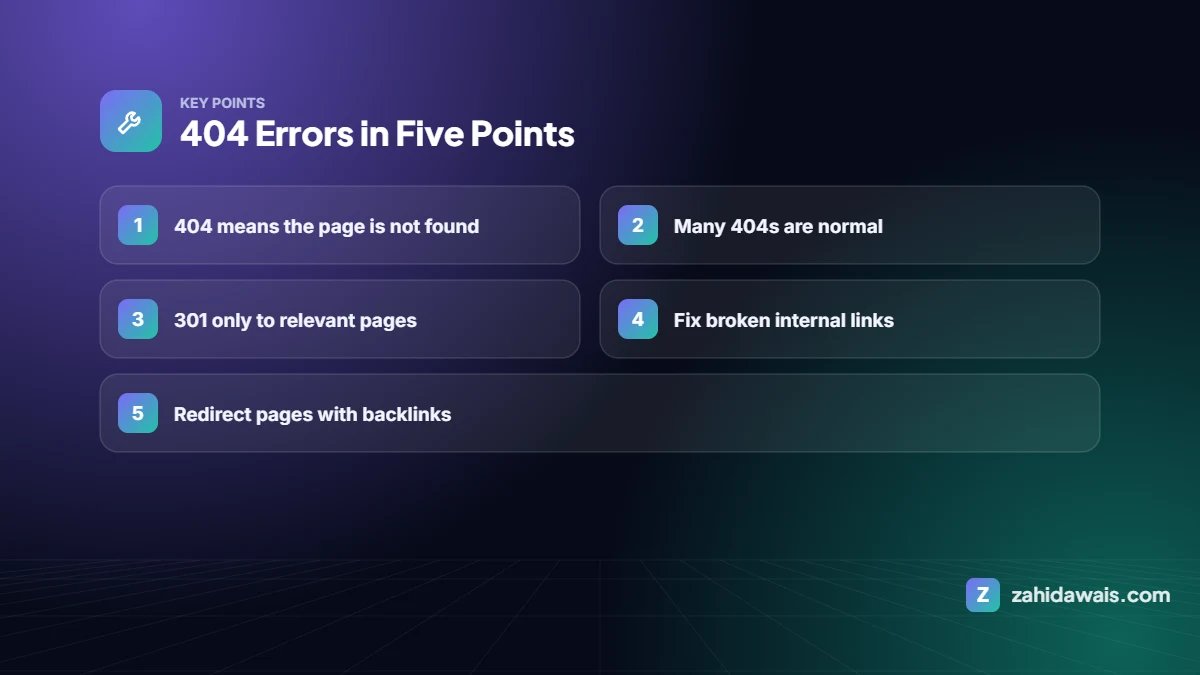
404 Errors in Five Points
Fix or ignore? A quick decision table
Situation
Action
Page moved to a new URL
301 redirect to the new URL
Page deleted, a close replacement exists
301 redirect to the replacement
Page deleted, no replacement
Leave as 404 or use 410
URL never existed (typo, spam link)
Ignore
Your own internal link points to it
Fix the internal link
Page should exist and is broken
Restore the page
How Google treats 404 and 410
Google treats all 4xx errors except 429 in a similar way: the content does not exist, previously indexed URLs are removed, and newly found 404 URLs are not processed and crawled less over time. A 410 says “gone for good” a little more clearly, but in practice both work.
How to find where the 404 comes from
In Search Console, open the URL and check “Referring page” in URL Inspection if shown.
Crawl your site with a crawler to find internal links to 404 URLs.
Check your backlinks report for external links pointing to the 404.
Check your sitemap does not list removed URLs.
Redirect only to relevant pages
Redirecting every 404 to the home page does not help. Google often treats irrelevant redirects as soft 404s. Redirect only when there is a truly equivalent page. See soft 404 error and 301 vs 302 redirects, and create rules with the htaccess redirect generator.
404 pages with backlinks
If a deleted page still has good backlinks from other sites, redirect it to the most relevant live page. This recovers value you would otherwise lose. Check with a backlink tool or the Links report.
Make your 404 page helpful
Your custom 404 page should return a real 404 status, explain the page is missing, and offer search, popular pages and a link home. That keeps visitors who land there.
Example
After a redesign, 120 old blog URLs show as 404. Forty have backlinks or traffic history and have new equivalents, so they get 301 redirects. The rest were thin tag pages with no value, so they stay 404. Internal links in old posts are updated to the new URLs.
Done for you
I audit and fix speed, Core Web Vitals, indexing, redirects and schema, and send you a clear report of every change.
404s for pages that should not exist are normal and do not hurt the rest of your site. Fix broken internal links and important pages that were lost by mistake.
Should I redirect all 404s to the home page?
No. Redirect only to truly relevant pages. Mass redirects to the home page are often treated as soft 404s.
What is the difference between 404 and 410?
404 means not found; 410 means gone permanently. Google treats them very similarly.
How long until 404 URLs disappear from Search Console?
Google recrawls them less often over time; they can show in reports for weeks or months, which is fine.
Should I mark 404 errors as fixed?
Use Validate fix only after you redirected or restored pages that should work.
Sources
Facts checked against these official pages on 10 October 2026. Read my editorial policy.
A 5xx error means your server failed when Googlebot asked for a page. If it keeps happening, Google slows crawling and can drop the pages. Here is how to find the cause and fix it.