
Guest posting and link types
How to Check Expired Domain History Before You Buy
The due diligence checklist I run on every expired domain before I use it or recommend it to a client.
Read articleA practical comparison from 5000+ link orders, with a decision table and a real world style example.
This article gives you a clear, practical comparison of niche edits vs guest posts, so you can decide which link type fits your budget, your risk tolerance and the page you want to grow.
In the niche edits vs guest posts debate, neither type is better by default. A niche edit adds your link to an existing page that already has age and possibly traffic. A guest post is a new article written around your topic. Guest posts give more control and context; niche edits are faster and usually cheaper.
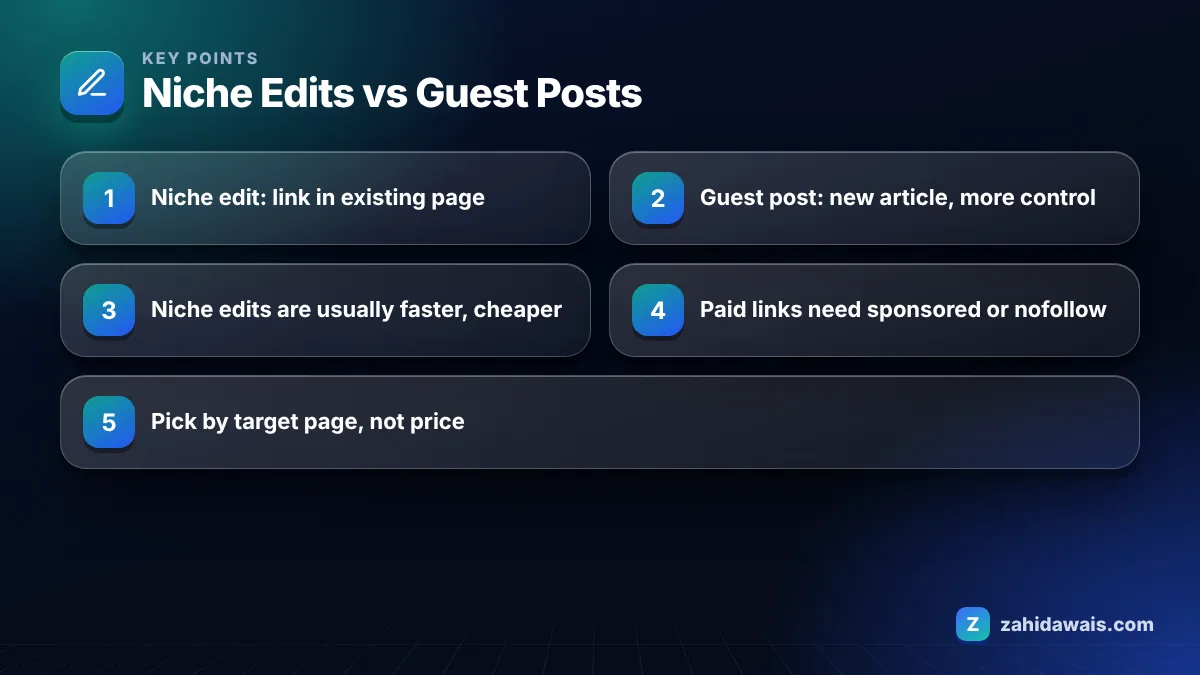
A niche edit places your link inside an article that is already published, while a guest post is a brand new article published on the host site with your link inside it. That is the whole technical difference. Everything else, such as price, speed and risk, follows from it.
A niche edit is also called a link insertion or curated link. The site owner opens an old post, adds a sentence or edits an existing one, and links to your page. The page keeps its URL, its publish date in most cases, and any links pointing to it.
A guest post starts from zero. Someone writes 800 to 1500 words on a topic that suits both the host site and your page, the editor reviews it, and it goes live as a new URL. The new page has no history yet, so it needs time to get crawled, indexed and linked internally.
In my orders across Adsy, Legiit and the other marketplaces, buyers often treat the two as interchangeable. They are not. They solve different problems, and the right choice depends on the page you want to support.
Niche edits are better when a relevant, indexed page with real traffic already exists on the host site; guest posts are better when you need full control over the topic, the anchor context and the surrounding content. Use the table below as a decision aid rather than a rule.
| Factor | Niche edit | Guest post |
|---|---|---|
| Page age | Existing page, often already indexed | New page, needs crawling and indexing |
| Topic control | Low: you fit into someone else’s article | High: the article is built around your topic |
| Context around the link | One or two sentences | A full section can support the link |
| Typical turnaround | Faster, often a few days | Slower, writing and editing take time |
| Typical price on the same site | Usually lower | Usually higher, content is included |
| Main risk | Link added to an irrelevant or dead page | Article on a site that publishes anything for money |
| Best for | Supporting a page that already ranks on page two | New pages, brand building, topical relevance |
The table is based on what I see when I deliver both types. Prices and turnaround vary by publisher, so treat them as patterns, not fixed numbers. If you want a broader view of how these placements fit into a plan, my step by step link building guide covers the full process.
A niche edit is not safe or unsafe by itself; what matters is whether the link is paid, how it is marked up and whether it helps readers of that page. Google treats buying links to manipulate rankings as link spam, whatever the format.
Google’s spam policies on link spam list buying or selling links that pass ranking credit as a violation. The same policies say paid links are fine when they carry a qualifying attribute. Google’s guide on how to qualify outbound links with rel attributes asks site owners to mark advertisements and paid placements with rel=”sponsored”, and says nofollow is still acceptable for those links.
So the honest answer is this: a paid niche edit should carry rel=”sponsored” or rel=”nofollow”. The same rule applies to a paid guest post. Any vendor who says a paid link of either type carries no risk is not being straight with you.
Beyond the policy, niche edits carry two practical risks that guest posts do not:
Choose by starting from the page you want to support, then check what the host site can offer for that exact topic. Here is the order I follow before I recommend one or the other to a client.
Most of my clients end up with a mix. Guest posts build topical depth on new pages, while a few careful insertions support pages that already rank. My link building service offers both, and I recommend the type after looking at the target URL rather than before.
Value depends on the cost per useful placement, not the sticker price, so a cheaper niche edit on a dead page is worse value than a pricier guest post on a site with real readers. Compare like with like on the same publisher.
When I quote both types on one site, the insertion is usually the cheaper option because no new content is written. But a guest post brings a full article that can earn internal links from the host and stay relevant for years. For a breakdown of what drives price, read my article on what link building costs in 2026.
Three questions decide value in practice:
Imagine a UK plumbing company with a $300 monthly budget and a guide on fixing a leaking tap that sits on page two. A home improvement blog has a five year old post on bathroom maintenance with steady organic traffic. A niche edit there, with one helpful sentence pointing to the tap guide, is the stronger fit for that page.
The same company also wants a new page on boiler servicing to gain visibility. No existing article on the blog covers boilers, so forcing a link into an unrelated post would look odd. Here a guest post on seasonal boiler checks, written by someone who understands heating, is the better use of the remaining budget. Both placements are paid, so both should carry rel=”sponsored” or rel=”nofollow”.
This split, one insertion for an established page and one guest post for a new topic, is the pattern I recommend most often. It keeps the profile varied and puts each link where it makes sense to a reader. If you are weighing these against riskier shortcuts, my comparison of guest posts vs PBN links explains why private networks are a different category altogether.
Whichever type you pick, judge the result by referral visits, indexing of the host page and the relevance of the site, not only by a third party authority score.
A niche edit is a link added to an article that is already published on another website. The site owner edits an existing sentence or adds a new one that points to your page. It is also called a link insertion or curated link.
On the same website, a niche edit usually costs less than a guest post because no new article has to be written. The lower price only means good value if the existing page is relevant, indexed and actually read by people.
Yes, if you pay for the link. Google asks site owners to mark paid placements with rel=”sponsored”, and rel=”nofollow” is also acceptable. Paid links that pass ranking credit without a qualifying attribute fall under Google’s link spam policies.
A niche edit is usually faster because the page already exists and is often indexed. A guest post needs writing, editing, publishing and then crawling and indexing of a brand new URL, which takes longer.
Yes, and most balanced link plans do. Guest posts work well for new pages and building topical relevance, while careful niche edits suit established pages that already rank and need extra support from a relevant, older article.
Open the page, confirm the link is in the main content, check the rel attribute in the source code, and confirm the page is indexed with a site: search. Then log the URL, anchor, date and price for later review.
Facts checked against these official pages. Read how I check facts in my editorial policy.
The due diligence checklist I run on every expired domain before I use it or recommend it to a client.
Read article
Find every insecure image, script and stylesheet on your HTTPS pages and replace it for good.
Read article
The documented reasons Google changes your title in search results, how to spot which one applies, and how to fix it.
Read articleSend your website and I will reply with a free audit.