On-page SEO
Ideal Keyword Density for SEO: Does It Still Matter in 2026?
Why there is no magic percentage, how to calculate density anyway, and the checks I use instead to avoid keyword stuffing.
Read articleThe documented reasons Google changes your title in search results, how to spot which one applies, and how to fix it.
This guide explains why Google rewrites title tags, using the causes Google itself documents, and shows you how to diagnose and fix each one so the title you wrote appears more often. Title rewrites are one of the most common questions I get from clients after a site launch, and most cases have a clear, fixable cause.
The main reason why Google rewrites title tags is that it judges your title as not the best description of the page. Google names causes such as half-empty, outdated, inaccurate or repeated boilerplate titles, unclear main headings and language mismatches. Fix the title so it matches the H1 and the content, then request a recrawl.
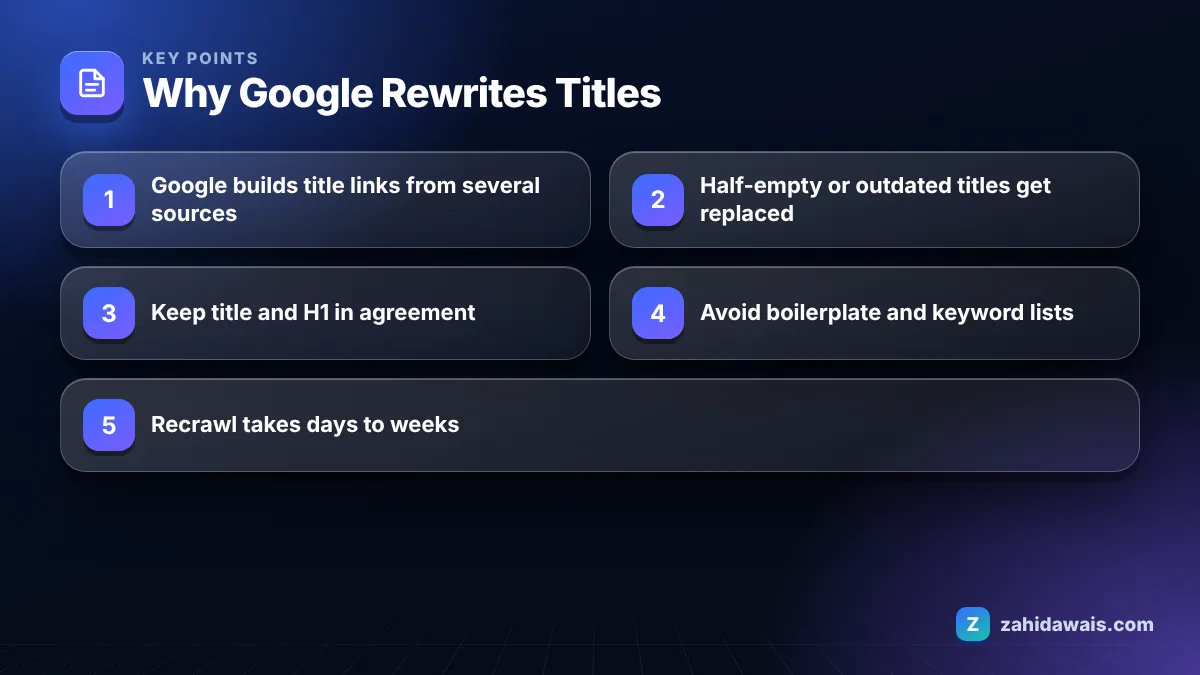
Google is changing your page title because it generates title links automatically and picks the text it believes best represents the page, which is not always your title element. Most of the time it uses your title, but it can draw on other text when your title has a problem.
According to Google’s guide to influencing title links, the sources Google uses include the content of the title element, the main visual title on the page, heading elements such as h1, og:title meta tags, other large and prominent text, anchor text and text in links pointing to the page, and WebSite structured data. If your title tag and these other signals disagree, Google may choose one of the others.
Google’s documentation lists specific situations where it is more likely to change a title. This reference table summarizes them with the fix I apply for each.
| Cause Google documents | What it looks like | Fix |
|---|---|---|
| Half-empty title | Title is only “| Brand Name” or missing the main part | Write a full descriptive title for every page |
| Obsolete title | Title says 2024 while the page heading says 2026 | Update dates in the title when you update content |
| Inaccurate title | Title does not reflect what the page actually covers | Rewrite the title to describe the real content |
| Micro-boilerplate | Many pages share almost the same title | Add the distinguishing detail to each title |
| No clear main title | Several headings look equally important | Make one H1 the most prominent heading |
| Language or script mismatch | Title in English, page content in Urdu or Spanish | Write the title in the page’s main language |
| Site name repeated | Brand appears twice in the result | Use one short brand suffix, or none where it repeats |
When I audit rewrites on client sites, three causes cover most cases: titles that do not match the H1, titles stuffed with keywords and separators, and template titles repeated across many pages.
There is no official ideal title tag length; Google says there is no limit on how long a title element can be, but title links are truncated in results as needed, typically to fit the device width. In practice, about 50 to 60 characters keeps most titles fully visible.
Length on its own is not one of the causes Google lists for rewrites. A long title usually gets shortened with an ellipsis rather than replaced. But long titles tend to contain the things that do trigger rewrites, such as keyword lists, repeated brand names and boilerplate. Keeping titles short forces you to choose one clear message.
Google’s SEO Starter Guide describes a good title as unique to the page, clear and concise, and accurately describing the contents of the page. Use my SERP snippet preview tool to see roughly where your title will be cut before you publish.
You cannot switch off title rewriting, because Google has no setting or tag for it, but you can make it much less likely by fixing the documented causes and keeping your title, H1 and content in agreement. Google says it cannot manually change title links for individual sites.
These are the steps I follow:
Also check that only one title element is in the HTML head. When two SEO plugins or a theme and a plugin both output titles, the page sends mixed signals; I find this on WordPress sites more often than people expect. Title and heading fixes like these are a core part of my on-page SEO service.
No, a rewritten title is not always a problem; sometimes Google’s version is simply a better fit for what people search. Google’s documentation says title link generation is completely automated and takes into account both the content of a page and references to it on the web.
Google’s own advice is to check whether your title follows its best practices and, if it does, to consider whether the title link shown in results is a better fit for the query. In practice I ask two questions. Is the shown title accurate? Is it at least as appealing to click as mine? If both answers are yes, I often leave it and spend the time on pages where the rewrite is wrong or outdated.
Before changing anything, test the search in a private window and on mobile. Truncated titles on small screens can look like rewrites when they are only shortened.
A travel agency’s page for Lake Como tours had this title: “Tours | Holidays | Italy Tours | Best Tours 2024 | TravelBrand”. The H1 on the page was “Lake Como Guided Tours 2026”. Google showed “Lake Como Guided Tours 2026” in results, taking the H1 instead of the title, which matches two of Google’s documented causes: an obsolete year and an inaccurate, keyword heavy title.
The new title: “Lake Como Guided Tours: Small Groups From Milan | TravelBrand”, which is 59 characters. It names the main topic first, adds one unique detail, keeps a single brand suffix and drops the year, so it will not go stale. The H1 stayed close to it: “Lake Como Guided Tours From Milan”. After requesting a recrawl, the new title appeared in results. The same pattern was then applied to the agency’s 30 other destination pages, which all used the same template.
A title rewrite is rarely a crisis, but it is a useful signal that something on the page is unclear. For a wider self check, my free SEO audit checklist covers titles, headings and duplicates, and the free SEO tools page lists quick checkers for each step.
A rewritten title link is a display choice, not a penalty. It can affect clicks if the new text is less appealing, though. Treat it as a hint that your title, H1 or template text is unclear, and fix the cause.
Search Console does not have a report listing rewritten titles. Check manually by searching for your pages and comparing the result with your title element, or use a rank tracking tool that records the title shown in results.
Sometimes. Google lists heading elements such as the h1 among the sources it can use for title links, along with the title element and other prominent text. Keeping the H1 and the title consistent makes it more likely your title is used.
It can help click through for time sensitive topics, but an outdated year is one of the causes Google documents for rewriting titles. Only include a year if you will update it whenever you refresh the content.
Google suggests including your site name at the start or end of the title with a delimiter. Use one short brand suffix and avoid repeating it twice. On the home page, the brand often works best at the start.
Google has to recrawl and reprocess the page first. Google’s documentation notes this can take from a few days to a few weeks. Request indexing in the URL Inspection tool to speed up important pages.
Facts checked against these official pages. Read how I check facts in my editorial policy.
Why there is no magic percentage, how to calculate density anyway, and the checks I use instead to avoid keyword stuffing.
Read article
How to spot pages competing for the same search, decide what to do with each one, and fix it without losing traffic.
Read article
E-E-A-T is how Google's quality raters judge whether content comes from someone who knows the topic. It is not a single ranking factor, but the signals behind it shape what ranks.
Read articleSend your website and I will reply with a free audit.