On-page SEO
Why Google Rewrites Title Tags and How to Stop It
The documented reasons Google changes your title in search results, how to spot which one applies, and how to fix it.
Read articleWhy there is no magic percentage, how to calculate density anyway, and the checks I use instead to avoid keyword stuffing.
This article explains whether an ideal keyword density for SEO exists, how to calculate density if you want to measure it, and the practical checks I use instead to keep content natural and safely away from keyword stuffing. If a plugin is telling you to hit 2.5 percent, read this first.
There is no ideal keyword density for SEO. Google has never published a target percentage, and its spam policies treat repeating words so often that it sounds unnatural as keyword stuffing. Use the main keyword in the title, H1 and opening, then write naturally with variations and answer related questions.
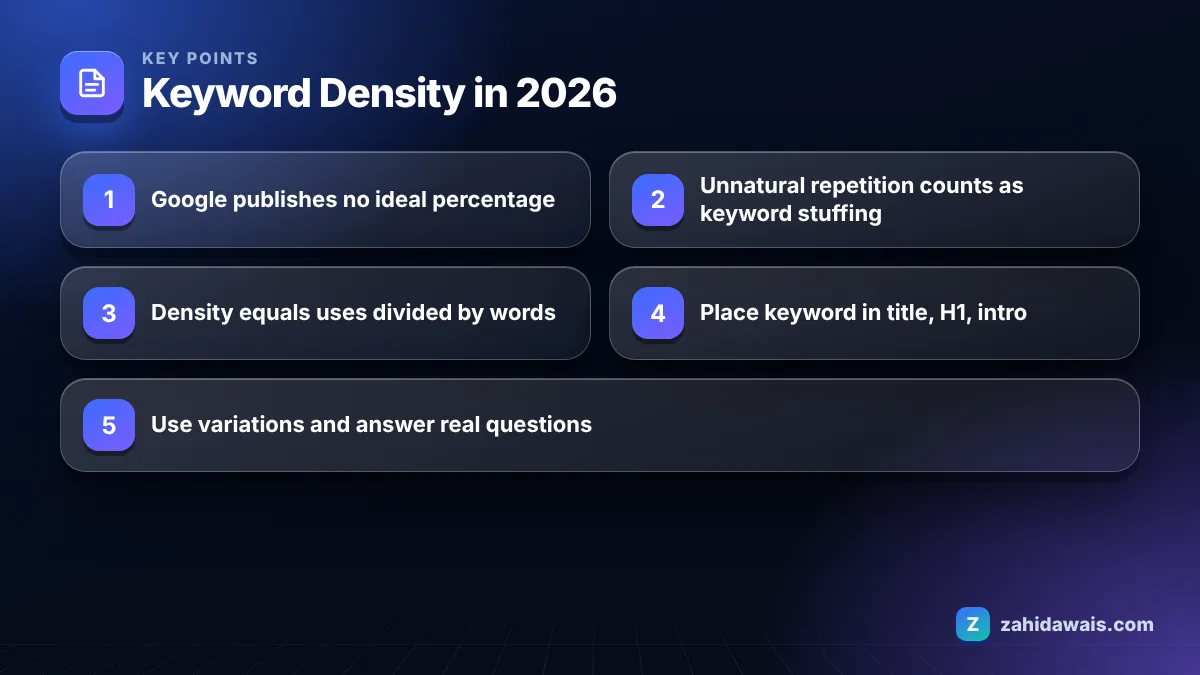
There is no good keyword density percentage that Google rewards, so any fixed target, whether 1 percent, 2 percent or 3 percent, is a rule of thumb from SEO tools rather than from Google.
The idea of a target percentage comes from early search engines, which relied heavily on counting words. Some plugins still score pages on density, and that keeps the myth alive. Google’s documentation does not mention a percentage anywhere. What it does say, in the SEO Starter Guide, is that excessively repeating the same words over and over, even in variations, is tiring for users.
In my own work I treat density as a warning light, not a target. When I check client content, natural articles almost always land somewhere around 0.5 to 1.5 percent for the main phrase without anyone trying. When a page is far above that, it usually reads badly, and that is the real problem.
Yes, keyword stuffing is against Google’s spam policies, and pages that violate those policies can rank lower or be removed from results, either by automated systems or through a manual action.
Google’s spam policies define keyword stuffing as filling a web page with keywords or numbers in an attempt to manipulate rankings in Google Search results. The examples Google lists include:
Notice that none of these examples mentions a percentage. The test is whether the text sounds unnatural or exists to manipulate rankings. A 1,000 word page can be stuffed at a low density if it has a block of 40 city names in the footer, while a technical article can use a term many times naturally because there is no other word for it.
Places where I find stuffing most often: location pages with lists of towns, footers with keyword anchors, image alt text full of keywords, and old articles written to a density target years ago.
You calculate keyword density by dividing the number of times the keyword appears by the total number of words on the page, then multiplying by 100. For a phrase of several words, many tools multiply the count by the number of words in the phrase first.
The two formulas give different results for the same page, which is one more reason not to chase a precise number. My free word counter and keyword density checker does both counts in seconds, and I use it mainly to spot phrases repeated far more than the rest.
The keyword should appear in the places that define the topic: the title tag, the H1, the URL where it fits naturally, and the first paragraph. After that, placement matters far more than repetition.
Here is the placement list I give writers working on client content:
Everything else in the body should be written for the reader. Use pronouns, synonyms and natural phrasing. If you have covered these placements, the page states its topic clearly, and adding the phrase ten more times adds nothing a reader or a search engine needs. This list also works as a quick edit pass for older content that was written to a density target.
Instead of density, check where the keyword appears, whether variations are used, and whether the page answers the questions searchers have. This reference table compares the old density habit with what I check today.
| Old density habit | What to check instead | Why |
|---|---|---|
| Hit 2 percent exactly | Keyword in title, H1 and first paragraph | These placements make the topic clear without repetition |
| Repeat the exact phrase | Use natural variations and synonyms | People search in many ways; one page can match many wordings |
| Add the keyword to every heading | Make headings answer real questions | Question headings help readers and answer engines find answers |
| Fill alt text with the keyword | Describe each image honestly | Google warns against keyword stuffing in alt attributes |
| Add a list of towns served | Write a real section about service areas | City lists are a named example of keyword stuffing |
| Write longer to fit more keywords | Cover the topic completely, then stop | Google says content length alone does not matter for ranking |
The last row is worth stressing. Google’s starter guide says the length of the content alone does not matter for ranking purposes. Padding an article to fit more keywords makes it worse on both counts.
A locksmith’s service page has 600 words and uses “emergency locksmith London” 21 times. Simple density: 21 divided by 600, times 100, equals 3.5 percent. Phrase density with 3 words: 21 times 3 is 63, divided by 600, times 100, equals 10.5 percent. Either way, reading the page aloud makes the problem obvious: almost every sentence ends with the same phrase, and a footer lists 35 London areas.
The rewrite keeps the exact phrase in the title, H1, first paragraph and one H2: 4 uses, about 0.7 percent. Other sentences use natural variations such as “locksmith available 24 hours”, “locked out of your flat” and “lock change”. The 35 area names become a short paragraph naming the boroughs actually covered, with typical response times. The page now reads like a person wrote it, answers more searches by covering more questions, and no longer matches Google’s description of keyword stuffing.
A density check is a quick way to find pages like this across a site. I include it in every on-page SEO audit, and you can run your own review with the free SEO audit checklist. New to terms like keyword stuffing or search intent? The SEO glossary explains them.
Not as a target number. Google has not published any ideal density, and its documentation focuses on helpful, natural content. Very high repetition can hurt, because repeating words unnaturally is keyword stuffing, which is against Google’s spam policies.
Some SEO plugins, including Yoast, show a keyphrase density score with their own recommended range. These are plugin guidelines, not Google rules. Use the score as a prompt to reread your text, not as a goal to hit exactly.
For most pages, yes. Five percent means the phrase appears once every 20 words, which usually reads as repetitive. Read the page aloud; if the keyword sounds forced, rewrite with variations regardless of the percentage.
Most density tools only count the exact phrase. Variations, synonyms and related terms are good for readers and help the page match more searches, so do not avoid them just because they do not raise your density score.
There is no required number. As a habit, I use the exact phrase in the title, H1, first paragraph and a heading or two, then write naturally. That usually ends up between about 5 and 15 uses including variations.
Not directly. A page can rank without repeating the exact phrase often. Problems appear when the main topic is never stated clearly, for example a missing keyword in the title or H1. Clarity matters more than count.
Facts checked against these official pages. Read how I check facts in my editorial policy.
The documented reasons Google changes your title in search results, how to spot which one applies, and how to fix it.
Read article
How to spot pages competing for the same search, decide what to do with each one, and fix it without losing traffic.
Read article
E-E-A-T is how Google's quality raters judge whether content comes from someone who knows the topic. It is not a single ranking factor, but the signals behind it shape what ranks.
Read articleSend your website and I will reply with a free audit.