AI search (AEO and GEO)
GEO vs SEO: The Real Differences and Where to Focus First
GEO is mostly SEO with a different scoreboard. Here is what actually changes, what does not, and where to start.
Read articlePeople now get answers from Google AI Overviews, ChatGPT and Perplexity before they click anything. This guide shows how those systems pick sources and the 9-step plan I use to get clients cited.
This is my complete guide to AI search optimization: how answer engines pick the pages they quote, what AEO and GEO really mean, and the practical plan I use for clients who want to be cited in Google AI Overviews, ChatGPT and Perplexity. If you want it done for you, see my AEO services and GEO services.
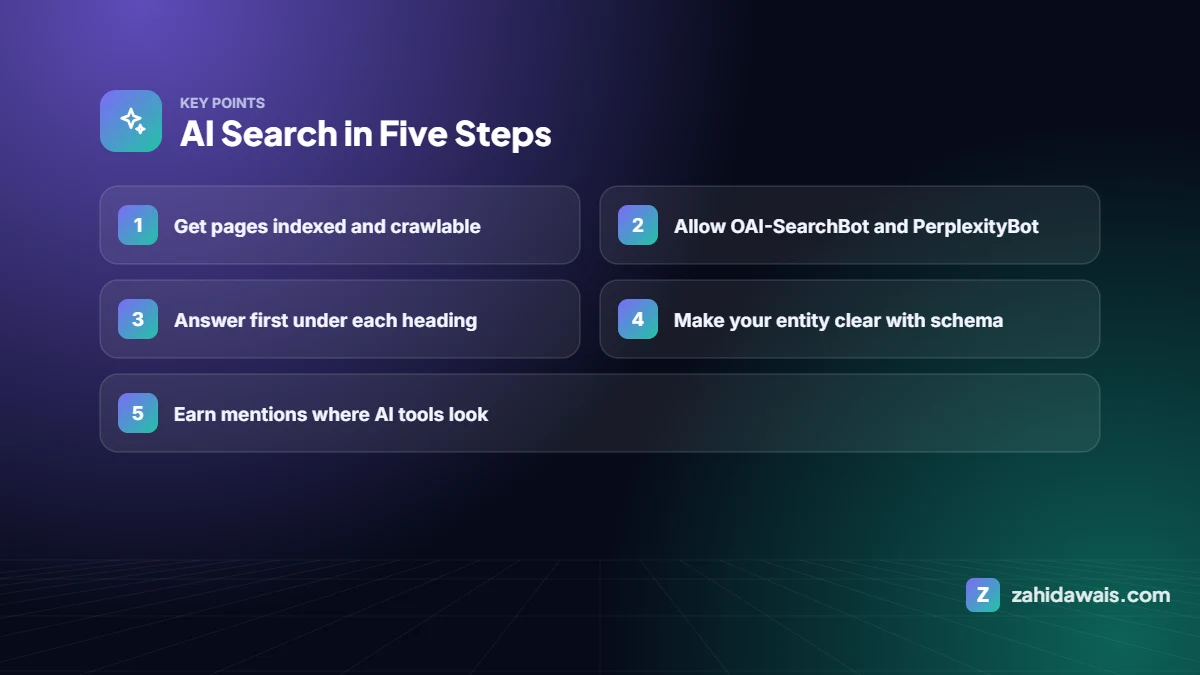
AI search optimization means making your pages easy for AI systems to find, understand, trust and quote. The foundation is normal SEO: crawlable, indexed pages with helpful content. On top of that, you write answer-first sections, build clear entities with schema and consistent profiles, earn mentions on sites AI tools already cite, and allow the AI search crawlers in robots.txt.
AI search is any search experience where an AI model writes the answer and links to a few sources, instead of only showing ten blue links. The main ones today are:
| Platform | Where answers come from | What you control |
|---|---|---|
| Google AI Overviews and AI Mode | Google’s index and ranking systems | Normal Google SEO: indexing, snippets, helpful content |
| ChatGPT search | OpenAI’s search crawler plus partner search data | Allowing OAI-SearchBot, being indexed and cited elsewhere |
| Perplexity | PerplexityBot index plus live page fetches | Allowing PerplexityBot, clear and current pages |
| Microsoft Copilot | Bing’s index | Bing indexing (Bing Webmaster Tools, IndexNow) |
The names overlap, so here is how I use them:
They are not separate projects. Good SEO is the base, AEO shapes the page, and GEO extends your presence across the web.
Google’s own documentation is clear: to be shown as a supporting link in AI Overviews or AI Mode, a page must be indexed and eligible to show with a snippet. There are no extra requirements and no special optimizations, files or schema needed. Google recommends the same fundamentals as always: allow crawling, use internal links, give a good page experience, keep important content in text, support it with images and video, keep structured data in line with the visible text, and keep Merchant Center and Business Profile data up to date.
That means anyone selling a “secret AI Overview hack” is selling something Google says does not exist. The edge comes from doing the fundamentals better than competitors. Read how to rank in Google AI Overviews for the full method.
No AI company publishes a full formula, but the patterns across Google, ChatGPT and Perplexity are consistent with what their documentation says:
| Do | Avoid |
|---|---|
| Question headings that match real searches | Clever headings with no keywords |
| Direct answer in the first 1 or 2 sentences | Long introductions before the answer |
| Specific numbers, dates and names | Vague claims like “many experts say” |
| Tables for comparisons, lists for steps | Walls of text |
| Author name, experience and sources | Anonymous pages with no evidence |
| One topic per page, covered fully | Many thin pages on tiny variations |
Question: “What is a niche edit?” A quotable answer: “A niche edit is a backlink added to an existing article that is already published and indexed on another website, instead of a new guest post. It works best when the article is relevant and already gets traffic.” Then a short table compares niche edits with guest posts. That first paragraph can be lifted as-is into an AI answer, and the table gives the detail a reader wants next.
No. Google says no AI-specific text files or markup are needed for AI Overviews or AI Mode. An llms.txt file is optional and costs little, but it will not make up for weak content or blocked crawlers. Details in what is llms.txt.
Start with the guide that matches your goal: rank in Google AI Overviews, get cited by ChatGPT, or build topical depth with semantic SEO.
I optimise your site for AI Overviews, ChatGPT and Perplexity: answer-first content, entity and schema fixes, and brand mentions on sites AI tools cite.
It builds on SEO. AI systems still need to find, index and trust your pages. AI optimization adds answer-first writing, clear entities and wider brand mentions.
No. Google says no special structured data is needed. Use normal schema that matches your visible content.
Blocking GPTBot only stops your content being used for OpenAI model training. To appear in ChatGPT search, allow OAI-SearchBot.
If your pages are already indexed and strong, changes can show within weeks. New sites usually need months to build enough trust and mentions.
Yes. AI answers often cite several sources, and specific, expert answers from smaller sites are cited regularly.
Facts checked against these official pages on 10 October 2026. Read my editorial policy.
GEO is mostly SEO with a different scoreboard. Here is what actually changes, what does not, and where to start.
Read article
Sites that cover one topic deeply tend to rank for more of it, faster. Topical authority is not a score; it is the result of complete, well-linked coverage plus outside recognition.
Read article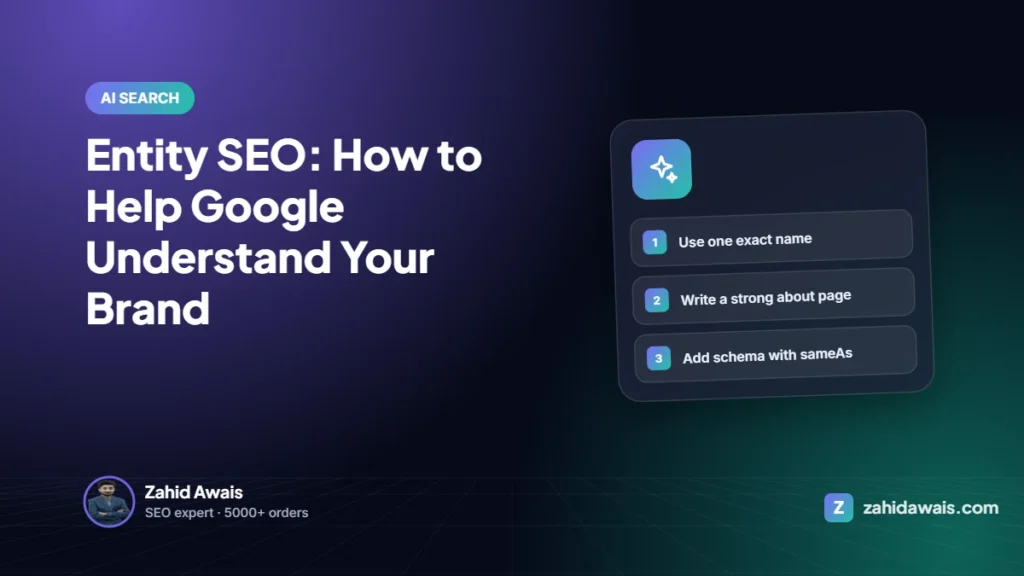
Google and AI tools think in entities: people, companies, places and things they can identify. Entity SEO makes sure your brand is one of them, with facts that agree everywhere.
Read articleSend your website and I will reply with a free audit.