E-commerce SEO
Category Page SEO: How to Write Content That Ranks
Category pages often target the biggest keywords in a store. Here is how to give them content and structure that earns rankings.
Read articleProduct pages are where search traffic turns into sales. Here is how to write them, structure them and mark them up so Google and shoppers both understand them.
This guide covers product page SEO for Shopify, WooCommerce and custom stores. It is part of my e-commerce SEO service.
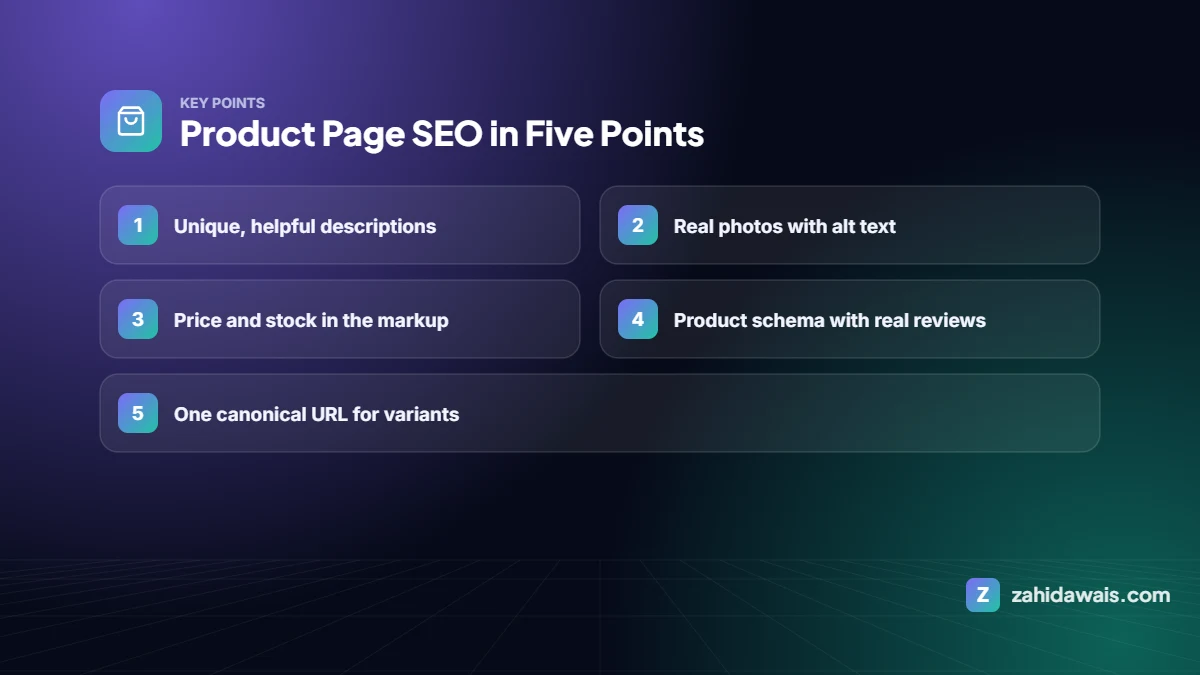
To optimise a product page, use a clear title with the product name and key attribute, write a unique description that answers buyer questions, add high quality images with alt text, show price, stock and shipping clearly, add Product schema with offers and genuine reviews, handle variants with one canonical URL, and link the product from its category and related products.
| Section | Purpose |
|---|---|
| One-line summary | Who it is for and the main benefit |
| Key features as bullets | Quick scanning on mobile |
| Specifications table | Size, weight, materials, compatibility |
| Use cases | Real situations where it helps |
| Care, delivery, returns | Removes doubt before purchase |
| FAQ | Answers questions shoppers search for |
Connecting a product feed to Google Merchant Center can show your products in free listings across Google and keeps price and stock data accurate. Google’s AI features documentation also advises keeping Merchant Center information up to date.
Picture two stores selling the same blender. Store A uses the manufacturer’s 80-word text, one white-background photo and no price in the markup. Store B adds a 300-word description for smoothie lovers, a specs table, eight real photos, a short FAQ about noise and cleaning, Product schema with price and stock, and 25 real reviews. Store B gives Google and shoppers far more reasons to choose it.
I optimise product and category pages, fix duplicate URLs and add product schema so your store earns more organic sales.
No. Thousands of stores use the same text. A unique, helpful description gives Google a reason to rank your page.
Long enough to answer buyer questions. For most products, 150 to 400 words plus a specs table works well.
Product schema with offers (price, currency, availability), images, brand, identifiers like GTIN or SKU, and genuine reviews if you have them.
Keep the page if the product will return. If it is discontinued, 301 redirect to the closest product or category.
Usually keep variants on one URL. If you need separate URLs, use a canonical to the main version unless each variant has unique search demand.
Facts checked against these official pages on 10 October 2026. Read my editorial policy.
Category pages often target the biggest keywords in a store. Here is how to give them content and structure that earns rankings.
Read article
Product pages rarely earn links on their own. Stores win links with guides, gift lists, suppliers, creators and PR. Here are nine methods and where to point the links.
Read article
WooCommerce gives you full control of your store's SEO, which also means more to set up. Here is the setup, speed and content checklist I use for WooCommerce stores.
Read articleSend your website and I will reply with a free audit.