E-commerce SEO
Category Page SEO: How to Write Content That Ranks
Category pages often target the biggest keywords in a store. Here is how to give them content and structure that earns rankings.
Read articleWooCommerce gives you full control of your store's SEO, which also means more to set up. Here is the setup, speed and content checklist I use for WooCommerce stores.
This guide covers WooCommerce SEO from settings to speed. It is part of my e-commerce SEO service.
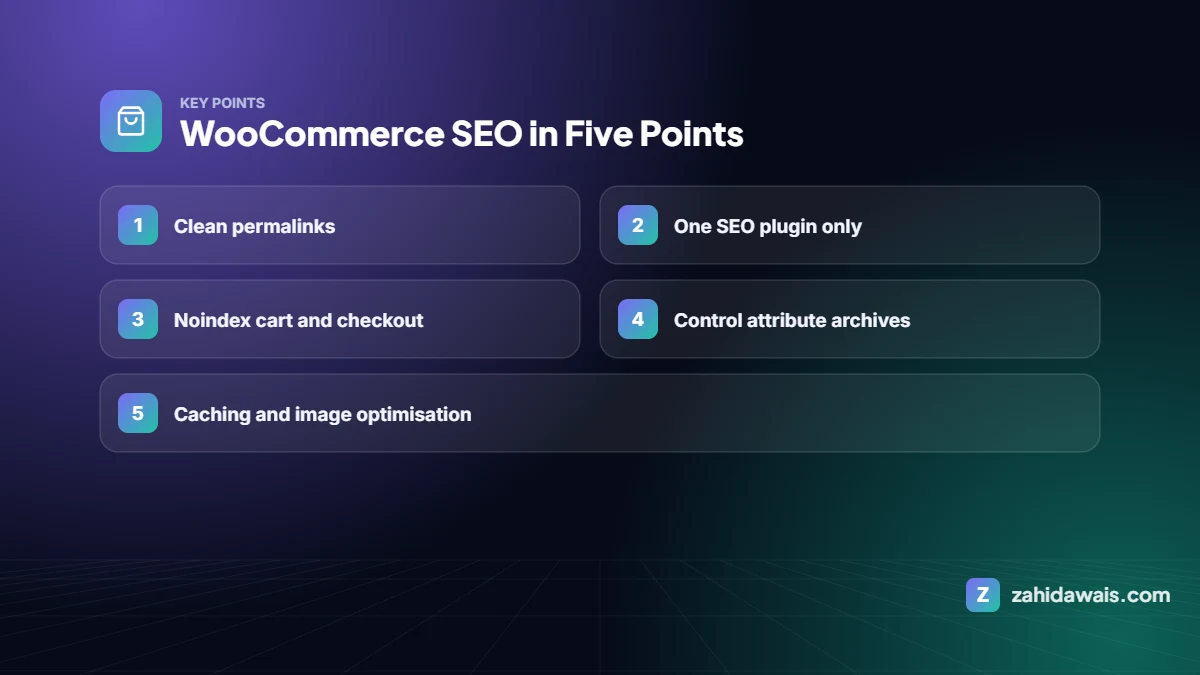
For WooCommerce SEO, set clean permalinks, use one SEO plugin for titles, meta and sitemaps, write unique product and category content, control attribute and filter URLs, add caching and image optimisation for speed, check that product structured data is valid, and keep cart, checkout and account pages out of the index.
WooCommerce can create archive pages for tags and attributes, and filter plugins can create many parameter URLs. Index only the ones with real search demand and unique content; noindex or block the rest so crawling goes to products. See crawl budget.
| Fix | Effect |
|---|---|
| Server-level page caching (cart and checkout excluded) | Faster product and category pages |
| Image compression to WebP with dimensions | Better LCP and CLS |
| Remove unused plugins and heavy page builder widgets | Less JavaScript, better INP |
| Object caching (Redis) on larger stores | Faster database queries |
| Good hosting with PHP 8+ | Lower server response time |
Details in the Core Web Vitals guide.
WooCommerce outputs basic Product structured data, and SEO plugins often extend it. Test a product with Google’s Rich Results Test, and add brand, GTIN or SKU and genuine reviews where missing. See the schema markup guide.
I optimise product and category pages, fix duplicate URLs and add product schema so your store earns more organic sales.
Yes. It runs on WordPress and gives full control, but it needs good setup, a fast host and caching.
Yoast and Rank Math both work well. Use only one.
Yes. They have no search value and should stay out of the index.
Use server caching (excluding cart and checkout), optimise images, remove unused plugins and use good hosting.
Yes, basic Product structured data. Check it with the Rich Results Test and fill missing fields.
Facts checked against these official pages on 10 October 2026. Read my editorial policy.
Category pages often target the biggest keywords in a store. Here is how to give them content and structure that earns rankings.
Read article
Product pages rarely earn links on their own. Stores win links with guides, gift lists, suppliers, creators and PR. Here are nine methods and where to point the links.
Read article
Shopify handles a lot of SEO basics for you, but it also creates duplicate URLs, slow app scripts and thin collection pages. Here is what to fix and in what order.
Read articleSend your website and I will reply with a free audit.