
E-commerce SEO
Product Variants SEO: Should Each Variant Get Its Own URL?
Colours, sizes and materials can multiply your product pages. Here is how to decide what deserves its own URL and how to mark it up.
Read articleEvery store retires products. The status code you choose decides whether that page's value is kept, moved or lost.
This guide gives you a simple rule set for discontinued products SEO: when a retired product should redirect, when it should return a 404, and when it is smarter to keep the page live.
For discontinued products SEO, redirect with a 301 when a close replacement exists, keep the page live with a clear notice when it still earns links or traffic, and return a 404 or 410 when it has no value and no successor. Avoid redirecting everything to the homepage or a loosely related category.
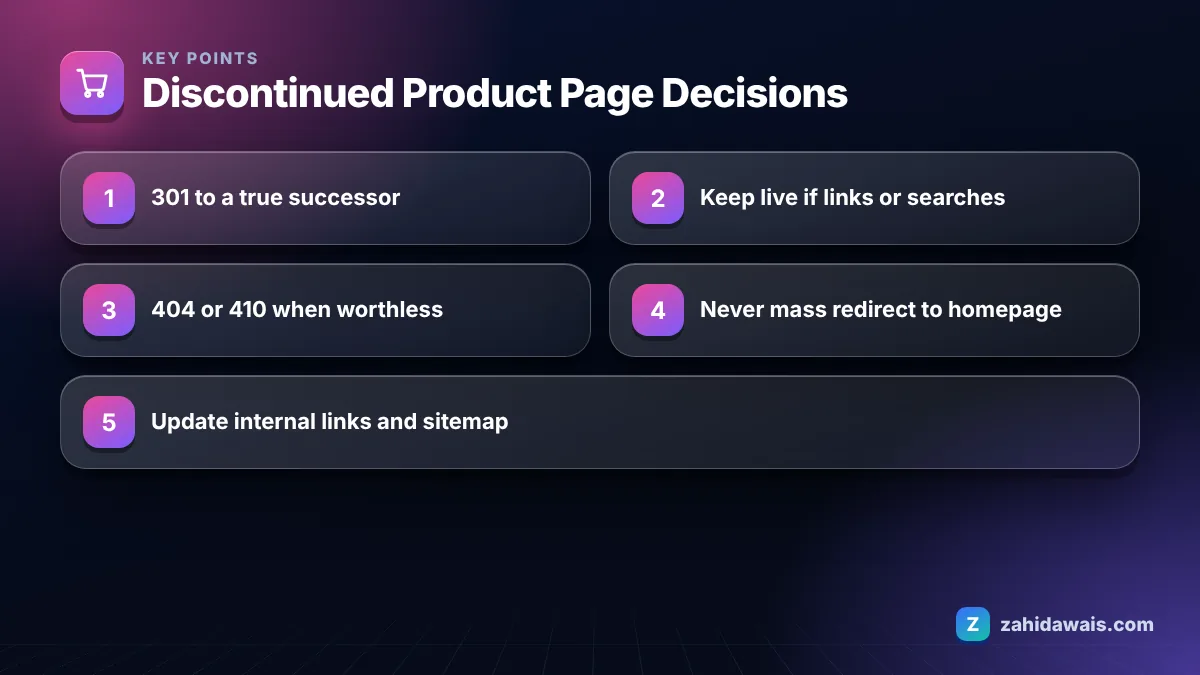
Redirect a discontinued product only when there is a page that genuinely satisfies the same need, such as the newer model, the same item from another brand or a very specific subcategory. A redirect tells Google and visitors that the content now lives elsewhere, so the destination has to be a fair substitute.
Google’s documentation on redirects and Google Search explains that permanent redirects (301 and 308) show the new target in search results, while temporary redirects (302, 303 and 307) keep the source page in results. For a product that will never return, a permanent redirect is the correct type. The same page says to use permanent redirects only when you are sure the redirect will not be reverted, which is another reason to be certain the product is truly gone before you switch.
Good redirect targets, in order of preference:
If none of those exist, a redirect is probably the wrong choice.
A useful test is to imagine the visitor who clicked an old link to the retired product. If they land on the redirect target and think “yes, this is what I needed”, the redirect is right. If they think “why am I here?”, it is not. Search engines see the same mismatch: a redirect to something unrelated does not pass along the relevance of the old page, and it leaves the visitor confused.
Also keep the redirect at the server level where possible. Google’s redirect documentation lists server-side redirects as the most reliable option, with meta refresh and JavaScript redirects as fallbacks for when a server-side redirect cannot be set up.
No, 404 pages for products that no longer exist are normal and do not harm the rest of your site. Every store that sells physical goods produces them, and Google expects it.
According to Google’s page on how HTTP status codes affect crawling, URLs that are already indexed and return a 4xx status are removed from the index, and Google treats 404 and 410 the same way. Crawling of those URLs gradually slows down. In other words, a 404 is a clean, honest signal that the page has gone.
What makes a 404 bad is wasted value. If the old product page had backlinks from blogs or forums, or still received visits from search, a 404 throws that away. That is why the decision should be made per product, based on data, not with a single rule for the whole catalog.
Make your 404 template helpful: keep the main navigation, add a search box, and link to top categories so visitors who arrive from an old link still find something useful.
A soft 404 happens when a page tells visitors a product is unavailable or missing but the server still returns a 200 success code. Search Console’s Page indexing report help describes a soft 404 as a page that returns a user-friendly not found message without a 404 HTTP response code.
For discontinued products, soft 404s usually come from three patterns I see in client audits:
The fix is to make each URL honest. Either return a real 404 or 410, redirect to a genuine substitute, or keep the page with enough content to be useful. My full guide to the soft 404 error walks through the checks in Search Console.
Choose based on three questions: does a true replacement exist, does the page have links or traffic, and will people keep searching for this product by name. This table turns those answers into an action.
| Replacement exists? | Links or traffic? | People still search for it? | Best action |
|---|---|---|---|
| Yes, direct successor | Any | Any | 301 redirect to the successor |
| No | Yes | Yes | Keep live: discontinued notice, specs, alternatives |
| No | Yes | No | 301 to a close subcategory if one fits, otherwise keep live |
| No | No | Yes | Keep live as an information page with alternatives |
| No | No | No | 404 or 410 with a helpful error template |
Keeping a page live works well for products that people research long after they stop being sold, such as appliances, spare parts and electronics where owners look up manuals, compatibility and replacement parts. On those pages, show “This product is discontinued” near the top, keep the specifications, and link to the current equivalent. If you use Product structured data, set the availability to Discontinued so the markup matches the page.
An electronics store retires 60 products at the end of a season. The team exports each URL with backlinks from a link tool, clicks from Search Console for the last 12 months, and whether a newer model exists.
Results: 22 products have a direct successor, so they get a 301 to the new model. 9 have backlinks and steady branded searches but no successor, so they stay live with a discontinued notice and links to alternatives. 4 have a few links but no searches, and a matching subcategory exists, so they redirect there. The remaining 25 have no links, no clicks and no successor, so they return a 404. The work takes one afternoon and every URL ends up with an honest status.
A short written process stops discontinued products piling up as broken links, redirect chains and soft 404s. Most of the problems I fix on stores come from products being removed ad hoc by different people over several years.
If your catalog changes often and this feels like a lot to manage, my e-commerce SEO service can set up the rules and audit past removals. For the Search Console side, the guide on page with redirect explains which redirect reports need action and which are normal.
Either works. Google documents that it treats 404 and 410 the same way, and indexed URLs returning either code are removed from the index. Choose whichever your platform supports easily, and focus on deciding which products should redirect or stay live instead.
It is not a good idea. A visitor looking for a specific product gains little from the homepage, and such redirects can be reported as soft 404s. Redirect only to a genuine substitute, and let products without one return a 404 with a helpful template.
Keep it as long as the old URL still receives visits or has links pointing to it, which in practice often means years. Redirects cost little to maintain, and removing them early can break old backlinks and bookmarks.
It can, especially for brand and model searches from people researching an old product. Keep the specifications, add a clear discontinued notice and link to current alternatives, so the page stays useful and can convert visitors into buyers of newer items.
Not by themselves. Google expects removed products to return 404s, and they do not lower the rest of your site. Problems arise only when valuable pages with links or traffic return 404 or when internal links still point to removed products.
If you keep the page live, use the Discontinued availability value in your Product offer so the markup matches the visible notice. If the page redirects or returns a 404, it should not output product markup at all.
Facts checked against these official pages. Read how I check facts in my editorial policy.
Colours, sizes and materials can multiply your product pages. Here is how to decide what deserves its own URL and how to mark it up.
Read article
A clear category plan helps shoppers find products and helps Google understand which pages matter most. Here is how to build one.
Read article
Filters help shoppers but can create millions of crawlable URLs. Here is how to keep the useful ones and block the rest.
Read articleSend your website and I will reply with a free audit.