AI search (AEO and GEO)
GEO vs SEO: The Real Differences and Where to Focus First
GEO is mostly SEO with a different scoreboard. Here is what actually changes, what does not, and where to start.
Read articlellms.txt is a proposed Markdown file for AI agents. It is cheap to add, but Google does not use it for AI search features.
This article explains what is llms.txt, how to create one, and, most importantly, what it will and will not do for your visibility in AI answers.
llms.txt is a proposed Markdown file at /llms.txt that gives AI agents a short summary of a site and links to its key pages. Jeremy Howard proposed it in 2024. It is optional, and Google says no AI text files are needed for AI Overviews or AI Mode.
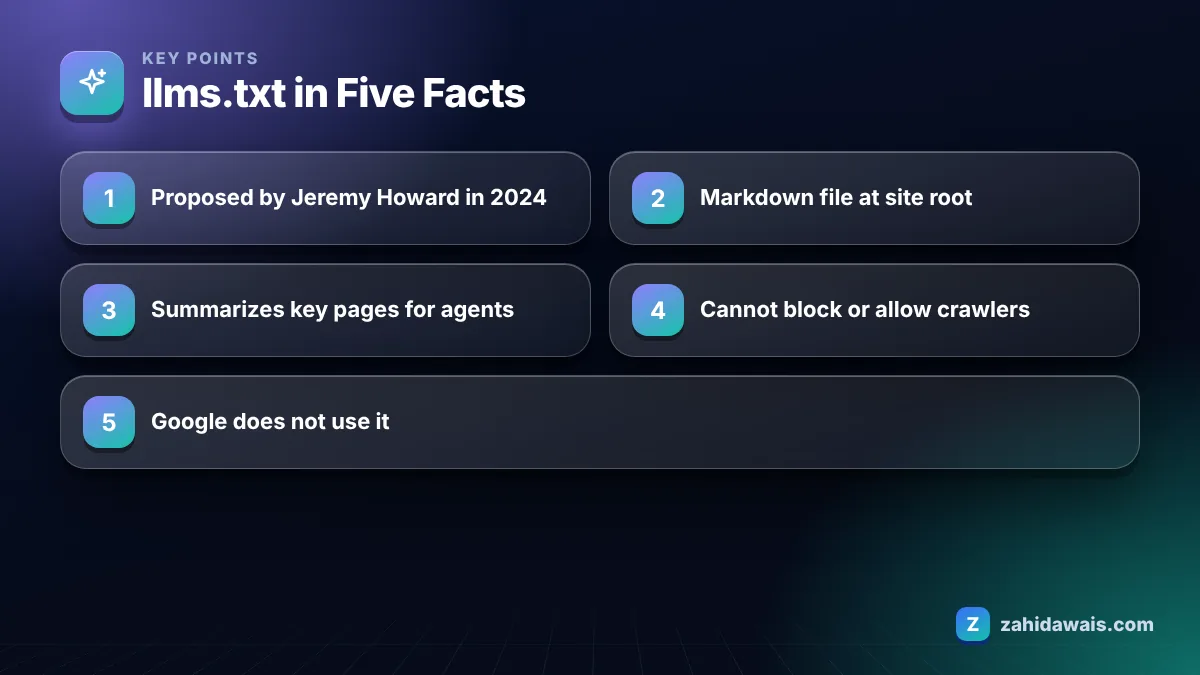
llms.txt is a plain text file written in Markdown that sits at the root of a website and tells a language model, in a few lines, what the site is about and where the best content lives. The llms.txt proposal was published by Jeremy Howard in September 2024, mainly with developer documentation in mind.
The idea is that an AI agent helping a user can read a short, clean summary instead of parsing menus, scripts and ads. The proposal says the file is mainly meant to be used on demand, when an agent needs information while assisting a user, rather than as a training signal.
The format is simple. Only an H1 with the site or project name is required. After that, the proposal suggests a short blockquote summary, optional notes, and H2 sections that list links with a short description. A section titled “Optional” holds links an agent can skip when it needs less context.
No, Google does not use llms.txt for its AI search features. Google’s guide to AI features and your website says you do not need to create new machine readable files, AI text files or markup to appear in AI Overviews or AI Mode. Google’s John Mueller has also publicly compared llms.txt to the old keywords meta tag, which Google ignores.
That matters because many tool vendors sell llms.txt as a ranking factor for AI search. It is not one for Google. For Google, what decides AI Overview links is the same thing that decides regular results: indexable, helpful pages. My guide on AEO vs SEO explains why those two are mostly the same work.
Very few AI providers document that they read llms.txt, so you should assume it is not used unless a provider says otherwise in its own documentation. The proposal has been adopted mostly by software documentation sites and by some coding assistants and developer tools that can fetch the file when you point them at it.
The bigger AI search products publish their own guidance, and it is about crawler access rather than llms.txt. OpenAI’s crawler documentation is about allowing OAI-SearchBot. Perplexity documents PerplexityBot. Anthropic documents ClaudeBot, Claude-User and Claude-SearchBot. Google, as covered above, says AI text files are not needed at all. None of those guides tells site owners that llms.txt is required to be cited.
There is also a practical check you can run yourself. Look at your server access logs for requests to /llms.txt and note the user agents. On most small business sites I have checked, the file gets occasional hits from SEO tools and scanners and very little from the AI assistants people actually use. Your logs are the honest answer for your own site, and they are worth more than any vendor claim.
So the realistic view in 2026 is this: llms.txt is a reasonable convention for documentation heavy sites, a harmless extra for everyone else, and not a lever for Google rankings or AI Overview links.
You create an llms.txt file by writing a short Markdown document and uploading it to your site root so it loads at yourdomain.com/llms.txt. On a WordPress site you can upload it by FTP or through your host’s file manager, or use a plugin that generates it.
Keep it factual. Do not paste keyword lists or marketing claims into it; an agent reading it is looking for orientation, not persuasion.
Two common mistakes I see when reviewing these files: linking to pages that redirect or return 404, and listing 200 URLs so the file becomes a second sitemap. Both defeat the purpose. Link only to final, indexable URLs, and keep the main sections to the pages a new customer or a developer would genuinely need first. If your site is on WordPress, also confirm that a caching or security plugin is not serving the file as HTML or blocking it for unknown user agents.
No, llms.txt and robots.txt do different jobs: robots.txt tells crawlers which URLs they may or may not request, while llms.txt only offers a summary and links. An llms.txt file cannot block or allow any bot. If you want to control AI crawlers such as GPTBot or ClaudeBot, that still happens in robots.txt, which you can check with my robots.txt tester.
| File | Purpose | Standard status | Used by Google Search? |
|---|---|---|---|
| robots.txt | Crawl permissions per user agent | Internet standard (RFC 9309) | Yes, by Googlebot |
| sitemap.xml | List of URLs to discover | Widely supported protocol | Yes, as a discovery hint |
| llms.txt | Summary and key links for AI agents | Community proposal | No, Google says AI text files are not needed |
| Structured data | Describes entities on a page | schema.org vocabulary | Yes, for understanding and rich results |
Add llms.txt only if it takes you less than 30 minutes and you treat it as a convenience for AI agents and developer tools, not as an SEO tactic. For a documentation site or a software product with an API, it can genuinely help coding assistants find the right pages. For a local business site, the benefit is speculative.
What I tell clients is to finish the work that is known to matter first: fix indexing problems, allow the search crawlers you want, write answer-first pages and build real authority. That is the core of my GEO services, and llms.txt is a small optional extra at the end of the list, never the headline.
For a small SEO consultancy, a complete file could be 15 lines. Line 1: “# Example SEO Studio”. Line 3, a blockquote: “Independent SEO and link building consultant serving small businesses in the UK and US.” Then “## Services” with links to the SEO services page, the link building page and the pricing page, each followed by a colon and a 6 to 10 word note. Then “## Guides” with the three most useful evergreen guides. Then “## Optional” with the about page and case studies. Total time to write and upload: about 20 minutes. Expected effect on Google AI Overviews: none, per Google’s documentation. Possible effect: an AI agent asked “what does this studio offer and how much does it cost” can find the pricing page faster. Review the file every quarter, or whenever you launch or retire a service, so it never points to a page that no longer exists.
The llms.txt proposal was published by Jeremy Howard in September 2024. It is a community proposal hosted at llmstxt.org, not a standard from Google, OpenAI or any search engine, and support for it varies between AI tools.
OpenAI’s publisher documentation focuses on allowing OAI-SearchBot and does not list llms.txt as a requirement for appearing in ChatGPT search. Treat any claim that llms.txt boosts ChatGPT citations as unproven unless the provider documents it.
No. llms.txt has no allow or disallow rules. To block or allow crawlers such as GPTBot, ClaudeBot or PerplexityBot, use robots.txt rules for each user agent, and check that your firewall settings match what you want.
Place it at the root of your domain so it loads at yourdomain.com/llms.txt. The proposal also allows files at subpaths covering only that section. It should return plain text with a 200 status code.
No. Some sites also publish an llms-full.txt file that contains the full text of their documentation in one place. It is a related convention used by some documentation tools, but it is optional and Google does not use either file.
No. A small Markdown file at your root has no negative effect on Google rankings. The only real cost is the time to write and maintain it, so keep it short and update it when important pages change.
Facts checked against these official pages. Read how I check facts in my editorial policy.
GEO is mostly SEO with a different scoreboard. Here is what actually changes, what does not, and where to start.
Read article
Sites that cover one topic deeply tend to rank for more of it, faster. Topical authority is not a score; it is the result of complete, well-linked coverage plus outside recognition.
Read article
Google and AI tools think in entities: people, companies, places and things they can identify. Entity SEO makes sure your brand is one of them, with facts that agree everywhere.
Read articleSend your website and I will reply with a free audit.