Technical SEO
HTML Sitemap vs XML Sitemap: Which One Does Your Site Need?
HTML sitemap vs XML sitemap: what each one does, what Google says about sitemaps and links, when a site needs one or…
Read article
This guide is for site owners, developers and SEOs who want to know which structured data still earns a visible feature in Google Search before they spend time on it. You will get the list of rich results Google still shows, taken from Google’s own search gallery, the features Google retired since 2023 with the exact dates, and what to do with old markup.
In 2026, Google’s search gallery lists 25 structured data features, including Article, Breadcrumb, Carousel, Event, Job posting, Local business, Product, Recipe, Review snippet and Video. FAQ rich results stopped appearing on 7 May 2026. How-to, sitelinks search box, course info, estimated salary, learning video, special announcement, vehicle listing and practice problem are also gone.
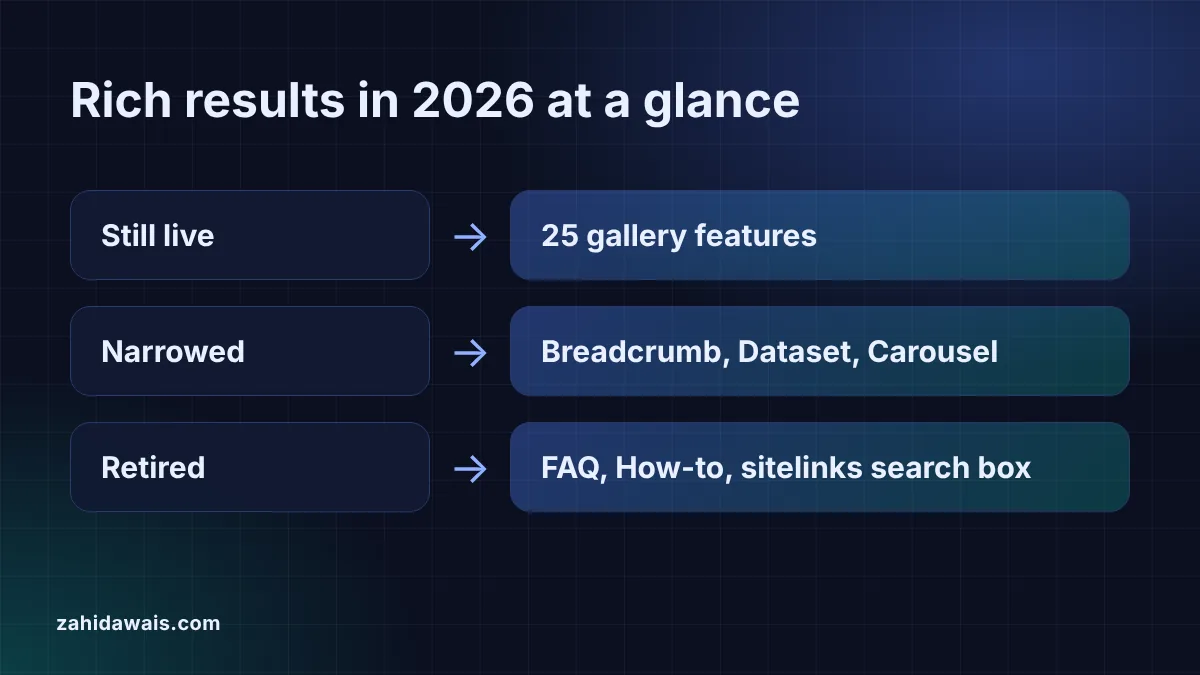
Google still supports the 25 features listed in its structured data search gallery, which was last updated on 16 October 2026 when I checked it. That gallery is the only list worth trusting: if a feature is not there, Google does not document it as a Search feature any more, whatever an old plugin or tutorial says.
The table below lists every feature in the gallery in Google’s own order, with the main schema.org type behind it and any limit stated in Google’s documentation. A feature being listed means your page can be eligible. Google says on its feature pages that it “does not guarantee that features that consume structured data will show up in search results”.
| Feature in Google's gallery | Main schema.org type | Limit noted by Google |
|---|---|---|
| Article | Article, NewsArticle, BlogPosting | |
| Breadcrumb | BreadcrumbList | Desktop results |
| Carousel | ItemList | Only with Recipe, Course list, Restaurant or Movie |
| Course list | Course in an ItemList | |
| Dataset | Dataset | Used by Dataset Search, not Google Search |
| Discussion forum | DiscussionForumPosting | |
| Education Q&A | Quiz | |
| Employer aggregate rating | EmployerAggregateRating | |
| Event | Event | |
| Image metadata | ImageObject | |
| Job posting | JobPosting | |
| Local business | LocalBusiness | |
| Math solver | MathSolver | |
| Movie | Movie in an ItemList | |
| Organization | Organization | |
| Product | Product, ProductGroup, Offer | Includes product variants |
| Profile page | ProfilePage | |
| Q&A | QAPage | |
| Recipe | Recipe | |
| Review snippet | Review, AggregateRating | No self serving reviews for your own business |
| Software app | SoftwareApplication | |
| Speakable | SpeakableSpecification | |
| Subscription and paywalled content | isAccessibleForFree on the article | |
| Vacation rental | VacationRental | |
| Video | VideoObject |
Google has retired at least ten structured data features since 2023, and its documentation updates log records each one with a date. These are the retirements stated there:
Fact check markup is on the way out too. The ClaimReview page now opens with: “We’re phasing out support for ClaimReview markup in Google Search.” Fact check is no longer in the gallery.
FAQ rich results no longer appear in Google Search for any site. Google first limited them on 14 September 2023 to “well-known, authoritative government and health websites”, then added a deprecation notice on 8 May 2026 saying the feature would stop appearing from 7 May 2026, and removed the documentation on 15 June 2026. Google’s old FAQ documentation URL now opens the updates log.
Visible questions and answers still help readers, and they give AI answers a clear sentence to quote. FAQPage markup is now optional: it describes the page, but it earns nothing visible in Google. If you still want it for other consumers, the FAQ schema generator builds it, but never promise a client FAQ snippets.
Four features in the gallery come with limits that change what you should expect from them:
Both are live and worth the effort on the right pages. Product is one of the strongest features left, and product variant markup is part of it. Google’s product variants documentation says ProductGroup markup makes products “eligible for display with variant information in merchant listing experiences”. If you sell one item in several sizes or colours, the product variant schema generator builds the ProductGroup, variesBy and one Offer per variant from a simple table.
Carousels are narrower. Google shows a host carousel, several swipeable cards from one site, only for courses, movies, recipes and restaurants. If your list page fits one of those, the ItemList schema generator writes the list for a summary page or an all in one page. Shops should also look at shipping and return markup, which I cover in how to show shipping and returns in Google Search.
Test the page in the Rich Results Test, then check the live URL with the URL Inspection tool in Search Console. Google’s feature pages, including product variants and carousel, give exactly those two steps: validate with the Rich Results Test and fix critical errors, then use URL Inspection to see how Google reads the page.
To check the syntax of any JSON-LD, including types with no rich result, paste it into the JSON-LD validator first. Then compare each type you use against the table above: anything missing from the gallery is optional markup, not a route to a rich result.
Example: a recipe blog with a small shop asks which of its markup still does anything. The recipe pages use Recipe, BreadcrumbList and FAQPage, the cake category page has no list markup, and the shop sells one apron in three colours, each marked up as a separate Product. Checked against the gallery, Recipe and Breadcrumb stay as they are, with breadcrumbs expected on desktop only. FAQPage becomes optional, because FAQ rich results stopped on 7 May 2026. The category page gets ItemList markup, because recipes are a supported carousel type. The three apron Products become one ProductGroup with variesBy color, productGroupID and three variants, each with its own SKU and Offer.
No. Google’s documentation updates say the FAQ rich result would no longer appear in Google Search starting 7 May 2026, and the FAQ documentation was removed on 15 June 2026. Visible FAQs can still help readers.
No. Google removed the How-to structured data documentation on 14 September 2023, saying the rich result is no longer shown in search results. HowTo markup no longer produces anything visible in Google Search.
No. Google removed the sitelinks search box documentation on 29 November 2024, saying the feature is no longer available in Google Search results. A SearchAction in WebSite markup no longer triggers anything.
You do not have to rush. Retired markup simply earns nothing visible in Google. Remove it when you next edit the template, and keep it only if another tool you rely on still reads it.
Google’s structured data search gallery on Search Central lists every feature Google currently supports. Its documentation updates log records each addition, change and removal with a date, so check both before you add new markup.
No. Google says it does not guarantee that features using structured data will show up in search results. Valid markup makes a page eligible, and Google decides whether to show the feature for each search.
This guide is part of my schema markup guide.
Checked 23 Oct 2026. Facts checked against these official pages. Read how I check facts in my editorial policy.
Want your structured data checked against what Google supports today? See my technical SEO service.
HTML sitemap vs XML sitemap: what each one does, what Google says about sitemaps and links, when a site needs one or…
Read article
Do you need an image sitemap or a video sitemap? When Google says they help, which tags it still supports, the limits,…
Read article
XML sitemap size limit explained: 50,000 URLs or 50MB uncompressed per file, what happens above it, and how to split a big…
Read articleSend your website and I will reply with a free audit.