Review Rating Calculator
5-star reviews needed to reach a target average, exact and as shown rounded.
Enter your promoter, passive and detractor counts, or paste raw 0 to 10 survey scores, to get your NPS, the distribution and a margin of error.
Scores come from the question "How likely are you to recommend us to a friend or colleague?" on a 0 to 10 scale. Everything is calculated in your browser.
| Metric | Value |
|---|
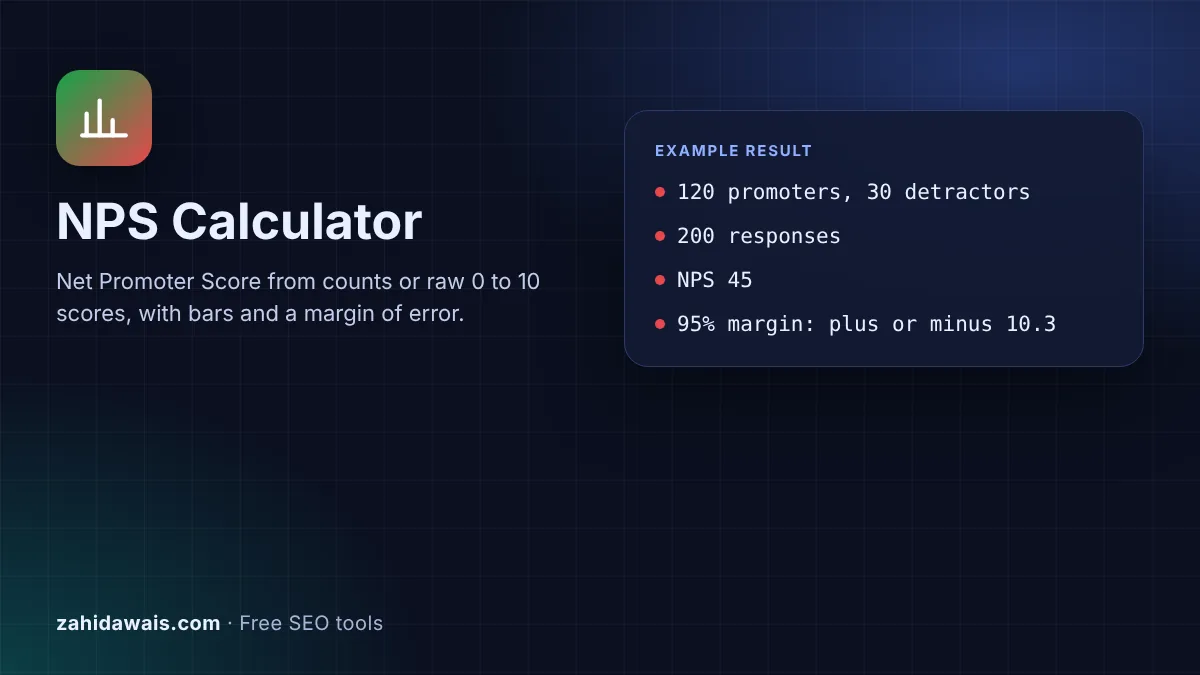
The free NPS calculator turns survey answers to the 0 to 10 "how likely are you to recommend us" question into a Net Promoter Score. Enter the number of promoters, passives and detractors, or paste the raw scores, and it shows the score, the share of each group as bars and a margin of error for your sample size.
Net Promoter Score is the percentage of promoters (scores of 9 or 10) minus the percentage of detractors (0 to 6). Passives (7 or 8) count only in the total. With 120 promoters, 50 passives and 30 detractors out of 200, NPS is 60% - 15% = 45, with a 95% margin of error of about 10 points.
An NPS calculator is a tool that sorts answers to one survey question into three groups and turns them into a single score from -100 to 100. Bain & Company's Net Promoter System site gives the question as "How likely are you to recommend us to a friend or colleague?" and the groups as "Promoters (9 to 10)", "Passives (7 or 8)" and "Detractors (0 to 6)". In Bain's words, "the Net Promoter Score is simply the percentage of promoters minus the percentage of detractors".
The score alone hides how sure you can be, so this calculator adds a margin of error from your sample size. Net Promoter, NPS and Net Promoter System are registered trademarks of Bain & Company, Inc., NICE Systems, Inc. and Fred Reichheld, and Net Promoter Score is their service mark, as the Net Promoter System site states. This free calculator is not connected to them.
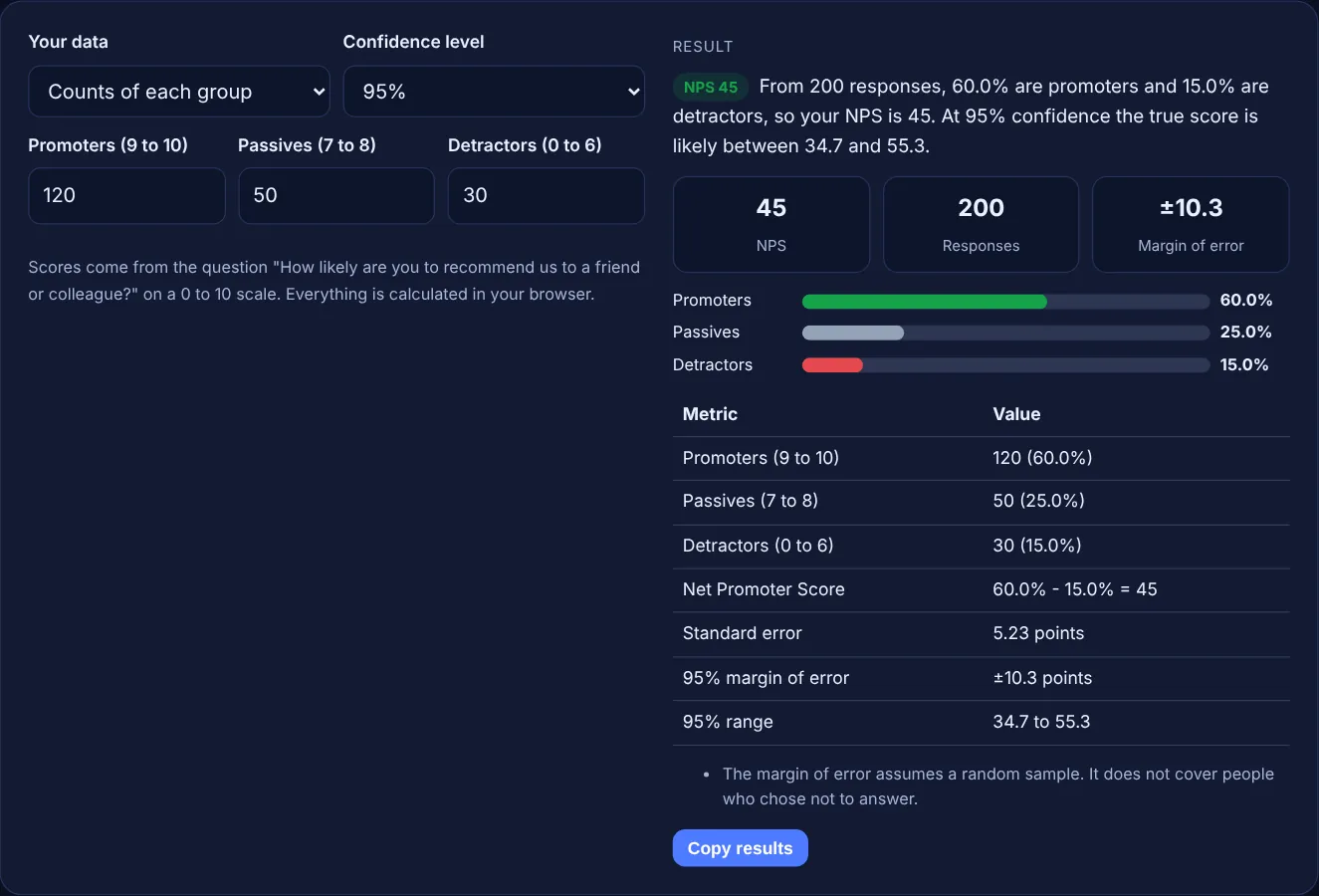
Subtract the percentage of detractors from the percentage of promoters. With 200 responses, 120 promoters are 60.0% and 30 detractors are 15.0%, so NPS = 60.0 - 15.0 = 45. The 50 passives are 25.0% of the sample: they do not appear in the subtraction, but they lower both percentages by adding to the total. NPS is written as a plain number, not a percentage, from -100 when everyone is a detractor to 100 when everyone is a promoter.
Treat each answer as +100 for a promoter, 0 for a passive and -100 for a detractor; NPS is the average of those values. The variance in proportion terms is p + d - (p - d)2, where p and d are the promoter and detractor shares. The standard error is the square root of variance divided by responses, times 100, and the margin of error is that times 1.96 for 95% confidence. For the sample: 0.60 + 0.15 - 0.452 = 0.5475, the square root of 0.5475 / 200 times 100 is 5.23, and 1.96 x 5.23 gives plus or minus 10.3 points.
There is no universal good score, because NPS varies by industry, country, survey channel and timing. A positive score means you have more promoters than detractors. The most useful comparison is with your own earlier scores from the same kind of survey. Before calling a change real, check that the ranges from this calculator do not overlap heavily: a move from 40 to 45 with a margin of 10 points may be noise.
| Item | Rule | Sample (200 responses) |
|---|---|---|
| Promoters | Score 9 or 10 | 120 = 60.0% |
| Passives | Score 7 or 8 | 50 = 25.0% |
| Detractors | Score 0 to 6 | 30 = 15.0% |
| NPS | % promoters - % detractors | 60.0 - 15.0 = 45 |
| Standard error | 100 x square root of (p + d - (p - d)^2) / n | 5.23 points |
| 95% margin of error | 1.96 x standard error | plus or minus 10.3, range 34.7 to 55.3 |
Example: a web design studio surveys 200 past clients. 120 answer 9 or 10, 50 answer 7 or 8 and 30 answer 0 to 6. The calculator shows 60.0% promoters, 25.0% passives and 15.0% detractors, an NPS of 45, a standard error of 5.23 points and a 95% margin of error of plus or minus 10.3, so the true score is likely between 34.7 and 55.3. With only 8 raw scores, say 10, 9, 8, 7, 6, 0, 10 and 5, NPS is 0 and the 99% margin is plus or minus 78.9 points, far too wide to act on.
Passives are not subtracted or added, but they still count in the total number of responses. More passives lower both the promoter and detractor percentages, so they pull the score towards zero without appearing in the subtraction itself.
Yes. When you have more detractors than promoters, the score is below zero. The lowest possible NPS is -100, when every respondent scores 0 to 6, and the highest is 100, when every respondent scores 9 or 10.
There is no fixed number, but the margin of error shrinks as responses grow. With 200 responses in the sample it is about 10 points at 95% confidence. With 8 responses it is about 60 points, so compare scores only when their ranges are narrow.
No. It is calculated from two percentages, but the result is written as a plain number such as 45, not 45%. The scale runs from -100 to 100, which is why a change from 30 to 40 is described as 10 points.
No. A star rating is the average of 1 to 5 scores, so every rating moves it. NPS sorts 0 to 10 answers into three groups and ignores the difference between, say, a 0 and a 6. Use both to understand customers.
No. The calculator runs entirely in your browser with JavaScript. Your counts and raw scores are never uploaded or stored, so you can paste real survey results safely.
Checked 23 Oct 2026. Facts checked against these official pages. Read how I check facts in my editorial policy.
5-star reviews needed to reach a target average, exact and as shown rounded.
CRR from start, end and new customers, implied churn and a period by period retention table.
Customer churn, gross and net revenue churn, and compounded monthly to annual rates.
A percentage change calculator is a tool that shows how much a value grew or shrank relative to where it…
Send your website and I will check it for you, free.
One short email when something new goes live: articles, free SEO tools, package updates, discounts and price alerts. No spam, unsubscribe in one click.