Shipping Details Schema Generator
ShippingService or OfferShippingDetails JSON-LD with rates, free shipping and delivery times.
Describe your returns once and get MerchantReturnPolicy JSON-LD that follows Google's current documentation, with every required property checked.
Mark up the same terms your returns page shows. Nothing you type leaves your browser.
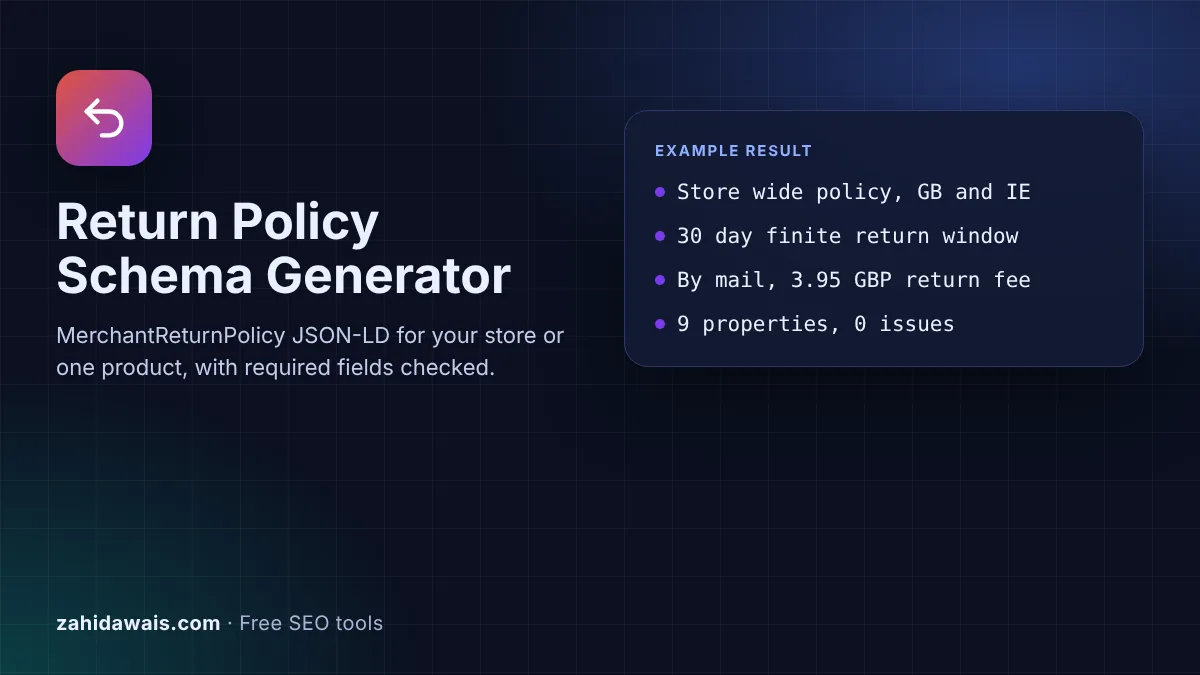
The free merchant return policy schema generator turns your return terms into MerchantReturnPolicy JSON-LD, either for the whole store or as an override for one product. It checks the properties Google requires and runs in your browser, so nothing you type is sent anywhere.
Merchant return policy schema is MerchantReturnPolicy structured data that tells Google your return window, return fees and methods. Google can show this alongside your products and in knowledge panels. Add it once under Organization on your returns page, and use an Offer level policy only for products with different terms.
Merchant return policy schema is structured data built on the schema.org MerchantReturnPolicy type. Google's return policy documentation says Google Search can use it to show return policies "alongside your products and in knowledge panels in Search results".
There are two places to put it. The standard policy goes under your Organization, or a subtype such as OnlineStore, using the hasMerchantReturnPolicy property. A product with different terms gets its own policy inside its Offer, which overrides the store policy for that product. Shipping works the same way, and the shipping policy schema generator builds that half.
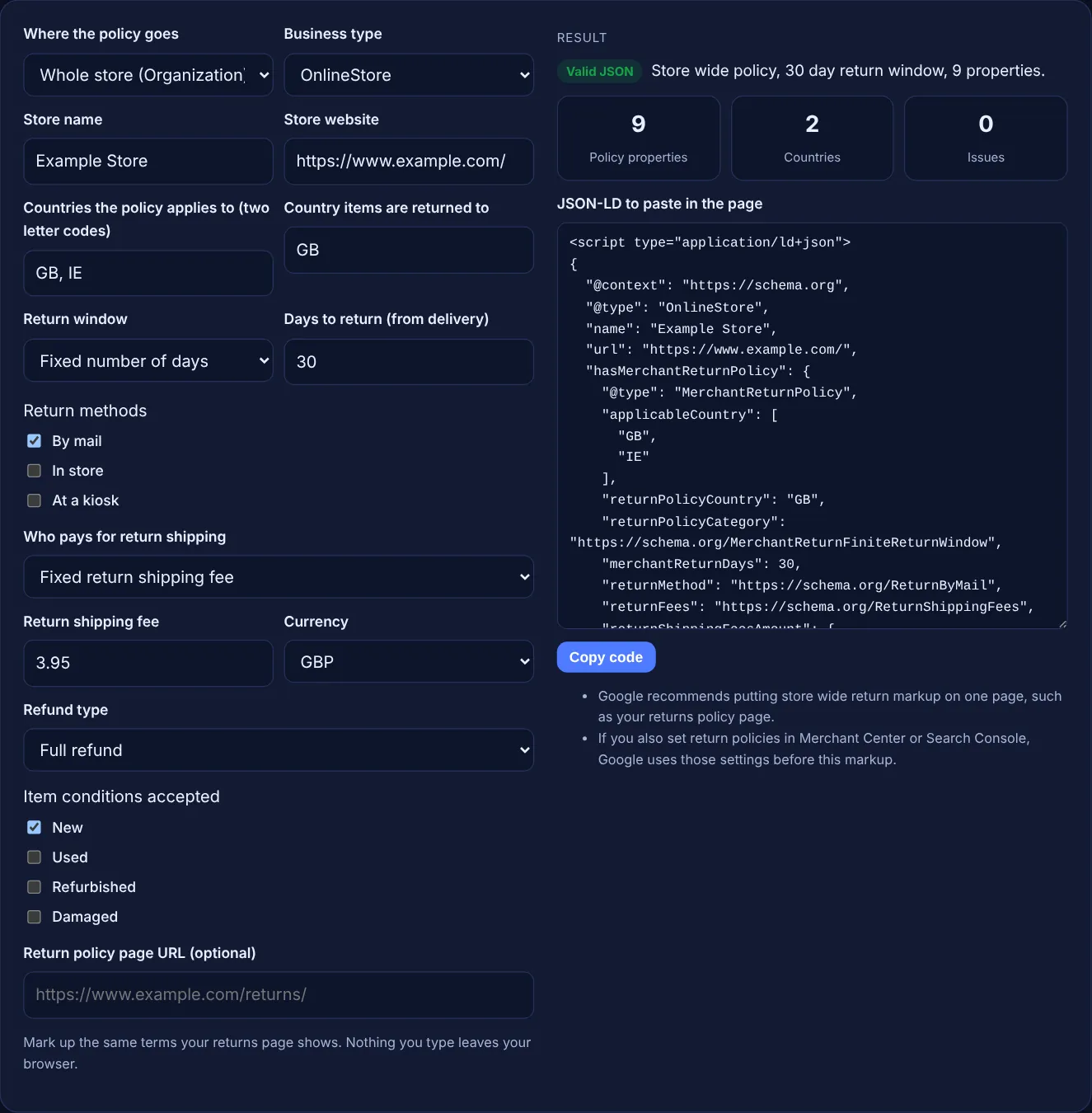
Google gives two options. Either provide applicableCountry and returnPolicyCategory, or provide merchantReturnLink, a URL of a page describing the policy. When the category is a finite window, merchantReturnDays is also required. When returnFees is ReturnShippingFees, add returnShippingFeesAmount; Google says it "must be specified only" in that case. Everything else, such as refundType and returnMethod, is recommended.
Put your standard policy under Organization. Google's merchant listing documentation says "we recommend nesting the MerchantReturnPolicy markup under the Organization type", and that product level policies should only override a standard merchant level policy or be used when you have none. Offer level policies support a smaller set of properties, so this tool leaves out the return country, refund type, item condition and policy link at that level.
Then the Merchant Center settings win. Google lists an order of precedence from strongest to weakest: Content API for Shopping return settings, then settings in Merchant Center or Search Console, then product level merchant listing markup, then Organization level markup. Google even recommends Merchant Center or Search Console when your return details change often. Keep all sources saying the same thing, so whichever Google uses is correct.
| Property | Allowed values | Status in Google's docs |
|---|---|---|
| applicableCountry | ISO 3166-1 alpha-2 codes, up to 50 | Required (option A) |
| returnPolicyCategory | MerchantReturnFiniteReturnWindow, MerchantReturnUnlimitedWindow, MerchantReturnNotPermitted | Required (option A) |
| merchantReturnLink | URL of your returns page | Required (option B) |
| merchantReturnDays | Number of days from delivery | Required for a finite window |
| returnFees | FreeReturn, ReturnFeesCustomerResponsibility, ReturnShippingFees | Recommended |
| returnShippingFeesAmount | MonetaryAmount with value and currency | Only with ReturnShippingFees |
| returnMethod | ReturnByMail, ReturnInStore, ReturnAtKiosk | Recommended |
| refundType | FullRefund, ExchangeRefund, StoreCreditRefund | Recommended |
| itemCondition | NewCondition, UsedCondition, RefurbishedCondition, DamagedCondition | Recommended |
Example: a UK online shop sells to the UK and Ireland, gives customers 30 days from delivery, accepts new items back by mail, charges 3.95 GBP for return shipping and gives a full refund. With the default values above, the tool outputs an OnlineStore block named "Example Store" with a MerchantReturnPolicy of 9 properties: applicableCountry GB and IE, returnPolicyCountry GB, a finite return window, merchantReturnDays 30, ReturnByMail, ReturnShippingFees with returnShippingFeesAmount 3.95 GBP, FullRefund and NewCondition. The result shows 2 countries and 0 issues. If you type "uk, gb, Germany" as the countries and -5 as the days, only GB is kept and the tool reports 3 issues.
Paste the store wide block into the HTML of one page, ideally your returns policy page, which is what Google recommends. For a product with different terms, paste the hasMerchantReturnPolicy property inside that product's Offer in its Product markup.
No. The ISO 3166-1 alpha-2 code for the United Kingdom is GB, and Google asks for ISO codes in applicableCountry. The tool removes UK and tells you to use GB instead, so the markup stays valid.
No. Google requires merchantReturnDays only when the category is MerchantReturnFiniteReturnWindow. For an unlimited window or for returns not permitted, leave it out. The tool removes the field automatically when you change the window.
Yes. Google supports returnPolicySeasonalOverride, with its own returnPolicyCategory and, for a finite window, merchantReturnDays, plus recommended start and end dates. This tool builds the standard policy; add the seasonal override by hand if you need one.
No. The generator runs entirely in your browser with JavaScript. Nothing you type is uploaded or stored, so you can use it for client stores and policies that are not live yet.
Google's documentation says to validate the code with the Rich Results Test and fix any critical errors, then use the URL Inspection tool in Search Console to see how Google reads the live page.
Checked 23 Oct 2026. Facts checked against these official pages. Read how I check facts in my editorial policy.
ShippingService or OfferShippingDetails JSON-LD with rates, free shipping and delivery times.
A product schema generator is a tool that writes schema.org Product structured data. It combines product…
An organization schema generator is a tool that writes schema.org Organization structured data. It gathers…
A JSON-LD validator is a tool that checks structured data written in JSON for Linked Data. It first parses…
Send your website and I will check it for you, free.
One short email when something new goes live: articles, free SEO tools, package updates, discounts and price alerts. No spam, unsubscribe in one click.