Link building strategy
How to Audit Backlinks in a Spreadsheet: Free Steps and Tools
How to audit backlinks in a spreadsheet: export your links, group them by referring domain, check anchors and rel values, flag link…
Read article
AI tools launch fast, and most look alike on the surface. Link building for AI tools is how a new AI product earns the trust signals that help it rank and get recommended. This guide covers the five link sources that work for AI startups and the ones to skip.
AI tool startups earn backlinks from five main sources: quality software directories, comparison and “alternatives” articles, integration partners, guest posts on relevant tech sites, and original data people want to cite. Paid placements must carry rel=”sponsored”. Mass directory submissions and link swaps are spam under Google’s policy.
Link building is harder for AI tools because many products in the same category look similar, launch in the same month and pitch the same sites. Editors receive a flood of requests and ignore the generic ones.
New AI products also face a trust gap. A buyer, a journalist or a blogger wants to know the tool is real, maintained and safe with their data. A link from a known site helps close that gap.
A few terms shape the rest of this guide:
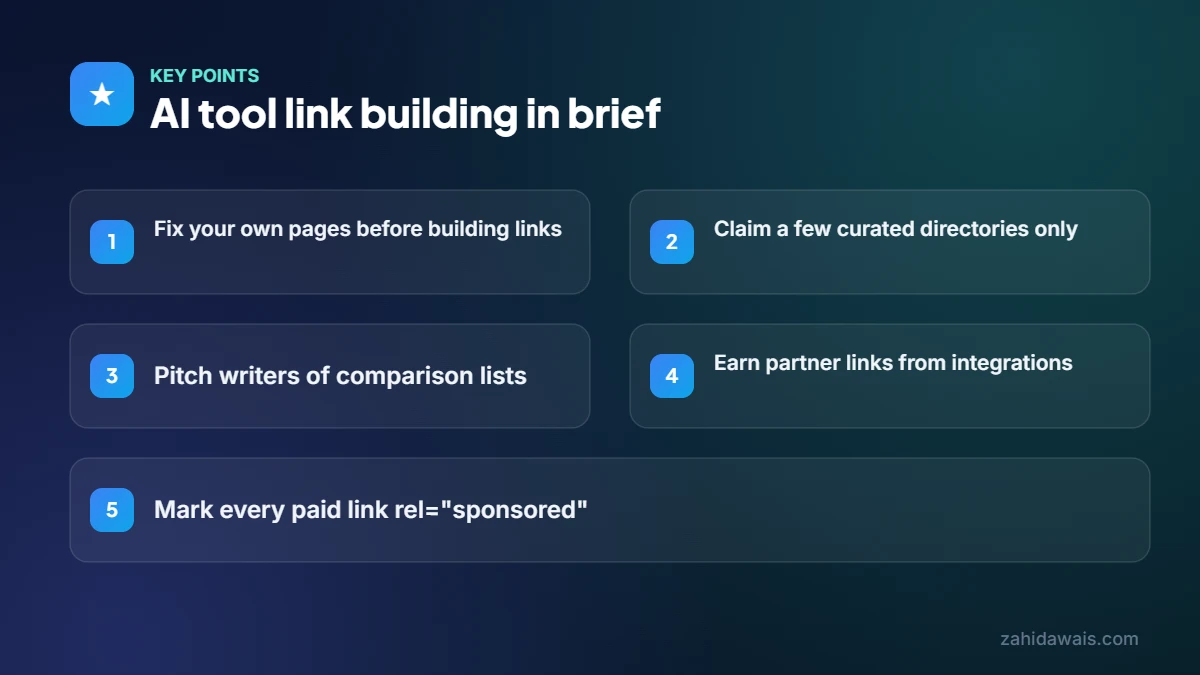
Five link sources work well for AI tools: directories, comparison content, integrations, guest posts and original data. Each one fits a different stage of the product, and each earns a different kind of link.
The table compares them.
| Source | Best stage | Effort | Main value | Watch out for |
|---|---|---|---|---|
| Curated software directories | Launch | Low | Discovery, referral traffic, brand entity | Low quality directory networks |
| Comparison and alternatives articles | After first users | Medium | Buyer traffic, inclusion in shortlists | Paid inclusion without rel=”sponsored” |
| Integration partners | Once you connect to other apps | Medium | Relevant links from trusted product sites | Listings with no page about your tool |
| Guest posts on tech sites | Any stage | Medium | Topic relevance, authority, anchor control | Sites that publish anything for anyone |
| Original data and tools | Once you have usage or test data | High | Editorial links that keep coming | Claims you cannot back up |
Directories. Pick a small number of curated AI and software directories that review submissions and have real visitors. Google’s spam policies list “Low-quality directory or bookmark site links” as an example of link spam, so a bulk submission package does more harm than good.
Comparisons. Writers who publish “best AI tools for X” lists update them often. Send a short, honest note with what your tool does, who it suits and a free trial for testing. Review sites like Capterra and G2 also help with comparison visibility, which I cover in a separate post on review site backlinks.
Integrations. If your tool connects to a popular app, that app may have a marketplace or partner page. These links are relevant by nature. Build a matching integration page on your own site so both pages support each other.
Guest posts. A practical article on a relevant tech or business blog puts your tool in front of the right readers. Check the site first, using the steps in my guide on how to check guest post site quality.
Original data. AI tools often have something other sites lack: test results, benchmarks or anonymised usage patterns. Google asks whether content provides “original information, reporting, research, or analysis.” A clear data page with a method section gives writers a reason to cite you.
Plan it in five steps: fix your own pages first, claim a few curated listings, pitch comparison writers, publish one linkable asset, then add relevant guest posts. Doing them in that order means every link lands on a page worth visiting.
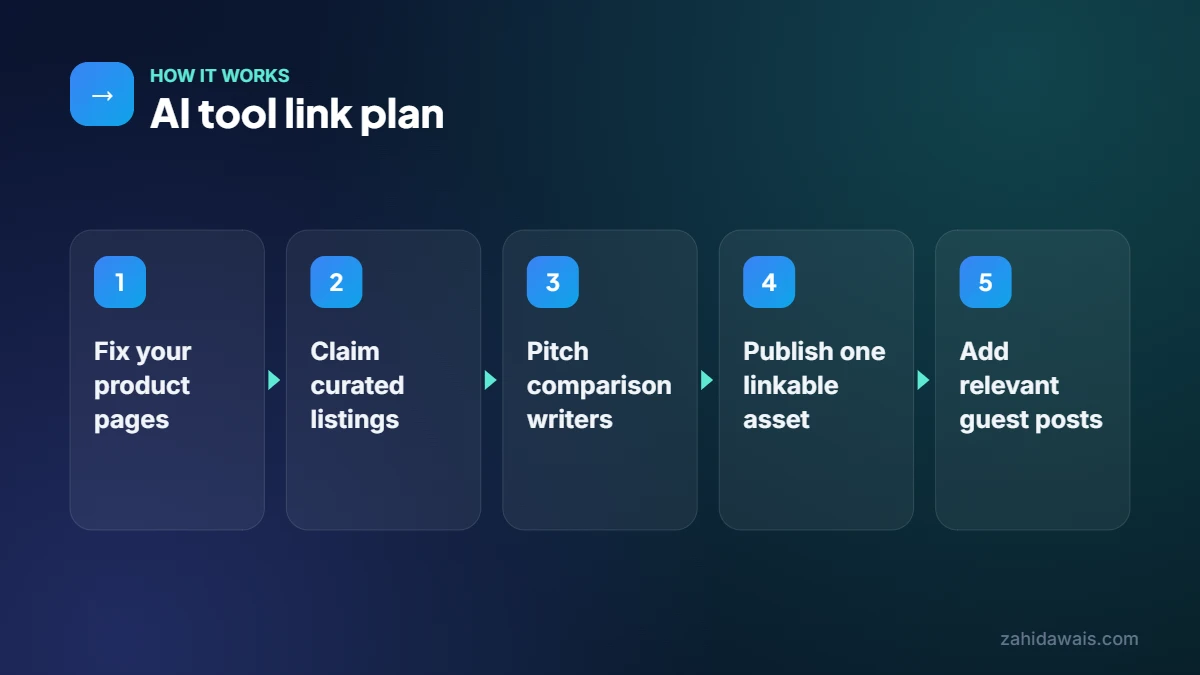
Spread the work over months, not days. A sudden burst of links to a brand new domain looks odd and adds risk. Steady, relevant growth is safer and easier to measure.
Illustrative example only. ExampleWrite, a made up AI writing assistant at examplewrite.com, launches with a homepage and a blog. It has no integration pages and no public pricing.
Month one: it adds pricing, three use case pages and an integration page for its browser extension, then claims four curated directory listings. Month two: it pitches ten writers who already rank for “AI writing tools for marketers” and offers trial accounts. Month three: it publishes a small test of how its tool handles 50 sample briefs, with the method and limits stated, and places two guest posts on relevant marketing blogs that link to the test. Each link points to a page that answers a buyer’s question.
Yes, AI startups can pay for placements, but paid links must be marked with rel=”sponsored”. Google’s spam policy accepts paid links for advertising or sponsorship “as long as they are qualified with a rel=”sponsored” attribute value.”
This applies to sponsored reviews, paid inclusion in “best tools” lists and sponsored newsletter mentions. Google’s guide on qualifying outbound links says to mark links that are “advertisements or paid placements” as sponsored.
Avoid these common shortcuts:
Backlinks help indirectly. Google says pages must be “indexed and eligible to be shown in Google Search with a snippet” to appear as supporting links in AI Overviews or AI Mode. Links help pages get found and trusted in that regular search system.
Google’s AI features guide also states there are “no additional requirements to appear in AI Overviews or AI Mode.” So there is no special AI link tactic. The same relevant links and clear pages that help classic rankings are the base.
Mentions matter alongside links. When comparison articles, reviews and partner pages describe your tool in the same words, AI tools have consistent text to draw on. I explain the difference in brand mentions vs backlinks.
Measure link building by the pages it supports: rankings for target queries, referral visits, sign ups from organic search and how often your tool appears in comparison lists. Link counts alone say little.
SEO results usually take 3 to 6 months. Links to specific pages, such as an integration page, often show movement before broad category terms do.
If you want a plan built around your product stage, my link building for startups service covers AI tools too.
A few curated ones are. Choose directories that review submissions, have real visitors and show a proper page for your tool. Avoid bulk packages that submit to hundreds of sites, since Google names low quality directory links as an example of link spam.
There is no fixed number. It depends on your category and the pages that already rank. Start with a handful of relevant links to your most important pages, then compare your profile with the pages above you for each target query.
Editorial links in a comparison list can be followed when the writer chose to include you freely. If you paid for inclusion, the link should carry rel=”sponsored”. Google’s link spam policy treats unmarked paid links meant to pass ranking signals as spam.
Occasional natural links between related products are fine. Planned swaps for ranking are not. Google lists excessive link exchanges, such as link to me and I will link to you, as an example of link spam.
Mostly your brand name, plain URLs and natural phrases. Use descriptive anchors that match the page, such as an integration or use case name. Avoid repeating one exact match keyword across many links, as it looks unnatural.
I build links for legal AI products worldwide, including writing, marketing, coding and business tools. I do not take gambling, casino, betting or other illegal niches. Every link comes with a refund if it does not go live.
Facts checked against these official pages. Read how I check facts in my editorial policy.
How to audit backlinks in a spreadsheet: export your links, group them by referring domain, check anchors and rel values, flag link…
Read article
Capterra and G2 backlinks explained: what review site links are, what the platforms' own docs say about paid links, and their value…
Read article
A gap analysis shows which sites link to several competitors but not to you. The skill is filtering that list into real opportunities.
Read articleSend your website and I will reply with a free audit.