Link building strategy
How to Find the Right Email for Link Outreach (Without Spamming)
How to find the right email for link outreach: shortlist sites, find the editor, confirm the address format and stay within CAN-SPAM…
Read articleToo many exact keyword anchors is one of the fastest ways to make a link profile look built. Here are the anchor types, a safe starting mix and how to check yours.
This guide shows how to plan a safe anchor text ratio for your backlinks, with real examples and a free calculator. It is part of my link building guide.
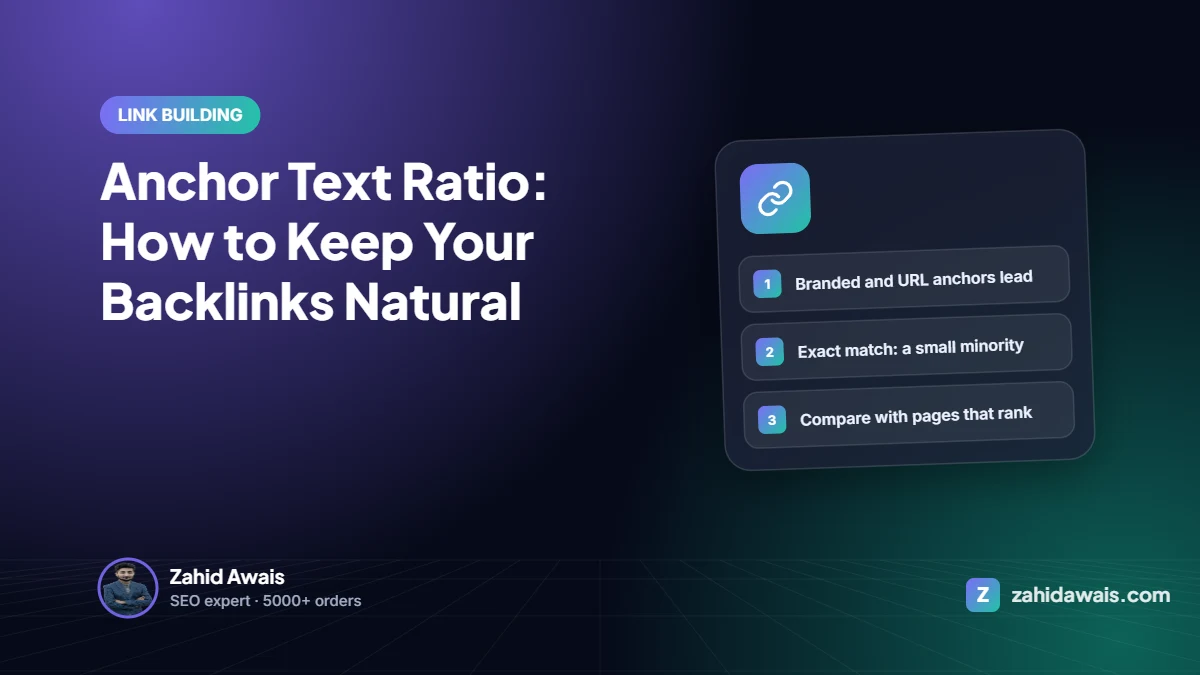
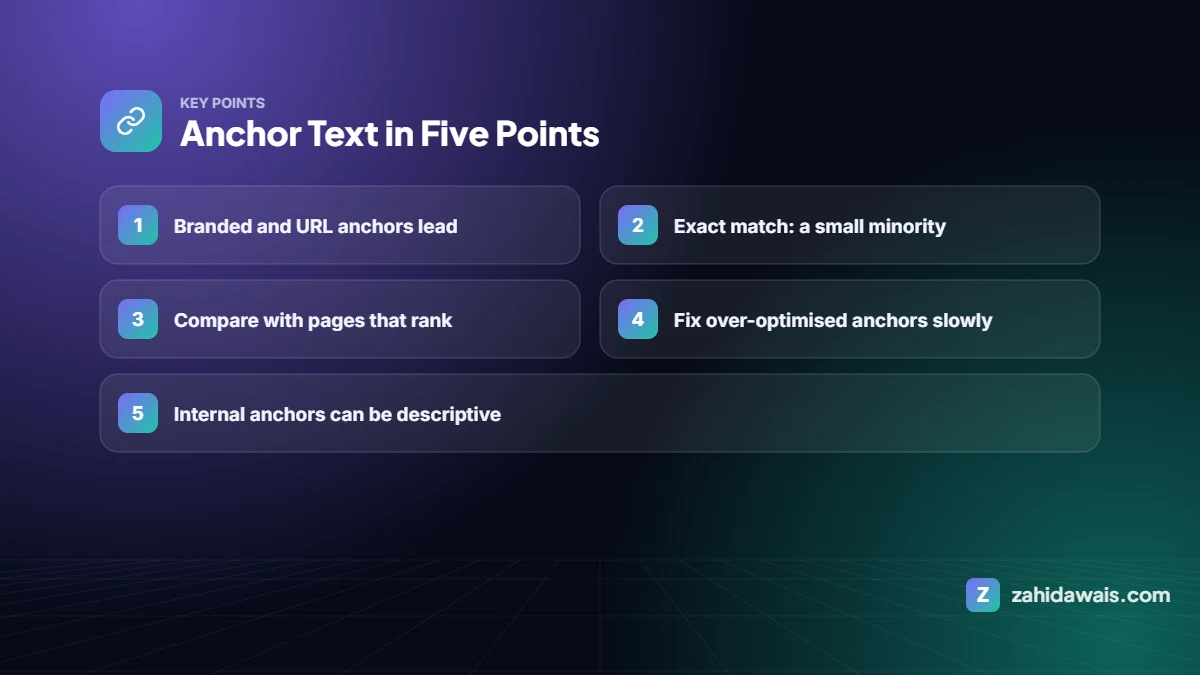
There is no official “safe” anchor text ratio. A natural profile is led by branded and URL anchors, with smaller shares of partial match, generic and exact match anchors. As a starting point, keep exact match keywords to a small minority of your links and compare your mix with the pages that already rank.
Anchor text is the clickable text of a link. In <a href="https://zahidawais.com/">Zahid Awais</a> the anchor is “Zahid Awais”. Google uses anchor text to understand what the linked page is about. Its own documentation asks site owners to write descriptive, natural anchor text, which is exactly why unnatural anchors stand out.
| Type | Example (target: running shoes page) | Risk |
|---|---|---|
| Branded | Nike, Zahid Awais | Very low |
| Naked URL | zahidawais.com, https://example.com/shoes/ | Very low |
| Brand + keyword | Nike running shoes | Low |
| Partial match | shoes for long distance running | Low to medium |
| Generic | this guide, read more, website | Low |
| LSI / related | marathon trainers, jogging footwear | Low |
| Exact match | best running shoes | High if overused |
Real people link with brand names, URLs and whatever words fit their sentence. They almost never all use your money keyword. When most links to a page use the same commercial phrase, it is a classic sign of manipulated links, and Google’s spam policies name keyword-rich anchor links in articles and guest posts as an example of link spam.
In the audits I run for new clients, over-optimised anchors are one of the most common problems I find after a site drops, often from older link building done before they came to me.
These ranges are not Google rules. They are a practical starting point I use for a normal business website. Always adjust to what the top ranking pages in your niche look like.
| Anchor type | Homepage | Inner money page | Blog article |
|---|---|---|---|
| Branded + naked URL | 60 to 75% | 30 to 45% | 25 to 40% |
| Partial match + related | 10 to 20% | 25 to 35% | 30 to 40% |
| Generic | 5 to 15% | 10 to 15% | 10 to 20% |
| Exact match | 0 to 5% | 5 to 10% | 5 to 10% |
A service page with 30 linking domains could have 11 branded or URL anchors, 9 partial match (“plumbing repair in Leeds”), 4 generic (“their website”), 3 related (“boiler repair experts”) and 3 exact match (“emergency plumber Leeds”). That page has keyword signals without looking forced.
Internal links are different. Google wants descriptive anchor text on your own site, and using the page’s main topic words in internal links is normal and helpful. Just avoid stuffing and vary the wording naturally. My internal linking strategy guide covers this in detail.
For every link building order, I plan the anchor for each link before outreach. The client gets a sheet with the target URL, the anchor type and the exact words, so the overall mix stays natural even after many months of links. If you order links anywhere, ask your provider for the same plan.
I have placed 5000+ links for clients, including brands like Capterra UK, Adobe and OKX. I only use real sites with real traffic, and every link is checked live for 6 months.
There is no official number. Most natural profiles are led by branded and URL anchors, with exact match anchors as a small minority. Compare with pages that already rank for your keyword.
Using too many exact match anchors, especially on paid or low quality links, is a common sign of link spam and can lead to a ranking drop or a manual action.
Google uses anchor text to understand what the linked page is about, so it still matters. Natural, descriptive anchors work best.
No. Mix branded, URL, partial match and generic anchors. Use exact match only for a small share of links.
Not in the same way. Descriptive internal anchors are recommended by Google. Just keep them natural and varied.
Facts checked against these official pages on 10 October 2026. Read my editorial policy.
How to find the right email for link outreach: shortlist sites, find the editor, confirm the address format and stay within CAN-SPAM…
Read article
How to audit backlinks in a spreadsheet: export your links, group them by referring domain, check anchors and rel values, flag link…
Read article
Capterra and G2 backlinks explained: what review site links are, what the platforms' own docs say about paid links, and their value…
Read articleSend your website and I will reply with a free audit.