SaaS SEO Services for B2B Software Companies Worldwide
SaaS SEO services for B2B software: feature, integration, comparison and pricing pages, a keyword funnel, a content plan and relevant links. Get a quote.
Software buyers search for a problem, then a category, then a shortlist, then a price. My SaaS SEO services build pages for each of those moments and support them with relevant links. I have worked in SEO and link building since 2020 and have placed links for software brands such as Capterra UK and Adobe.
SaaS SEO is search optimization for subscription software. It maps keywords to the buyer journey, builds feature, integration, comparison, use case and pricing pages, publishes helpful content, fixes technical issues and earns relevant links. The goal is qualified sign ups and demo requests, not just traffic.
What is SaaS SEO and how is it different?
SaaS SEO is SEO for software sold on a subscription, where the goal is trials, demos and sign ups. It differs from ecommerce or local SEO because the buyer often takes weeks to decide and talks to a team first.
A B2B software buyer rarely searches for your brand on day one. They search for a pain point. Later they search for a category, then for "best" lists, then for direct comparisons. Only near the end do they search for pricing and reviews.
That means a B2B SaaS SEO agency has to think in stages, not single keywords. A blog post alone will not win a buyer who is comparing two tools. A pricing page alone will not reach a buyer who does not know your category exists yet.
Three ideas shape the work:
- Search intent: the reason behind a query. "What is churn" is learning. "Churn software for Shopify" is buying.
- Topical authority: covering a subject in depth so search engines see you as a reliable source. I explain it in my guide to topical authority.
- Entities: the named things Google understands, such as your product, your category and the tools you integrate with.
Google says its people-first content guidance means content "created primarily for people, and not to manipulate search engine rankings." That rule fits SaaS well. Buyers can smell a thin page, and so can search systems.
Which SaaS page types should you build?
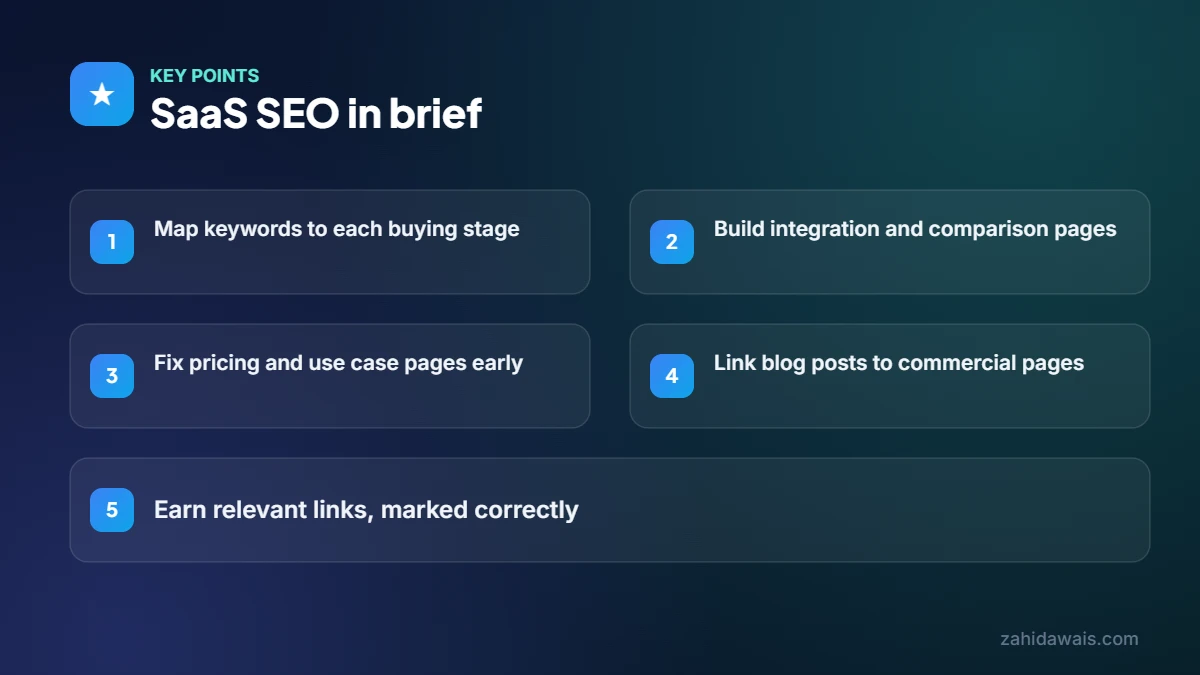
Most software companies need five commercial page types: feature pages, integration pages, comparison pages, use case pages and a pricing page. Each one matches a different search and a different buying question.
The table shows what each page does and the kind of query it targets.
| Page type | Buyer question | Example query shape | What it must include |
|---|---|---|---|
| Feature page | Can it do this job? | [category] with [feature] | What the feature does, screenshots, limits, who it suits |
| Integration page | Does it work with my stack? | [your tool] [other tool] integration | Setup steps, data that syncs, plan needed, help doc link |
| Comparison page | Why you and not them? | [your tool] vs [rival], [rival] alternative | Fair side by side facts, who each tool suits, dated checks |
| Use case page | Is it built for my role or industry? | [category] for [industry or team] | Real workflow, the problem solved, relevant features |
| Pricing page | What will it cost and what do I get? | [your tool] pricing, plans | Clear plan names, limits, FAQs, trial or demo path |
Integration pages are often the quickest wins. Their queries are specific, buyers who search them already use the partner tool, and few sites write useful pages for them. One page per real integration, with setup steps, beats one long list.
Comparison pages need care. Keep claims about other products factual and dated, and link to the source when you can. A fair page earns more trust than a one sided one, from readers and from review teams alike.
Pricing pages are part of SEO too. Buyers and AI tools both look for plan names, limits and what each plan includes. If that detail is hidden behind a form, someone else's page will answer the question instead.
How do you build a SaaS keyword funnel?
You build a SaaS keyword funnel by sorting every target query into top, middle or bottom of funnel, then giving each stage its own page type and goal. Bottom of funnel pages come first because they convert soonest.
- Bottom of funnel (BOFU): pricing, "vs" queries, alternatives, integrations, reviews. Small volume, high intent. Goal: demo or trial.
- Middle of funnel (MOFU): "best [category] for [use]", use cases, feature questions, templates. Goal: shortlist your product.
- Top of funnel (TOFU): problem and how to questions. Large volume, low intent. Goal: teach, build authority and collect links.
Software company SEO often fails because it starts at the top. A team writes 50 broad blog posts, gets traffic, and sees few sign ups. I reverse the order. First the pages a ready buyer needs, then the pages that create new buyers.
Every keyword gets one primary page. Two pages chasing the same query split signals and confuse readers. A simple keyword map, a spreadsheet with query, intent, stage and URL, prevents that.
What does the SaaS SEO process look like?
My process has five steps: audit, keyword map, commercial pages, content plan, then links and measurement. Each step builds on the one before, so results compound instead of resetting every month.
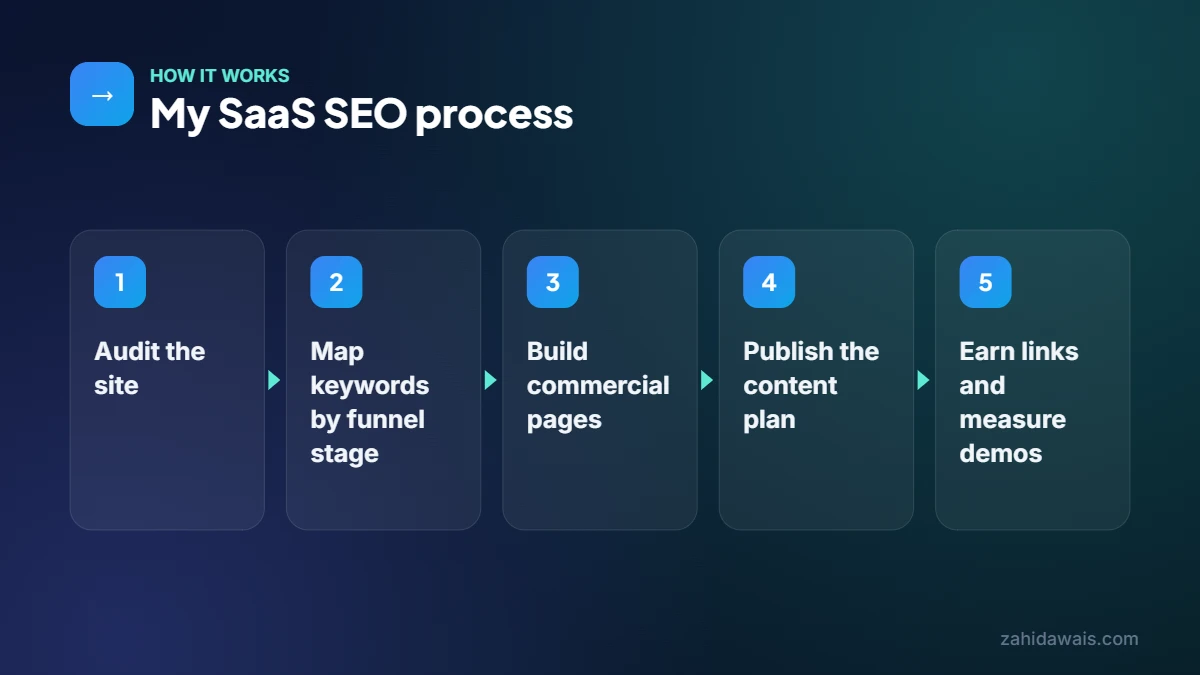
- Audit: crawl the site, check indexing, speed, internal links and duplicate pages. Many SaaS sites have app subdomains, docs and marketing pages that compete with each other. My technical SEO work covers this.
- Keyword map: group queries by stage and assign one URL to each group.
- Commercial pages: fix or build feature, integration, comparison, use case and pricing pages first.
- Content plan: publish middle and top of funnel articles that link to those commercial pages.
- Links and measurement: earn relevant links, then track rankings, sign ups and demo requests by page.
Google says it "primarily finds pages through links from other pages it already crawled." So internal links matter as much as new pages. Every new article should point to the feature or use case page it supports, with descriptive anchor text.
Illustrative example only. ExampleDesk, a made up help desk tool at exampledesk.com, has a blog with 80 broad posts and almost no demo requests from search. Its integration list is one page with 30 logos and no text.
The plan: write 10 integration pages for its most used connections, each with setup steps and a help doc link. Add 3 comparison pages against named alternatives with dated facts. Rewrite the pricing page with plan limits and FAQs. Then link every related blog post to those pages and earn a few relevant links to the integration and comparison pages. Progress is judged by demo requests from organic search, not by blog traffic.
What goes into a SaaS content marketing and SEO plan?
A SaaS content marketing and SEO plan lists the articles you will publish, the commercial page each one supports, the expert who reviews it and the month it goes live. It turns the keyword map into a calendar.
Good SaaS content uses what only your company has. That might be product screenshots, support ticket themes, setup steps, or anonymised usage patterns. Google asks whether content provides "original information, reporting, research, or analysis." Your product team is a source no other site can copy.
A plan I build usually includes:
- Pillar pages for each core problem your product solves.
- Cluster articles that answer narrower questions and link back to the pillar.
- Templates and checklists that buyers can use today.
- Glossary pages for category terms your buyers search.
- Refresh dates for comparison and pricing pages, since facts change.
I can write the articles myself through my content writing services, or brief your team. Either way, a subject expert should check product claims before they go live. That supports E-E-A-T, which stands for experience, expertise, authoritativeness and trust.
AI search is part of the plan too. Google states there are "no additional requirements to appear in AI Overviews or AI Mode." Clear, well structured pages that already rank well are the base. For deeper work on ChatGPT and Perplexity visibility, see my GEO services.
How do links fit into SaaS SEO?
Links help SaaS pages get found and trusted, but they work best after the commercial pages and content are in place. A link to a thin page wastes the link.
For software, the most useful links come from sites your buyers already read: industry blogs, partner sites, integration directories and relevant publications. I usually point links at integration, comparison and use case pages, plus a few strong guides.
Paid placements must follow Google's rules. Google's spam policy allows paid links for advertising or sponsorship "as long as they are qualified with a rel="sponsored" attribute value." I follow that rule and do not sell links meant to pass ranking signals while hiding that they were paid for.
My SaaS guest posts service places articles on niche relevant tech and business sites. Every link comes with a full refund if it does not go live, and a free replacement if it is removed within 12 months.
For proof of how I work with software brands, read the Capterra UK case study. I have completed 5000+ orders across marketplaces, with a 4.98/5 rating from 5160 assessments on Adsy.
Tell me your product, your main competitors and your target market, and I will send a SaaS SEO plan with a quote.
Request a quote or chat on WhatsApp. Replies within 24 hours.
Frequently asked questions
How long does SaaS SEO take to show results?
SEO results usually take 3 to 6 months to show. Bottom of funnel pages such as integrations and comparisons often move first because they target specific queries. Competitive category terms take longer. I report progress monthly so you can see which pages are gaining.
Do you work with early stage SaaS startups?
Yes. Early stage products often benefit most from integration, comparison and use case pages because those target specific searches with less competition. I also offer link building for startups when the site needs authority before content can rank.
Should comparison pages name competitors?
Yes, buyers search for named alternatives, so comparison pages should name them. Keep every claim factual, dated and fair. Link to the other product's own pricing or feature page where possible, and update the page when facts change.
Do you build links to pricing pages?
Rarely. Pricing pages usually rank on brand searches already. I point most links at integration, comparison, use case and guide pages, then pass value to pricing through internal links. This keeps the link profile natural and the anchors varied.
Can you work with our in house content team?
Yes. I can supply the keyword map, page briefs and internal linking plan while your team writes. Or I write the drafts and your product experts review them. Both models work, as long as someone checks product claims before publishing.
Do you work on any software niche?
I work on legal software niches worldwide, including B2B tools, marketing software, AI products and fintech tools. I do not take gambling, casino, betting or other illegal niches, and that rule applies to SaaS products in those spaces too.
Sources
Facts checked against these official pages. Read how I check facts in my editorial policy.
Link building by industry, country and for agencies
Pick the page that fits your business to see how links are planned, which sites fit and what it costs.