Link building strategy
How to Audit Backlinks in a Spreadsheet: Free Steps and Tools
How to audit backlinks in a spreadsheet: export your links, group them by referring domain, check anchors and rel values, flag link…
Read articleA gap analysis shows which sites link to several competitors but not to you. The skill is filtering that list into real opportunities.
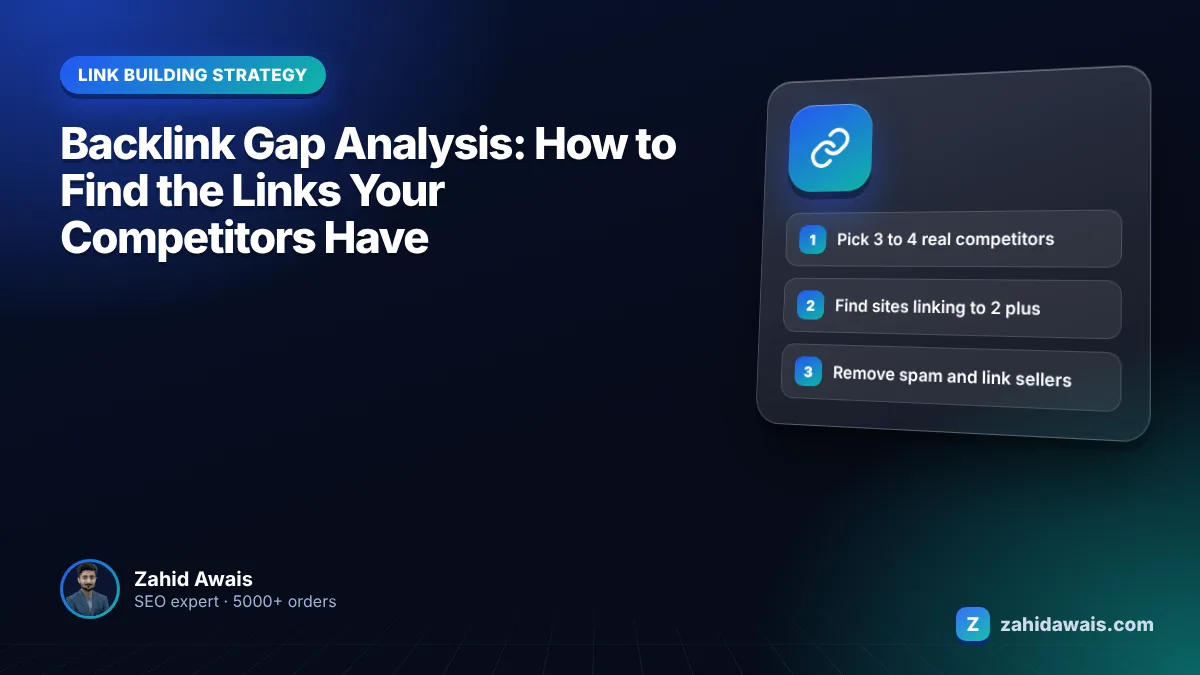
This guide walks you through a backlink gap analysis from start to finish: choosing the right competitors, pulling and filtering their links, scoring each opportunity, and deciding which ones to pursue first without copying their spam.
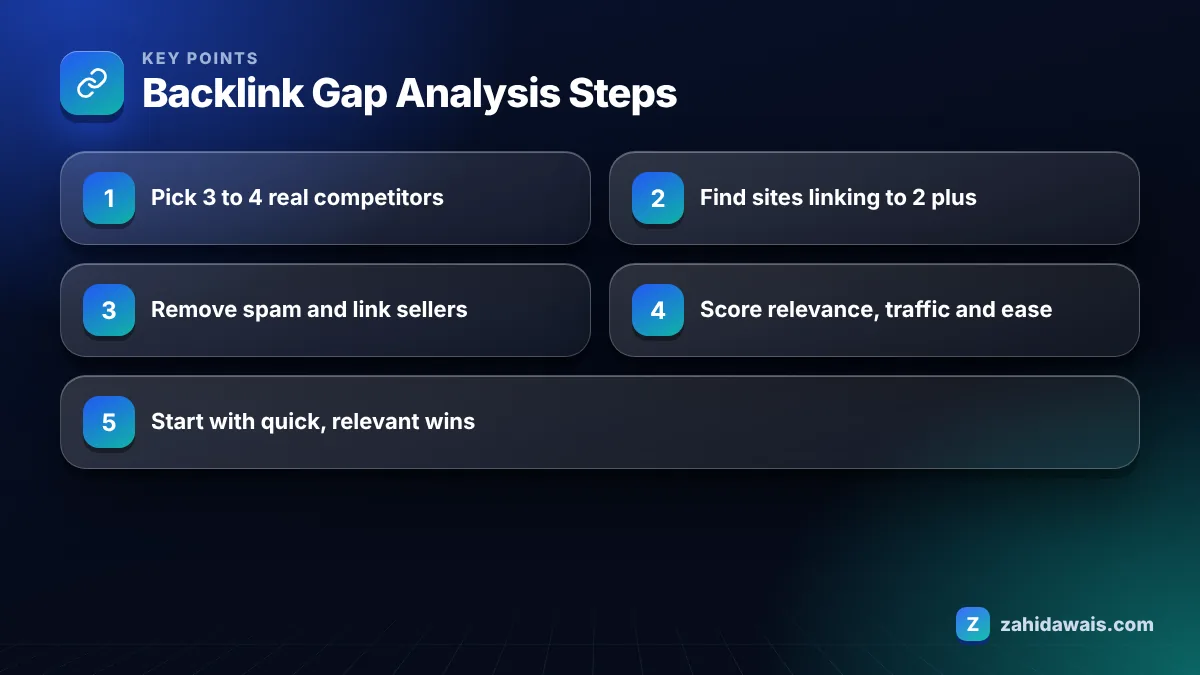
A backlink gap analysis compares the sites linking to your competitors with the sites linking to you, and lists domains that link to two or more competitors but not to you. Those overlaps are your most realistic opportunities. Filter out spam and paid networks, then prioritize relevant sites with real traffic and a clear way to earn a link.
A link gap analysis is a comparison of referring domains between your site and several competitors that reveals which sites link to them but not to you. It turns a vague goal, “get more links”, into a specific list of sites that already link to businesses like yours.
The logic is simple. A site that links to three of your competitors has shown that it covers your topic and links out to businesses in your space. That makes it a far warmer prospect than a random site found through a “write for us” search.
Gap analysis is not about copying every competitor link. Some of their links will be paid placements, network sites or old directory spam. Google’s link spam policies apply to you whatever your competitors do, so the filtering step is where the real work happens.
You find your competitors’ backlinks with a third party backlink tool, since Google Search Console only shows links to sites you own. Most major SEO tools have a backlink gap or link intersect feature that compares up to several domains at once.
Search Console still plays a part. Its Links report shows your own top linking sites, which you need for the “not linking to you” side of the comparison. Google notes the report is a sample, so combine it with your tool’s data for a fuller picture.
Choose competitors carefully. The right ones are the sites ranking for your target keywords, not necessarily the biggest brands in your industry. A local accountant should compare with other accountants ranking in the same city, not with a national firm.
You filter a backlink gap list by removing spam, networks and irrelevant sites first, then sorting what remains by relevance, real traffic and how the link was obtained. A raw export of 500 domains often shrinks to 40 to 80 real opportunities in my experience.
Remove these straight away:
Then open the linking pages of what is left. How the competitor earned the link tells you how to approach it.
| Link type found | How to pursue it | Effort | Typical value |
|---|---|---|---|
| Industry directory or association | Apply or join | Low | Medium, high relevance |
| Resource or “useful links” page | Suggest a genuinely useful page of yours | Low to medium | Medium |
| Guest post on a niche blog | Pitch your own topic | Medium | Medium to high |
| News or expert quote | Offer expert comment on future stories | Medium | High |
| Listicle or comparison (“best X tools”) | Ask to be reviewed or included | Medium | High for commercial pages |
| Link to a competitor’s data or tool | Create a better resource and share it | High | High and lasting |
| Paid placement or network site | Skip, or buy only with rel=”sponsored” | Varies | Low ranking value |
Target first the domains that link to the most competitors, are closely relevant to your niche, and have a clear, low effort way to earn a link, such as a directory, association or resource page. These quick wins build momentum while you work on harder pitches.
I score each opportunity from 1 to 3 on four points and sort by the total:
Anything scoring 10 or more goes into the first month’s outreach. If you are unsure how to judge site quality, my link building guide explains the vetting checks in detail.
You pitch gap sites by referencing what they already link to and offering something that fits the same purpose, because the existing competitor link shows exactly what kind of content the editor values. A pitch built on that insight reads as relevant rather than random.
For a resource page that lists competitors’ guides, point to your guide and explain in one sentence what it adds, such as updated prices or a checklist. For a “best of” list, ask to be considered and share the facts the author would need: what you offer, who it suits and a short honest comparison. For a news site, offer a quotable expert opinion on a topic they cover regularly.
Keep each email short and personal:
Expect a modest reply rate. Even a handful of yes answers from a well filtered list beats a large batch of cold pitches to sites that have never covered your topic. Track every pitch in the same sheet as your gap list so you never contact the same editor twice by mistake.
Here is a worked example for a dental clinic. The gap tool compares the clinic with 3 local competitors and returns 412 domains linking to at least one competitor. Filtering to 2 or more competitors leaves 96. Removing spam, scrapers and link sellers leaves 41. Scoring them: 9 score 10 or more (4 local business directories, 2 dental associations, a city health guide, a university outreach page and a local news site). The clinic joins the associations and directories in month 1, suggests its “emergency dentist checklist” to the health guide, and offers an expert quote to the news site. Result after 6 weeks: 7 new relevant referring domains, all with a clear reason to exist. The remaining 32 opportunities become the plan for the next quarter.
The biggest mistake is treating the gap list as a shopping list and buying the same paid links competitors have, because a competitor’s risky link does not become safe when you copy it. Other common mistakes:
Repeat the analysis every quarter, since competitors gain new links all the time. If you prefer to hand the research and outreach to someone experienced, my off-page SEO service includes a full gap analysis, and the placements are delivered through my link building service with every live URL reported for you to check.
No. Search Console only shows link data for properties you have verified. To see a competitor’s backlinks you need a third party backlink tool. Use Search Console for your own links, then compare against the competitor data from the tool.
Three to four direct competitors usually works best. Fewer gives limited overlap; more produces long lists full of noise. Pick sites that rank for your target keywords and are similar in size and business type, not the biggest names in the industry.
Only if the links themselves are legitimate. Directories, associations, resource pages and editorial mentions are fine. Paid placements need rel=”sponsored” or nofollow under Google’s policies, and network or spam links carry risk regardless of who else has them.
Every three months is a practical rhythm for most small and mid-size sites. Competitors gain and lose links constantly, and a quarterly check surfaces new opportunities such as fresh listicles, news stories or resource pages in your niche.
A backlink gap compares which sites link to competitors but not to you. A content gap compares which topics or keywords competitors rank for that you do not cover. Both work well together, since new content often creates new link opportunities.
For a full comparison, yes, because you need link data for competitor domains you do not own. Many tools offer limited free checks or trials. You can also do a rough manual version by searching competitor brand names to find mentions and listings.
Facts checked against these official pages. Read how I check facts in my editorial policy.
How to audit backlinks in a spreadsheet: export your links, group them by referring domain, check anchors and rel values, flag link…
Read article
Capterra and G2 backlinks explained: what review site links are, what the platforms' own docs say about paid links, and their value…
Read article
Link building for AI tools: how AI startups earn backlinks from directories, comparison lists, integrations, guest posts and original data, without spam.
Read articleSend your website and I will reply with a free audit.