Htaccess Redirect Generator
An htaccess redirect generator is a tool that converts old and new URLs into Apache directives such as…
Type any status code to see what it means and exactly how Google treats it.
Type a 3 digit code for a full answer, or a word such as "redirect", "gone" or "maintenance" to search. Clear the box to see every code.
| Code | Name | What Google does |
|---|
The free http status codes runs in your browser, needs no sign-up and never sends what you type anywhere.
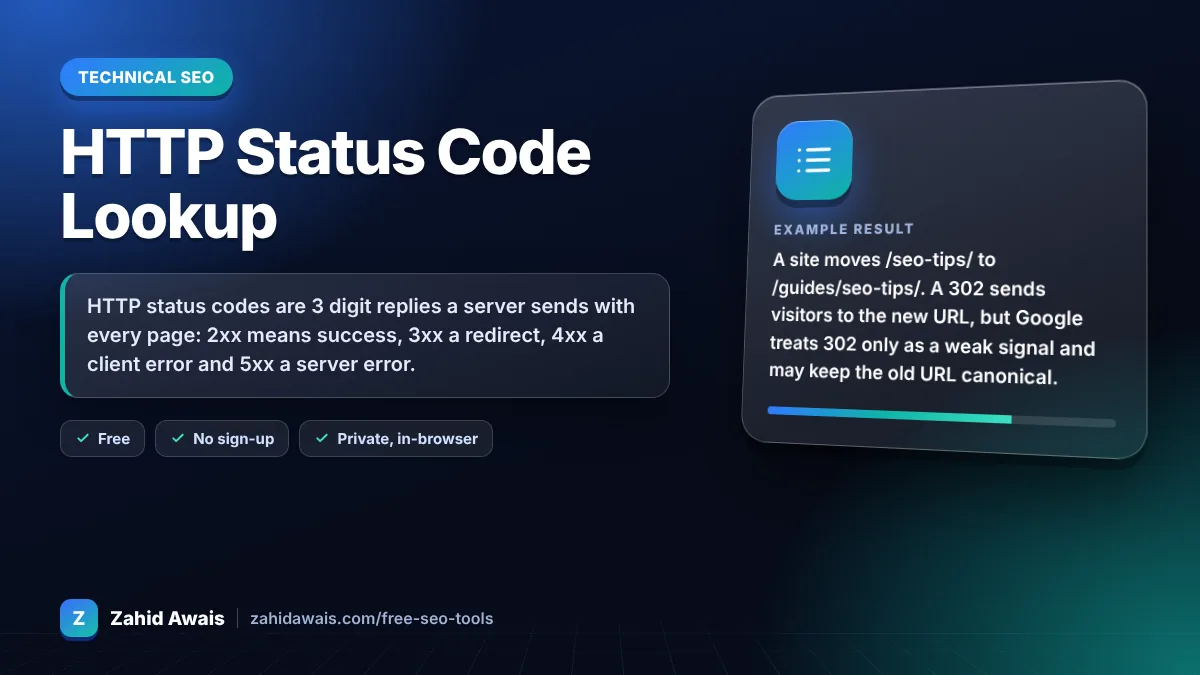
HTTP status codes are 3 digit replies a server sends with every page: 2xx means success, 3xx a redirect, 4xx a client error and 5xx a server error. For SEO, Google indexes 200 pages, follows 301 and 308 as strong redirect signals, drops 404 and 410 URLs over time, and slows crawling on 5xx and 429.
An HTTP status code lookup is a reference tool that explains each response code a server can send. The first digit sets the class (1 to 5), and this tool pairs the standard meaning from the HTTP specification with how Google's crawlers handle that code according to Google's documentation.
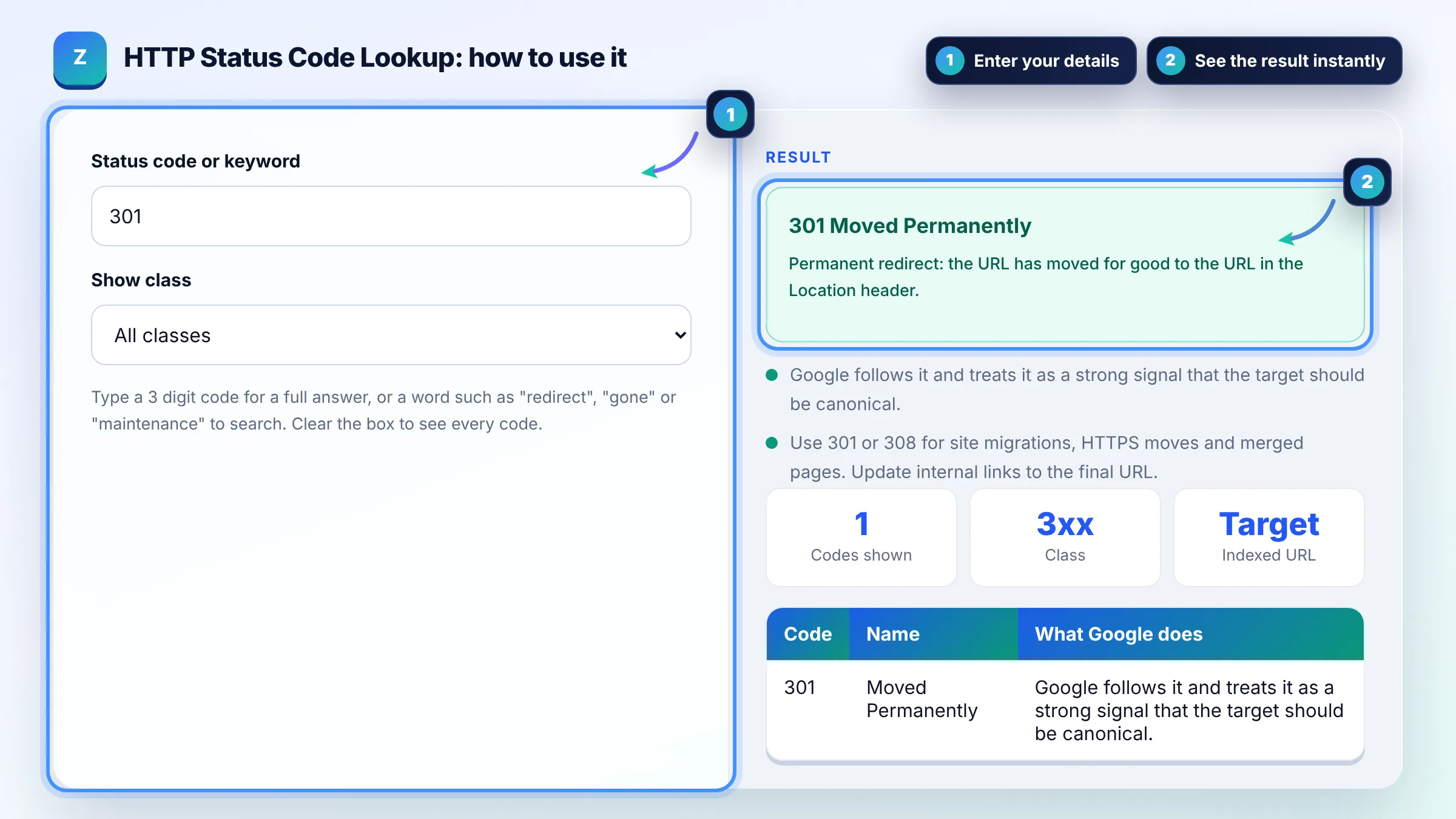
There are 5 classes, set by the first digit: 1xx informational, 2xx success, 3xx redirection, 4xx client error and 5xx server error. They are defined in RFC 9110 and listed in MDN's status code reference. For SEO the 200, 301, 302, 404, 410 and 503 codes matter most.
Use 301 (or 308) when a page has moved for good and 302 (or 307) only when the move is temporary. Google treats 301 and 308 as a strong signal that the target should be canonical and 302 and 307 as a weak signal. Both pass users and crawlers to the new URL.
No, 404 errors for pages that really no longer exist are normal and do not hurt the rest of your site. Google simply drops those URLs over time. Fix 404s only when they come from your own internal links, sitemaps or valuable backlinks; redirect those to the closest relevant page.
| Code | Google treatment | SEO action |
|---|---|---|
| 200 OK | Content passed to indexing | Make sure error pages do not return 200 (soft 404) |
| 301 / 308 | Strong canonical signal for target | Use for permanent moves |
| 302 / 307 | Weak canonical signal for target | Use only for temporary moves |
| 404 / 410 | Treated the same: URL dropped over time | Fine for removed pages |
| 429 / 503 | Crawling slowed temporarily | Use briefly for overload or maintenance |
| 500 / 502 / 504 | Crawling slowed; failing URLs dropped | Fix server or CDN errors quickly |
Example: a site moves /seo-tips/ to /guides/seo-tips/. A 302 sends visitors to the new URL, but Google treats 302 only as a weak signal and may keep the old URL canonical. Changing it to a 301 sends a strong signal. On site migrations I check every old URL returns 301 to its exact match, not to the homepage.
404 means not found and 410 means gone on purpose. Google's documentation says it treats all 4xx codes except 429 the same way, so both lead to the URL being dropped from the index over time. Use whichever matches the truth.
A soft 404 is a page that returns 200 OK but looks like an error, such as an empty category or a not found message. Search Console reports it as a soft 404. Return a real 404 or 410, or add useful content.
Google's crawlers follow up to 10 redirect hops by default, though some Google products use different limits. Long chains slow crawling and users, so point every redirect straight to the final URL and update internal links.
Use 503 Service Unavailable for short maintenance. Google treats 5xx and 429 as a signal to slow down and keeps indexed URLs for a while. If 503 lasts too long, Google starts dropping the failing URLs.
If robots.txt returns a 4xx code other than 429, Google assumes there are no crawl restrictions. If it returns 5xx, Google stops crawling the site for the first 12 hours, then uses the last cached copy for up to 30 days.
No. Browsers block JavaScript from reading other sites' raw responses, so a pure browser tool cannot fetch them reliably. Use URL Inspection in Search Console, your browser's Network tab or curl -I to see a URL's real status code.
Facts checked against these official pages. Read how I check facts in my editorial policy.
An htaccess redirect generator is a tool that converts old and new URLs into Apache directives such as…
A redirect chain finder is a tool that reads a list of redirect rules and follows each old URL through the…
A URL parser is a tool that reads a URL according to the URL standard and separates it into components. This…
Send your website and I will check it for you, free.
One short email when something new goes live: articles, free SEO tools, package updates, discounts and price alerts. No spam, unsubscribe in one click.