Content SEO and writing
Does Google Penalize AI Content? What Google Really Says
Google judges content by quality and purpose, not by the tool used, but mass produced, unreviewed AI pages can breach its spam policies.
Read articleTwenty yes or no questions drawn from Google's guidance, grouped into five areas, with a simple scoring method you can use on every draft.
This helpful content checklist gives you 20 questions to ask before you publish any page, based on Google’s own self-assessment guidance, plus a scoring method I use on client drafts.
A helpful content checklist asks whether a page is made for a real audience, shows first-hand experience, offers original value, is accurate and sourced, answers the query quickly and avoids search engine-first habits like padding or fake freshness. Google publishes its own self-assessment questions, and this list turns them into practical pre-publish checks.
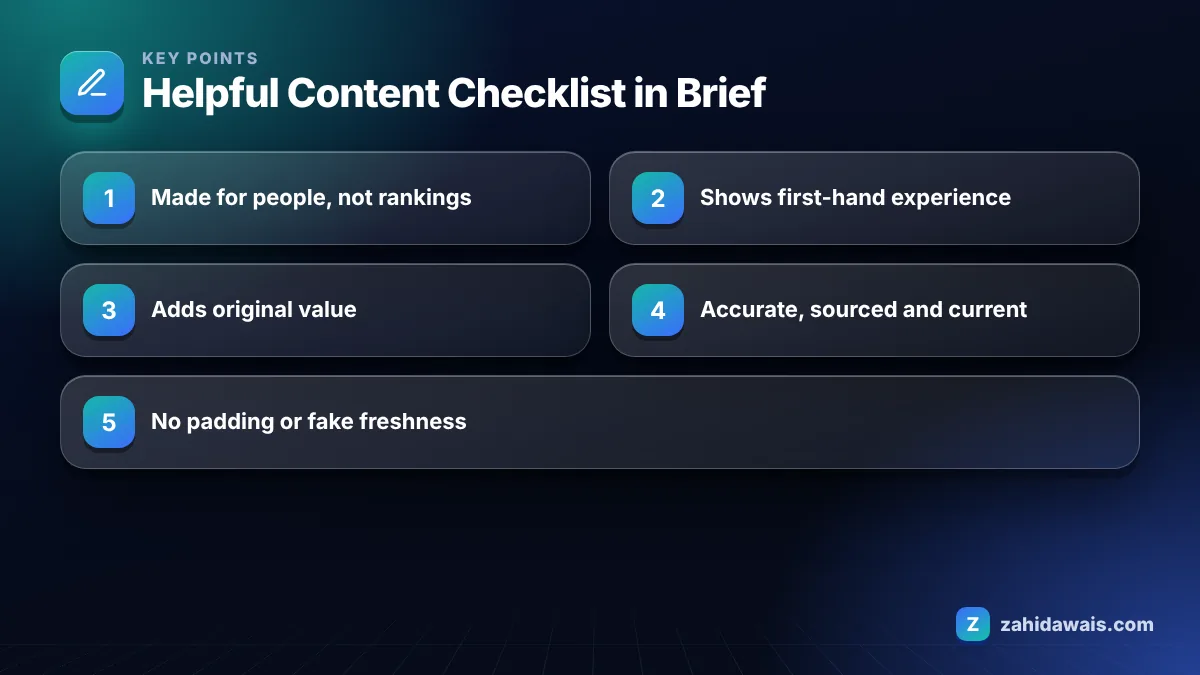
Google considers content helpful when it is created primarily to benefit people rather than to gain search engine rankings, and when it is reliable and satisfying for the reader. Its guide to creating helpful, reliable, people-first content lists self-assessment questions about content quality, expertise, people-first focus and search engine-first warning signs.
The same guide introduces the “Who, How and Why” test. Who created the content should be clear. How it was created, including any automation, should be explained where readers would expect it. Why it exists should be to help people, which Google calls perhaps the most important question of all.
The 20 questions below are grouped into five areas. Answer each with yes or no. They are my practical adaptation of Google’s guidance, written so a writer or editor can check them quickly.
| Area | Question |
|---|---|
| Purpose | 1. Would this page be worth publishing if search engines did not exist? |
| Purpose | 2. Is it written for our existing or intended audience, not just a trending keyword? |
| Purpose | 3. Does the topic fit the main focus of the site? |
| Purpose | 4. Will a reader leave able to achieve their goal without searching again? |
| Experience | 5. Does it show first-hand experience, such as use, testing or real work? |
| Experience | 6. Is the author clear, with background relevant to the topic? |
| Experience | 7. Are photos, data or examples our own where readers would expect them? |
| Experience | 8. Do we explain how the content was made where that would help readers? |
| Value | 9. Does it offer original information, analysis or examples? |
| Value | 10. Does it add something beyond the pages already ranking? |
| Value | 11. Does it go beyond summarising other sources? |
| Value | 12. Would a reader bookmark it or share it with a friend? |
| Reliability | 13. Is every fact checked, with sources for key claims? |
| Reliability | 14. Is it free of easily verified errors? |
| Reliability | 15. Are dates, prices and versions current? |
| Reliability | 16. Is the page well edited, without sloppy or hasty mistakes? |
| Not search-first | 17. Is the length set by the topic, not a target word count? |
| Not search-first | 18. Is the main question answered early, without padding? |
| Not search-first | 19. Has the date changed only because the content substantially changed? |
| Not search-first | 20. Is it one page per real need, not one of many near duplicates? |
Questions 1, 5 and 10 are the ones that most often fail in my reviews. They are also the hardest to fix late, which is why I check them at the brief stage before writing begins.
You know your content is helpful when it passes an honest self-review and real readers act on it: they stay, return, enquire or share it. Use the checklist before publishing and your data after publishing.
Google’s guide suggests getting honest assessments from people who are not affiliated with your site. On client projects I ask a customer or a staff member who did not write the page. Their first comment is usually more useful than any tool score.
Keep the scores from each review. After a few months you can compare pages that scored 19 or 20 with pages published at 15 or 16, and see whether the stricter standard shows up in impressions, enquiries or time on page. That turns the checklist from an opinion into a habit your whole team trusts.
Pages usually fail because they were planned around a keyword instead of a reader. The keyword decides the topic, a template decides the structure, and nobody adds anything that only this business could say. The result is accurate but interchangeable.
Thin or interchangeable pages often never get indexed at all. If you see many posts under “Crawled, currently not indexed”, my guide to crawled but not indexed pages explains how content quality connects to that status.
Not as a separate system. Google’s guide to ranking systems lists the helpful content system as retired and explains that in March 2024 it became part of Google’s core ranking systems. The principles behind it did not go away. They now sit inside the core systems that assess every page.
That means there is no separate “helpful content” event to wait for or recover from. Improvements are assessed as part of normal ranking and core updates. Sites that lost visibility in earlier helpful content updates generally need sustained, real improvement across their content, not quick fixes, and no one can guarantee when or whether rankings return.
A draft titled “10 Tips for Choosing a Business Accountant” for a small accounting firm scored 11 out of 20. It failed question 1 (it existed only because the keyword had volume), 5 and 7 (no experience, stock photos), 9 to 11 (tips matched every other result), 17 (padded to a target length) and 18 (the first tip appeared after 300 words of introduction).
The revision: a partner at the firm became the author. The tips were replaced with the five questions clients should ask in a first meeting, based on what the partner hears every week, plus three warning signs from real situations the firm had cleaned up. A short table compared fixed fee and hourly billing with typical scenarios. The introduction shrank to two sentences that answer the question. The draft scored 19, with question 12 still uncertain until real readers responded.
The page did not get longer. It got more specific, and every change came from the checklist.
If you want an independent review of your existing pages against this list, my on-page SEO service includes a content quality audit, and the free SEO audit checklist covers the technical side. My own standards are published in the editorial policy for this site.
Google describes helpful content as content created primarily to benefit people rather than to manipulate search rankings. It should be reliable, show expertise or first-hand experience where relevant, offer original value, and leave readers feeling they learned enough to achieve their goal.
Not as a separate system. Google’s ranking systems guide lists the helpful content system as retired and says it became part of the core ranking systems in March 2024. Its principles still apply through those core systems and core updates.
Review your content honestly against Google’s self-assessment questions, improve or merge weak pages, remove content with no audience, and add real experience and accuracy. Recovery can take months and is not guaranteed, because improvements are assessed through normal ranking over time.
Delete pages that have no audience, no links and no realistic way to become useful. Improve pages with potential, and merge overlapping pages into one stronger page with a redirect. Deleting content without reviewing it first can remove pages that were helping you.
No. Google says it has no preferred word count. Helpful content is as long as the reader needs. A short page that answers a narrow question completely can be more helpful than a long article padded to hit a target.
No checklist can guarantee rankings, because ranking depends on competition, relevance and many other signals. A checklist helps you publish pages that match what Google says it wants to reward and that genuinely serve readers, which improves your chances over time.
Facts checked against these official pages. Read how I check facts in my editorial policy.
Google judges content by quality and purpose, not by the tool used, but mass produced, unreviewed AI pages can breach its spam policies.
Read article
Google does not reward word count, so set length by search intent, the questions you must answer and what ranking pages actually cover.
Read article
A 12 step process I use for client posts, from picking the keyword to publishing, with a worked example for a real style of query.
Read articleSend your website and I will reply with a free audit.