Content SEO and writing
How Long Should a Blog Post Be for SEO? Real Word Counts by Intent
Google does not reward word count, so set length by search intent, the questions you must answer and what ranking pages actually cover.
Read articleGoogle judges content by quality and purpose, not by the tool used, but mass produced, unreviewed AI pages can breach its spam policies.
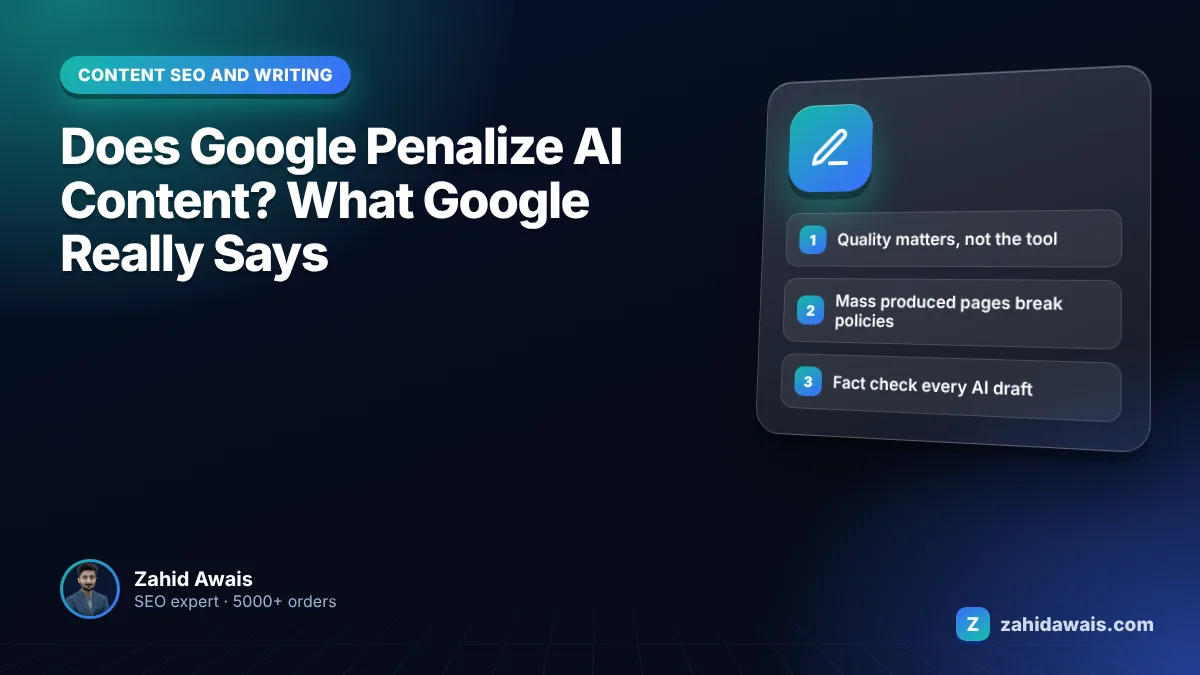
This article answers does Google penalize AI content using Google’s own published guidance, then shows you where the real risk sits and the review process I use before any AI-assisted text goes live.
No. When people ask does Google penalize AI content, the answer from Google is that it rewards high-quality content however it is produced. The risk is not AI itself but using automation to mass produce pages mainly to manipulate rankings, which breaks Google’s spam policies. Reviewed, accurate, genuinely useful AI-assisted content is allowed.
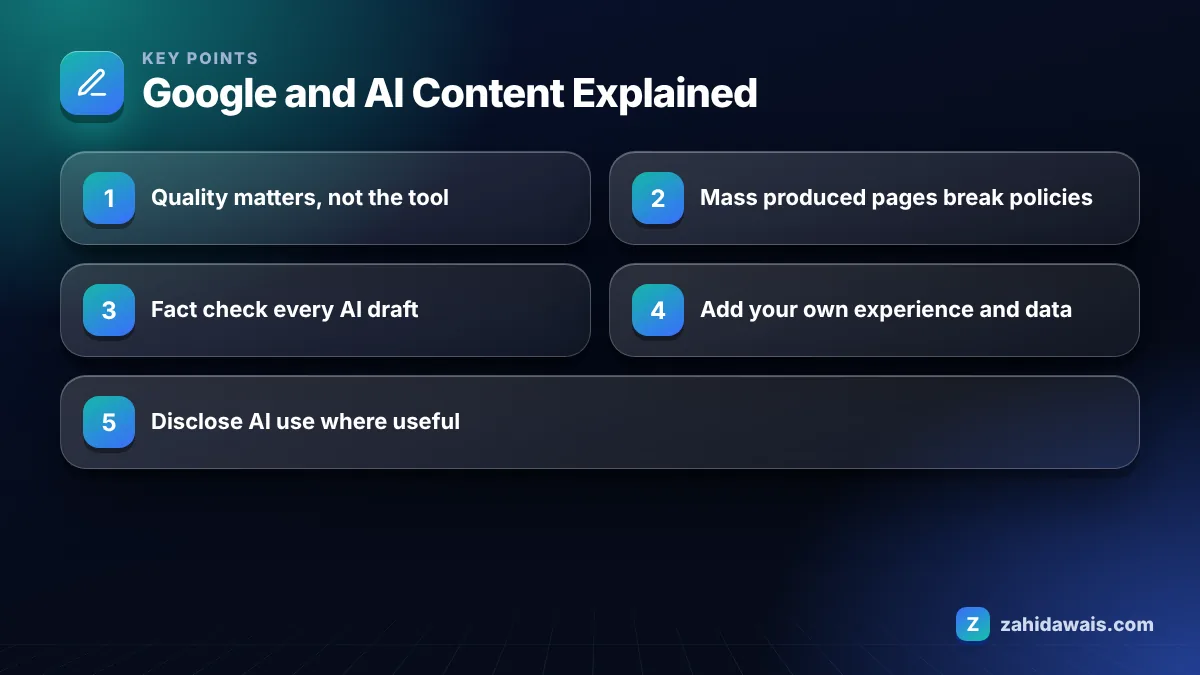
Google says appropriate use of AI or automation is not against its guidelines, and that it focuses on the quality of content rather than how it was produced. This was set out in February 2023 in Google Search’s guidance about AI-generated content on the Search Central blog.
The same post draws the line clearly. Using automation, including AI, to generate content with the primary purpose of manipulating rankings in search results is a violation of Google’s spam policies. Google also points out that automation has long been used to create useful content, such as sports scores and weather forecasts, so the tool is not the problem.
In plain terms, Google has given every site owner the same test: would this page still be worth publishing if search engines did not exist? If the answer is yes and the facts are right, AI help in writing it is not a problem. If the page only exists to catch traffic, no amount of human polish will make it safe.
Google later published more detailed guidance on using generative AI content on your site. It warns that generating many pages without adding value for users may breach the spam policy on scaled content abuse, asks site owners to check accuracy because AI can produce errors, and reminds you that titles, meta descriptions, structured data and alt text need the same review.
Google has not said that it identifies and demotes text simply because AI wrote it, and its stated approach does not depend on detection. Its systems aim to reward helpful, reliable content and to catch spam, whether a person or a machine produced it.
That is why “can Google detect it?” is the wrong question. A human writer who copies and lightly rewrites ten competitor articles is producing the same low value pattern that unreviewed AI content produces. Both are what Google’s systems are built to filter out. A practical consequence I see often: thin AI pages are not always demoted dramatically. Many simply never get indexed, and the site owner later finds them under “Crawled, currently not indexed” in Search Console, a status I explain in my guide to fixing crawled but not indexed pages.
AI content is bad for SEO when it is generic, inaccurate or published at scale without review, and it can be fine when a knowledgeable person shapes and checks it. The table below shows how I assess the risk of common AI workflows in client projects.
| How AI is used | Risk level | Why |
|---|---|---|
| Brainstorming topics and outlines | Low | A human still writes and decides what goes on the page |
| Drafting sections that an expert rewrites and fact checks | Low to medium | Fine if the final page adds real experience and accurate facts |
| Rewording competitor articles | High | Adds no original value, the pattern Google’s guide warns about |
| Hundreds of location or keyword pages from one template | High | Matches the description of scaled content abuse |
| Publishing raw output with no fact check | High | Errors damage trust and YMYL topics carry extra risk |
| AI product images in shopping feeds | Policy specific | Merchant Center requires IPTC metadata marking them as AI generated |
Google’s spam policies describe scaled content abuse as generating many pages primarily to manipulate rankings and not to help users, however the content is created. That phrase, however it is created, is the key. The policy applies to AI, human writers and content spinners equally.
You make AI-assisted content rank the same way you make any content rank: by making it the most useful, accurate and original answer for the searcher. AI can speed up the work, but the parts that matter most still need a human.
A small travel agency wanted 50 destination pages written with AI in one week. The plan was one prompt per city, published straight to the site. That is close to the scaled content pattern Google describes, and most of those pages would have said the same things as thousands of other pages.
We changed the plan. The agency picked the 12 destinations they actually sell. For each one, a staff member recorded a ten minute voice note covering hotels they had visited, the best months based on customer feedback, and common booking mistakes. AI turned each note into a structured draft. An editor then checked facts, added the agency’s own photos and real package prices, and cut anything generic.
Result: 12 pages that no other site could copy, instead of 50 that every site already had. The time saved by AI went into adding experience, not into adding volume.
You know AI content is hurting your site when large groups of pages fail to get indexed, lose impressions together, or attract visits that leave immediately. These are the same signs any low value content shows, so check them in Search Console rather than guessing.
The fix is rarely to delete everything. I usually sort affected pages into three groups: pages worth improving with real experience and facts, pages that overlap and should be merged with a redirect, and pages with no audience that can be removed. Improving twenty strong pages tends to do more than keeping two hundred weak ones.
If you want help building a process like this, my SEO services include content planning and editing, and my editorial policy shows how I handle AI assistance on this site. If you also want AI tools to cite your pages, the GEO service covers that side.
No. Google says appropriate use of AI or automation is not against its guidelines. What breaks its spam policies is using automation to generate content mainly to manipulate search rankings, such as mass producing low value pages. The same rule applies to content written by humans.
Google does not require a label for every AI-assisted article, but its guidance suggests explaining how content was created where readers would reasonably expect it. Google Merchant Center has specific rules, including IPTC metadata for AI-generated product images and labels on AI-generated product titles and descriptions.
AI use alone does not trigger deindexing. Sites can lose visibility or receive manual actions when they publish large amounts of low value content to manipulate rankings, which Google calls scaled content abuse. Thin AI pages often simply fail to get indexed or rank.
Yes, if the final page is genuinely helpful, accurate and better than competing results. Content that ranks usually has human editing, original examples and verified facts. Generic AI output that repeats existing pages rarely offers enough value to outrank them.
AI detectors are not reliable enough to base decisions on, and Google’s stated approach is about quality rather than detection. Spend that time on fact checking, adding original experience and improving structure. Those changes help readers and match what Google says it rewards.
It carries more risk. Google gives more weight to strong E-E-A-T on topics affecting health, money or safety, and AI can produce confident errors. Use AI only for drafting, and have a qualified expert review, correct and take responsibility for the final page.
Facts checked against these official pages. Read how I check facts in my editorial policy.
Google does not reward word count, so set length by search intent, the questions you must answer and what ranking pages actually cover.
Read article
A 12 step process I use for client posts, from picking the keyword to publishing, with a worked example for a real style of query.
Read article
SEO prices vary because the work varies. Here is how SEO is usually priced, what drives the cost, what a fair monthly plan should include and the red flags to avoid.
Read articleSend your website and I will reply with a free audit.