This guide shows you how to write SEO friendly blog post content step by step, using the same 12 steps I follow when I write and edit articles for clients.
Quick answer
To learn how to write SEO friendly blog post content, pick one main keyword, check what the top results cover, answer the question in your first paragraph, use clear question headings, write a descriptive title and meta description, add internal links and original examples, then edit for accuracy and readability before publishing.
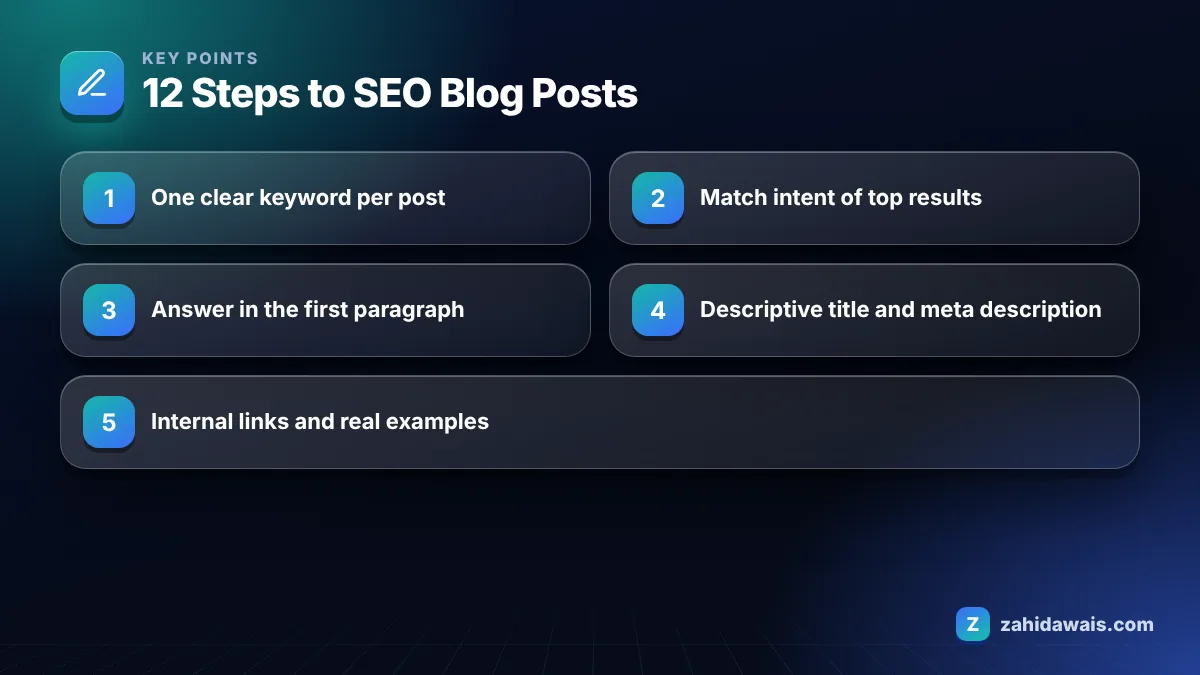
12 Steps to SEO Blog Posts
What makes a blog post SEO friendly?
A blog post is SEO friendly when search engines can understand it easily and readers find it the most useful answer to their query. Both parts matter. A post that is technically perfect but says nothing new will struggle, and a brilliant post with a vague title and no links may never be found.
Google’s SEO Starter Guide keeps the advice simple: make content helpful, reliable and people-first, use words your readers would search for, and organise the page so it is easy to follow. It also confirms a few things that save beginners time. Google does not use the keywords meta tag, the order of headings does not matter for ranking, and keywords in a URL have hardly any effect beyond appearing in breadcrumbs.
In my orders, the posts that underperform rarely fail on technical details. They fail because they repeat what ten other pages already say. So before any writing starts, I ask one question: what will this post include that a reader cannot get from the current top results? A tested method, a price range from real work, a mistake to avoid or a clear decision table are all good answers. If there is no answer, the post needs a different angle before it needs better keywords.
How do I write an SEO blog post for beginners?
Beginners should follow a fixed sequence so nothing gets missed. Here are the 12 steps in the order I use them.
Choose one primary keyword. Pick a phrase a real customer would type, such as “how to clean a suede sofa”, not a broad term like “sofas”.
Check the search intent. Search it yourself. If the top results are guides, write a guide. If they are product pages, a blog post may be the wrong format.
List what top pages cover. Note the subtopics most results share and the gaps none of them fill.
Find your angle. Add what only you can add: your process, a test, a mistake you made, real prices.
Outline with question headings. Use the questions people ask, then answer each in the first sentence under the heading.
Write the answer first. Put the direct answer in the opening paragraph. Context comes after.
Write a clear title. Keep it descriptive and concise with the keyword near the start.
Write a meta description. Summarise the page and give a reason to click.
Add internal links. Link to two to five related pages on your site with descriptive anchor text.
Cite official sources. Link to the original source for any fact or statistic.
Add media with alt text. Use images, tables or screenshots that explain something, and describe them in alt text.
Edit and check. Read it aloud, cut filler, check facts and preview the search snippet.
Step 12 is where most beginner posts improve the most. Read the draft as the person who searched. Every paragraph that does not help them should go.
How many keywords should I use in a blog post?
Use one primary keyword per post and let related phrases appear naturally as you cover the topic properly. There is no correct keyword count or density. Google’s spam policies treat keyword stuffing, meaning filling a page with keywords to manipulate rankings, as a violation.
In practice, I place the primary keyword in the title, the H1, the first paragraph and usually one subheading. After that I write naturally. The Starter Guide notes that people search with different words for the same thing, so variations help, but you do not need to cover every one because Google’s language matching is sophisticated. You can check a draft for accidental repetition with my free keyword density checker.
How do you write a good title and meta description for a blog post?
A good title describes the page accurately in a few words, puts the main topic first and is unique on your site. Google’s guidance on title links in search results asks for titles that are descriptive and concise, warns against keyword stuffing, and notes that long titles may be truncated.
For meta descriptions, summarise what the reader gets and why it is worth clicking. Google often builds the snippet from your page text instead, so a strong first paragraph matters as much as the meta tag. Before publishing, I paste both into my SERP snippet preview tool to see how they look on desktop and mobile.
Element
Weak version
SEO friendly version
Title
Sofa Tips and Tricks You Need to Know
How to Clean a Suede Sofa Without Water Marks
H1
Welcome to Our Cleaning Blog
How to Clean a Suede Sofa (Safe Method for Any Stain)
First paragraph
Sofas are an important part of every home…
Brush the suede, blot stains, then use a suede eraser or white vinegar on a cloth.
Subheading
More Information
Can you use water on a suede sofa?
Anchor text
Click here
our upholstery cleaning prices
Image alt
image1.jpg
Soft brush lifting dirt from a grey suede sofa cushion
What does an SEO friendly blog post outline look like?
Example
Keyword: “how to clean a suede sofa”. The top results were all guides, so a guide is the right format. Most covered brushing, vinegar and stain types. None covered what to do after a failed home attempt, which is the moment people call a professional.
The outline I would hand to a writer: H1 with the keyword. A first paragraph that gives the full method in two sentences. H2 “What do you need to clean a suede sofa?” with a short list. H2 “How do you clean a suede sofa step by step?” with six numbered steps. H2 “Can you use water on a suede sofa?” answering no in the first sentence and explaining why. H2 “How do you remove grease or ink from suede?” with a small table by stain type. H2 “What if cleaning made the stain worse?” covering water rings and when to call a professional, with an internal link to the service page.
That outline lands around 1,300 words with no padding, and the last section is the information gain the other pages lacked.
What should you check after you publish?
After publishing, confirm the post is indexable, linked from at least one existing page, and showing the title and snippet you expect. A post with no internal links pointing to it is hard for both readers and crawlers to find.
Open the live URL and check the title, headings and images render correctly on mobile.
Add a link to the new post from one or two older, related posts.
Use URL Inspection in Search Console to confirm Google can access the page.
Review performance after a few weeks and update the post with questions readers still ask.
If you would rather hand over the whole process, my on-page SEO service covers keyword planning, writing and optimisation, and my SEO audit checklist is a free way to review the rest of your site.
Frequently asked questions
What is an SEO friendly blog post?
An SEO friendly blog post targets a clear search query, answers it quickly and completely, and is easy for search engines to understand through a descriptive title, clear headings, internal links and accurate content. It is written for readers first, with search optimisation supporting that goal.
How long should an SEO blog post be?
There is no fixed length. Google states it has no preferred word count. Write as much as the query needs: a short answer for a simple question, and a longer, structured guide for a complex task. Compare what the top results cover to judge depth.
Should the keyword be in the URL?
A short, readable URL that describes the page is good practice, and using the keyword often does that naturally. Google’s Starter Guide says keywords in the URL path have hardly any effect beyond breadcrumbs, so do not stuff them or change old URLs just to add keywords.
How many internal links should a blog post have?
There is no fixed number. Add links where they genuinely help the reader go deeper, usually two to five contextual links in a typical post. Use descriptive anchor text and link to your most relevant service or guide pages rather than generic pages.
Can I write SEO blog posts with AI tools?
You can use AI to help with research or drafts, but you must edit for accuracy, add your own experience and check every fact. Google’s concern is quality and helpfulness, not the tool used. Mass producing posts without review risks breaching its scaled content abuse policy.
Do I need an SEO plugin to write SEO friendly posts?
No. Plugins help you edit titles and meta descriptions and generate sitemaps, but they cannot make content helpful. A post written for the reader with a clear title, headings and links can perform well without following every plugin score.
Sources
Facts checked against these official pages. Read how I check facts in my editorial policy.
SEO prices vary because the work varies. Here is how SEO is usually priced, what drives the cost, what a fair monthly plan should include and the red flags to avoid.