Text Compare Tool
A text compare tool, or diff checker, is a tool that finds the smallest set of additions and deletions that…
Paste two or three texts to measure how much wording they share, with Jaccard and cosine scores and every shared phrase highlighted.
Both scores are standard text measures run in your browser. They show shared wording, not meaning, and they are not how Google measures duplicate content, which Google does not publish. Nothing is uploaded.
| Pair | Jaccard | Cosine | Words |
|---|
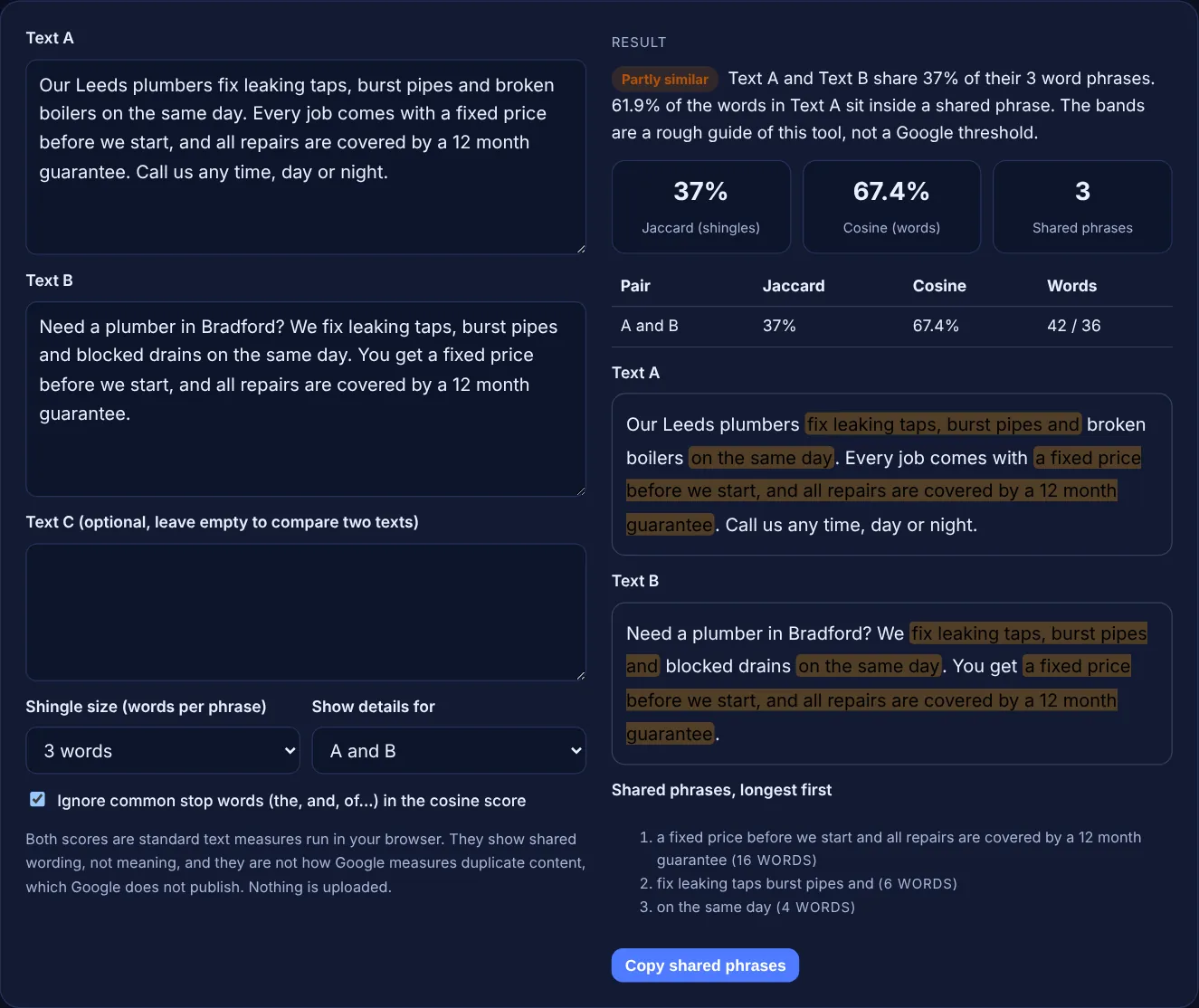
The free content similarity checker compares two or three texts and shows how much wording they share. It scores each pair with shingle based Jaccard similarity and cosine similarity of word counts, and highlights every shared phrase in place, so you can see exactly which sentences were reused.
A content similarity checker measures how much wording two texts share. This one splits each text into overlapping word sequences called shingles and compares the sets with Jaccard similarity, then compares word counts with cosine similarity. High scores mean reused wording, but Google does not publish how it measures duplicate content.
A content similarity checker is a tool that puts a number on the overlap between texts. It is useful for spotting near-duplicate service pages, location pages built from one template, product descriptions copied from a supplier, or a rewritten article that still follows the original too closely. This checker uses two classic measures from information retrieval and shows the phrases behind the score, so you are not left with a number alone.
Overlap is not automatically a problem. Google's canonicalization documentation says: "Some duplicate content on a site is normal and it's not a violation of Google's spam policies." What it does mean is that Google groups very similar pages and picks one to show, which may not be the page you prefer. A similarity score tells you where to look before that happens.
Jaccard similarity divides the number of shingles two texts share by the number of different shingles in both. A shingle is a run of consecutive words. With 3 word shingles, "fix a leaking tap fast" gives "fix a leaking", "a leaking tap" and "leaking tap fast". "Fix a leaking pipe fast" gives "fix a leaking", "a leaking pipe" and "leaking pipe fast". They share 1 of 5 different shingles, so the Jaccard score is 20%.
Because shingles keep word order, Jaccard reacts to copied phrases rather than to the same topic. Larger shingles make the score stricter: two texts on the same subject rarely share many 6 word runs unless one was copied from the other. The text is lower cased and punctuation is ignored before shingles are made.
Cosine similarity compares how often each word appears in the two texts, ignoring word order. Each text becomes a list of word counts, and the score is the cosine of the angle between the two lists: 100% when the words are used in the same proportions and 0% when no word is shared. In the example above, after ignoring the stop word "a", each text has 4 words and 3 match, which gives 75%.
Cosine is usually higher than Jaccard because it rewards shared vocabulary even when the sentences are different. A high cosine with a low Jaccard suggests the same topic in different words. A high score on both suggests copied or lightly edited text. Ignoring stop words stops "the" and "and" from pushing the score up.
No. Google does not publish the method it uses to find duplicate or near-duplicate pages, and this tool does not copy it. Google's documentation says it groups similar pages and selects a canonical URL, using signals such as redirects, rel="canonical" annotations and sitemaps, and that a canonical preference "is a hint, not a rule."
Use the scores as an editing aid. If two of your pages score high, decide whether they serve different searches. If they do, rewrite them so each answers its own question. If they do not, merge them or point one to the other, as explained in the duplicate without user-selected canonical guide. For a line by line view of changes, use the text compare tool.
| Shingle Jaccard | Cosine of word counts | |
|---|---|---|
| Looks at | Runs of consecutive words | Single words and how often they appear |
| Word order | Matters | Ignored |
| High score means | Phrases were reused | Similar vocabulary and topic |
| Synonyms and rewording | Lower the score a lot | Lower the score a little |
| Best for | Spotting copied or spun passages | Spotting pages on the same topic |
Example: the default texts are two made-up service blurbs for plumbers in Leeds and Bradford. With 3 word shingles, the Jaccard score is 37% and the cosine score is 67.4% with stop words ignored. The tool finds 3 shared phrases. The longest is 16 words in a row, "a fixed price before we start and all repairs are covered by a 12 month guarantee", which shows that the second blurb reused a whole sentence from the first. The verdict is Partly similar, so the next step is to rewrite that sentence, "fix leaking taps burst pipes and" and "on the same day" for the Bradford page.
There is no official number. Google does not publish a threshold. This tool labels 50% Jaccard or more as very similar and 20% or more as partly similar as a rough editing guide. Judge the highlighted phrases, not the score alone.
Use 3 words for short texts such as descriptions and intros, and 5 or 6 words for full articles. Small shingles catch more common phrases; large ones only match passages that were copied, so the score drops as the size grows.
No. It only compares the texts you paste, entirely in your browser. To find copies elsewhere, search Google for an exact sentence in quotes, then paste the page you find here to see how much was reused.
Cosine compares single words and ignores their order, so two texts on the same topic share many words even when every sentence is different. Jaccard needs whole runs of words to match, so it only rises when phrases are reused.
No. Both measures compare exact words after lower casing. "Cheap" and "affordable" count as different words, so a careful rewrite can score low even if the meaning is the same. That is why the shared phrases list matters more than the number.
No. The comparison runs in JavaScript in your browser and nothing is sent to a server. You can safely compare client drafts, unpublished pages and supplier descriptions.
Checked 23 Oct 2026. Facts checked against these official pages. Read how I check facts in my editorial policy.
A text compare tool, or diff checker, is a tool that finds the smallest set of additions and deletions that…
A keyword cannibalization checker is a tool that finds multiple URLs on one site aimed at the same query. It…
Checks hundreds of titles and metas at once for duplicates, gaps, length and repeats.
Send your website and I will check it for you, free.
One short email when something new goes live: articles, free SEO tools, package updates, discounts and price alerts. No spam, unsubscribe in one click.