On-page SEO
Keyword Cannibalization Fix: How to Find and Solve It
How to spot pages competing for the same search, decide what to do with each one, and fix it without losing traffic.
Read articleInternal links are the cheapest SEO win you control. Here is the pillar and cluster model I use, how to choose anchors, and a 6-step plan to fix any site.
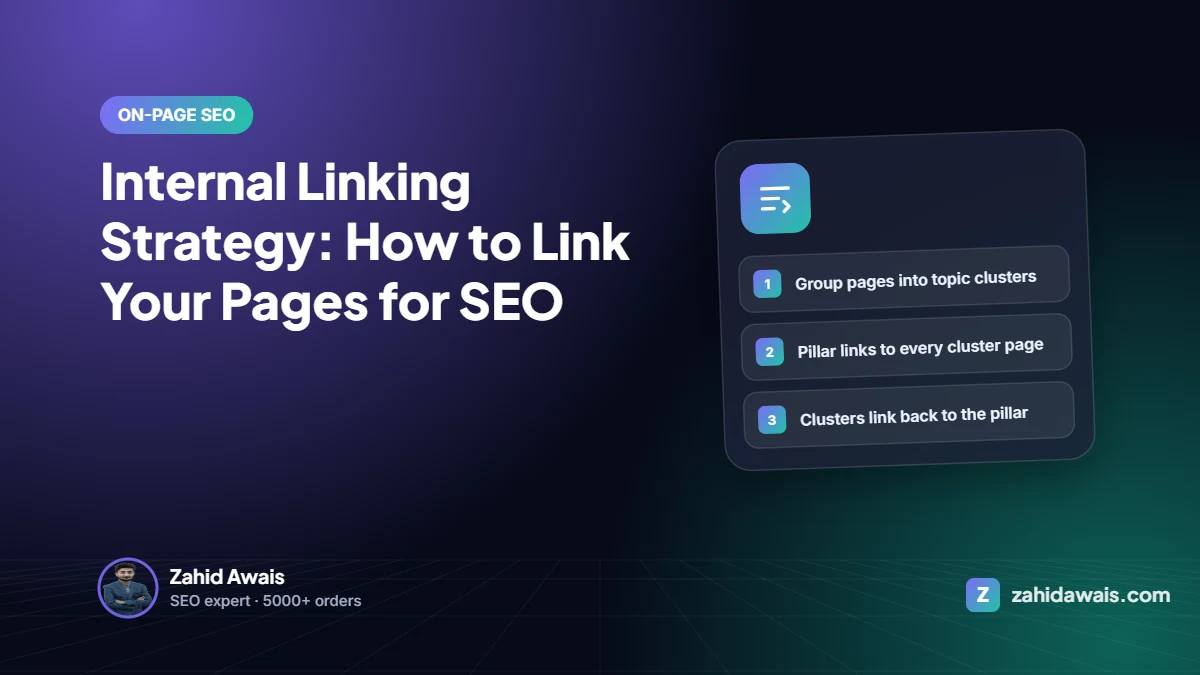
This guide explains the internal linking strategy I use on client sites and on zahidawais.com itself. It is part of my on-page SEO checklist.
Internal links connect pages on the same website. They help Google find pages, understand which pages are most important and how topics relate, and they guide readers to the next step. The best strategy groups pages into topic clusters: a pillar page links to every supporting article, every article links back to the pillar and to a few close siblings, and all of them point readers to the matching service or product page.
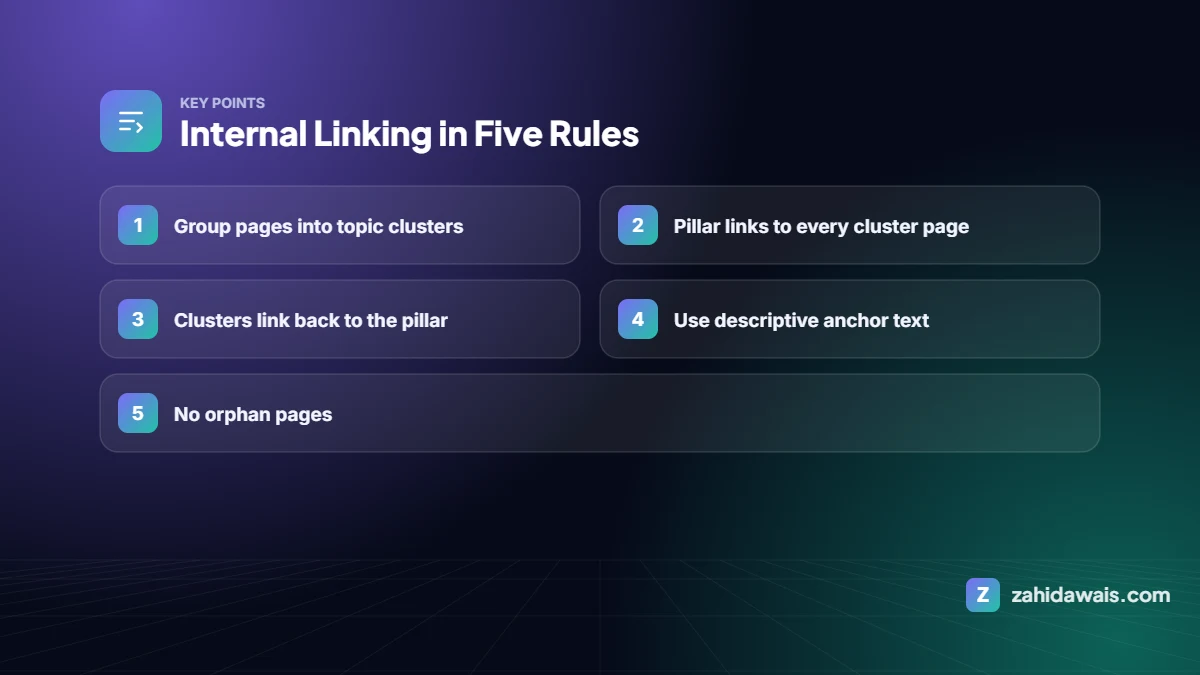
Group your content by topic. Each topic has:
| Page | Role | Example on this site |
|---|---|---|
| Pillar page | Complete guide to the topic | Link building guide |
| Cluster articles | Deep answers to one question each | Anchor text ratio, DR vs DA |
| Tool | Lets the reader do the task | Anchor text ratio calculator |
| Proof | Case study | Capterra UK case study |
| Money page | Service or product | Link building service |
The links run both ways between the pillar and every cluster, cluster articles link to 2 or 3 siblings, and every page offers a route to the money page. This is how topical authority is built in practice. Read more in my semantic SEO guide.
Google asks for anchor text that is descriptive and makes sense on its own. For internal links you can and should use the topic words of the target page:
Google has no fixed number. My working rules:
<a href> links.nofollow to internal links. It does not “save” value; it just weakens your own pages.I fix titles, meta descriptions, headings, internal links and schema across your whole site, page by page, with a before and after report.
A link from one page of a website to another page on the same website, such as a link from a blog post to a service page.
Yes. They help Google discover pages, understand topics and see which pages matter most, and they guide readers to the next step.
Yes, descriptive keyword anchors are fine internally. Just keep them natural and do not repeat the same phrase everywhere.
A page with no internal links pointing to it. Google may struggle to find or value it, so every page should be linked from related pages.
Every time you publish a new page, add links to it from 3 related older pages, and review your main topics every few months.
Facts checked against these official pages on 10 October 2026. Read my editorial policy.
How to spot pages competing for the same search, decide what to do with each one, and fix it without losing traffic.
Read article
E-E-A-T is how Google's quality raters judge whether content comes from someone who knows the topic. It is not a single ranking factor, but the signals behind it shape what ranks.
Read article
Good keyword research finds searches your buyers make that your site can realistically win. Here is the process I use, from seed list to a prioritised plan.
Read articleSend your website and I will reply with a free audit.