This guide covers practical category page SEO: how much text a category needs, where it should go, how products and subcategories should be linked, and the mistakes that keep category pages stuck on page two.
Quick answer
Category page SEO works when the page targets one clear product type, shows the products first, links directly to every item and subcategory with crawlable links, and adds a short, useful description that helps shoppers choose. Quality and structure matter more than adding hundreds of words of filler text.
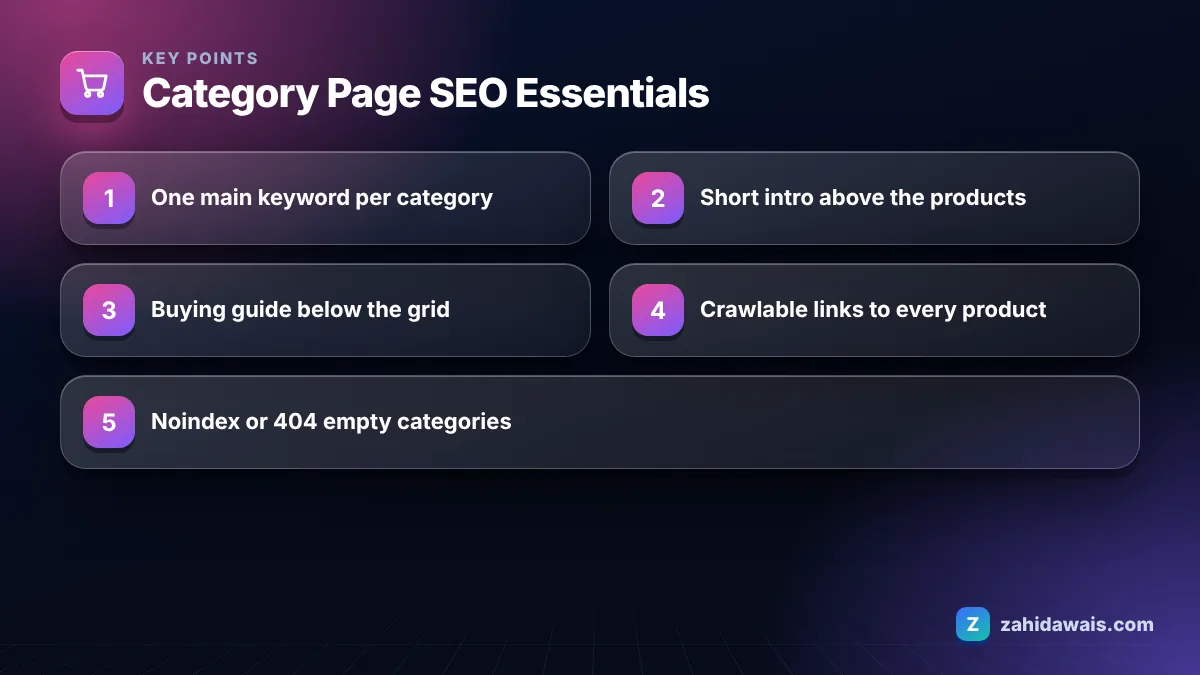
Category Page SEO Essentials
Do category pages rank better than product pages?
Category pages usually rank better than product pages for broad commercial searches such as “running shoes” or “oak dining tables”, because the searcher wants to compare options rather than see one item. Product pages tend to win specific searches that include a brand, model or exact specification.
That split should shape your keyword plan. Give each category one main term and a few close variations, and leave model names and very specific queries to product pages. When a category and a product both target the same broad phrase, they compete with each other and neither performs well.
Category pages also have a structural advantage: they sit high in the site hierarchy and receive many internal links from menus and breadcrumbs. Google’s guide to ecommerce site structure explains that Google uses the number of links needed to reach a page, and the number of links pointing to it, to estimate how important that page is relative to others.
How long should a category page description be?
A category description should be as long as it needs to be to help a shopper choose, which for most stores means a short intro of about 50 to 150 words above the products and, for competitive categories, a longer buying guide section of 200 to 500 words below them. Google does not set a word count for category pages.
Length is the wrong target. In my orders I regularly see category pages with 800 words of generic text that repeats the keyword and says nothing a buyer needs. Text like that does not answer any question and pushes the products off the screen.
Useful category text answers questions such as:
What types or styles are in this category, and how do they differ?
How do I choose the right size, material or capacity?
Which subcategories or popular filters should I start with?
What delivery, returns or fitting information applies to this range?
Different category types need different amounts of help. A category of phone chargers needs a few lines about connector types and wattage. A category of mattresses benefits from a proper guide to firmness, materials and sizes, because buyers are nervous about an expensive decision. Match the depth of the content to the difficulty of the choice.
Look at the pages already ranking for your category term, too. If the top results all show a short intro and a large product grid, a long essay is unlikely to be what searchers want. If they include comparison guides, that tells you buyers need more help choosing.
Write for the person standing in the aisle, then check length with a word counter only to keep pages consistent across the store.
Where should text go on a category page?
Put a short intro of one to three sentences above the product grid and any longer guide content below it, so shoppers see products immediately and readers who want help can scroll to it. This layout serves both groups without forcing anyone to scroll past a wall of text.
Use this reference when planning each block of the page:
Page element
Position
Typical length
Purpose
H1 with category name
Top
2 to 6 words
Matches the main search term
Intro text
Above products
1 to 3 sentences
Confirms the range and its main benefit
Subcategory links
Above or beside products
4 to 12 links
Helps users narrow down and passes internal links
Product grid
Main area
All products, paginated
Direct links to every product
Buying guide
Below products
200 to 500 words
Answers choice and sizing questions
Short FAQ
Bottom
3 to 5 questions
Covers delivery, care or compatibility
Avoid hiding the main text behind a “read more” control that loads the content only after a click event. If the text is in the HTML when the page loads and simply collapsed for design, it is still available. If it is fetched by JavaScript after a click, search engines may never see it.
How should category pages link to products and subcategories?
Category pages should link directly to every product in the category and to every subcategory, using standard HTML anchor links. The same Google site structure guide says to use <a href> links rather than JavaScript events on other elements for navigation, and warns that if category pages do not link directly to all products, Googlebot might miss some of them.
Three linking issues come up again and again:
Infinite scroll without paginated URLs. If products load only as the user scrolls, give each set its own URL so all products are linked somewhere crawlable. Google’s documentation on pagination and incremental loading covers this.
Products reachable only through search. Google notes that Googlebot generally does not try to submit searches into a search box, so products found only via internal search may stay undiscovered.
Subcategories hidden in filters. Important subcategories should be visible links, not just options inside a filter panel.
Keep category URLs readable and stable, too. Google’s guidance on designing an ecommerce URL structure recommends descriptive words in URL paths and consistent URLs across internal links, sitemaps and canonical tags.
What does an improved category page look like?
Example
A garden store’s “Garden Hoses” category had an H1 of “Hoses”, no intro, 64 products loaded by infinite scroll, and a 700 word keyword heavy block at the bottom.
The rewrite changed the H1 to “Garden Hoses”, added a two sentence intro on lengths and materials, and added links to four subcategories: expandable, reinforced, soaker and hose reels. The grid moved to paginated URLs of 24 products each, so all 64 products now sit behind plain links across three pages. The bottom text was cut to a 320 word guide answering “what length do I need?”, “rubber or PVC?” and “how do I stop kinks?”, plus four short FAQs. The page is shorter, but every block now has a job.
What is a quick category page SEO checklist?
Use this checklist on each important category before you spend time on new content or links.
One main keyword per category, not shared with any product or other category.
A unique title tag and H1 that use the category name naturally. Preview titles with the SERP snippet preview tool.
Short intro above products, helpful guide below.
Crawlable links to all products and subcategories, with paginated URLs if needed.
Breadcrumbs that reflect the real hierarchy.
Self-referencing canonical on the main category URL and sensible handling of filter URLs.
Links to the category from the homepage, menus and relevant blog posts.
No empty categories left indexable; Google’s URL structure guide suggests noindex for empty categories, or a 404 if the category is removed.
Google’s ecommerce SEO best practices close with the same idea that runs through this checklist: create content that is useful for shoppers. If you want help applying it across a whole catalog, my e-commerce SEO service focuses on product and category pages specifically.
Frequently asked questions
Does adding text to category pages help SEO?
Helpful text can help, because it gives search engines and shoppers context about the range. Generic text written only to repeat keywords rarely helps. Focus on choice guidance, sizing and differences between subcategories, and keep products visible near the top of the page.
Should category pages have their own FAQ section?
A short FAQ can be useful when shoppers ask the same questions about a range, such as sizing or delivery. Keep answers brief and specific to the category. Add one because customers need the answers, not as a search engine trick.
How many products should a category page show?
Show enough to be useful without slowing the page, commonly 24 to 48 per page. If there are more, use paginated URLs so every product is reachable through crawlable links rather than only through infinite scroll or a load more button.
Should I noindex empty category pages?
Yes, if a category is temporarily empty, noindex is a reasonable choice, as Google’s ecommerce URL guidance suggests. If the category has been removed permanently, returning a 404 is cleaner. Avoid leaving empty pages indexable with a no products message.
Can two categories target the same keyword?
It is better not to. Two categories targeting the same term split relevance and links between them. Merge them, or give each a distinct focus such as men’s and women’s, with clear titles and intros that make the difference obvious.
Do breadcrumbs help category page SEO?
Breadcrumbs help users understand where they are and add consistent internal links up the hierarchy. They also reinforce the parent and child relationship between categories. Make them plain HTML links that match the real structure of your store.
Sources
Facts checked against these official pages. Read how I check facts in my editorial policy.
Product pages rarely earn links on their own. Stores win links with guides, gift lists, suppliers, creators and PR. Here are nine methods and where to point the links.
WooCommerce gives you full control of your store's SEO, which also means more to set up. Here is the setup, speed and content checklist I use for WooCommerce stores.
Shopify handles a lot of SEO basics for you, but it also creates duplicate URLs, slow app scripts and thin collection pages. Here is what to fix and in what order.