E-commerce SEO
Product Schema Missing Field Errors: How to Fix Them
Search Console flags missing fields in Product markup constantly. Some block rich results, most do not. Here is how to tell them apart.
Read articleCopying the manufacturer's text is normal, but it gives Google no reason to pick your page. Here is how to fix that efficiently.
This article explains what duplicate product descriptions really do to an online store’s SEO, when rewriting is worth the effort, and a workflow I use to make large catalogs unique without rewriting every page by hand.
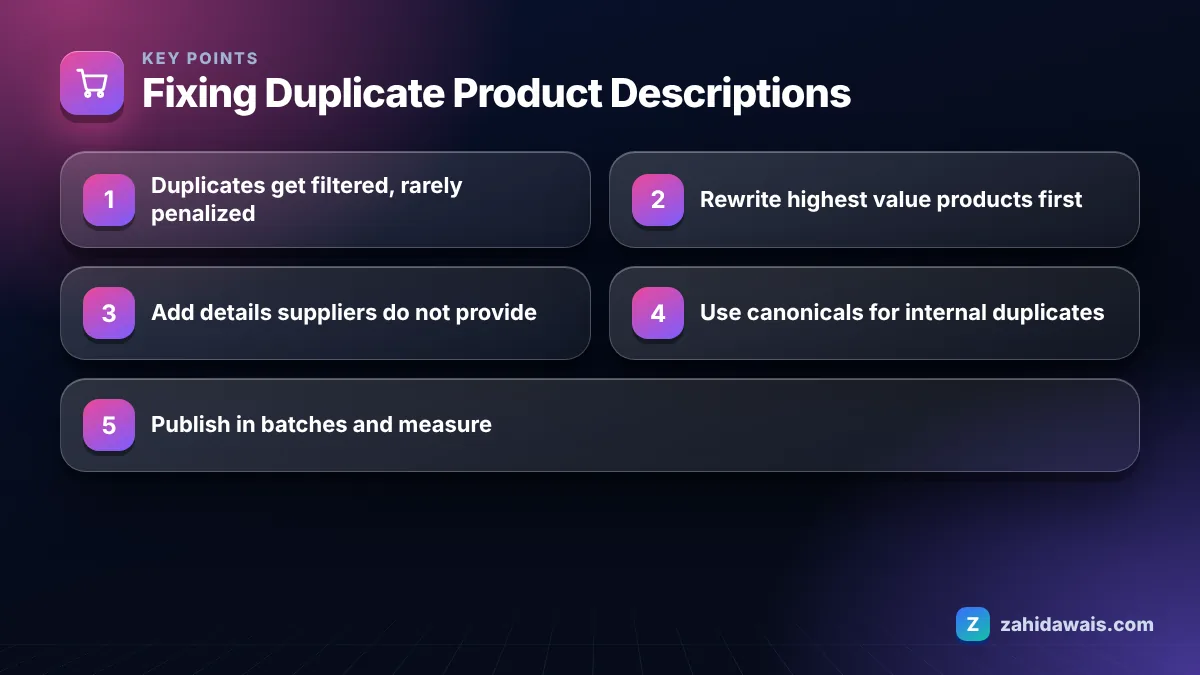
Duplicate product descriptions copied from a manufacturer usually do not trigger a penalty, but they make it hard to outrank the many other stores using the same text. Google tends to show one version and filter the rest. Rewrite your highest value products first and add original details buyers need.
Yes, you can legally and technically use manufacturer descriptions if your supplier allows it, and many stores do, but it is the weakest possible starting point for search. The same paragraph may already sit on the brand’s own site, on large marketplaces and on dozens of competing stores.
When several pages carry the same text, a search engine has little to separate them except authority, price and other signals. Big retailers usually win that contest. A small store using identical copy is asking Google to choose it for no visible reason.
Manufacturer text is still useful as a source of facts: dimensions, materials, compatibility and care instructions. Keep those facts accurate, then build original content around them.
A quick way to see the scale of the problem is to copy one sentence from a product description, wrap it in quotation marks and search for it on Google. If dozens of stores appear with the same sentence, your page is one of many identical candidates. If only your store and the brand appear, the duplication matters far less, and your time is better spent elsewhere.
Also check your supplier agreement. Some brands require resellers to use approved wording for safety claims, ingredients or warranty terms. In that case, keep the required wording exactly and add your original content in separate sections around it.
Google does not generally penalize ordinary duplicate product descriptions; it chooses which version to show and filters the others from the results. That is a ranking outcome, not a manual action, but in practice it can feel similar because your page simply does not appear.
The line is crossed when copying is the whole strategy. Google’s spam policies describe scraping as republishing content from other sites without adding original content or value, and describe thin affiliate pages as product text copied directly from the original merchant without original content or added value. A real store with real stock and its own checkout is not an affiliate page, but the principle is the same: pages that add nothing have little reason to rank.
There is also duplication inside your own site, which is a separate problem. The same product reachable at several URLs, or two nearly identical products with the same text, creates internal duplicates. Google’s guide on how to specify a canonical URL explains how to tell Google which version you prefer, using redirects, rel=”canonical” or sitemaps.
There are three different duplicate description problems, and each has a different fix. Mixing them up is the most common reason stores spend money on rewriting and see no change.
| Type | Example | Main risk | Fix |
|---|---|---|---|
| Copied from manufacturer or supplier | Same paragraph on 50 stores | Filtered in favour of stronger sites | Rewrite top products, add original details |
| Same product at several URLs on your site | Product reachable under two category paths | Split signals, wasted crawling | Canonical tag or redirect to one URL |
| Near identical products with one shared text | Ten phone cases differing only by model | Pages compete with each other | Unique opening lines and specs, or merge as variants |
| Your text copied by other sites | Scrapers or resellers reusing your copy | Usually limited if your page is the clear original | Monitor, contact the site, or file a copyright request if needed |
If the second or third row describes your store, the fix is structural rather than editorial. My guide to duplicate without user-selected canonical covers the Search Console side of internal duplicates.
You write unique descriptions at scale by prioritising products by value, using a fixed template of original elements, and rewriting in batches rather than all at once. Nobody needs to hand-write 8,000 descriptions in one quarter.
AI writing tools can help with first drafts, but feeding them the same supplier text produces the same facts in different words. The value comes from the original information in step four, not from rewording.
Consider a kitchenware store with 2,400 products, all using supplier descriptions. Search Console shows that 300 products receive most of the impressions, and sales data shows 180 of them also produce most of the revenue.
Tier one is those 180 products: full rewrites with original usage notes and owner questions, about 150 to 250 words each. Tier two is the next 420 products: a new two sentence opening and a structured specs table. Tier three, the remaining 1,800, keep supplier text with rewritten titles. At 15 rewrites a day, tier one takes about 12 working days, which is a realistic project instead of an impossible one.
A product page becomes original through everything around the description, not just the paragraph itself. Google sees the whole page, and so do shoppers.
In my orders I often see stores rewrite descriptions while leaving thin category pages and missing internal links untouched. Product copy is one part of a wider e-commerce SEO job, and the stores that improve most usually fix structure, categories and content together.
If you only have time for one action this week, export your top 50 products by impressions, check how many still use supplier text word for word, and rewrite the first ten. That small test will show you whether the effort pays off in your niche before you commit a budget to the whole catalog.
It can help, especially on products where many stores share the same text, but there is no guarantee. Rewrites work best when they add original information such as sizing notes, use cases and buyer questions, and when the page also has good internal links and photos.
There is no required length from Google. Write enough to answer what a buyer needs to decide, which is often 100 to 300 words for standard products and more for technical or expensive items. Clarity and useful detail matter more than word count.
Using the same description on a marketplace and your own site creates external duplication, and the marketplace often has more authority. Write a different, richer description for your own store so your site has a clear reason to rank for searches about the product.
You can use AI as a drafting aid, but rewording the same supplier text adds little value. Give the tool original inputs such as your measurements, customer questions and testing notes, then edit the result so it is accurate and helpful.
Usually not. Noindex removes the page from search entirely, which means it cannot rank at all. For low priority products it is better to keep them indexed with supplier text and improve them gradually, starting with the products that matter most.
First check whether your page still ranks for its main terms. If it does, the copy may not be harming you. If a site is clearly copying your content, contact them, and if needed submit a copyright removal request through Google’s legal process.
Facts checked against these official pages. Read how I check facts in my editorial policy.
Search Console flags missing fields in Product markup constantly. Some block rich results, most do not. Here is how to tell them apart.
Read article
Shoppers often search with their eyes first. These nine tips help your product photos get found, understood and clicked.
Read article
A sold out product does not have to lose its rankings. Here is how to decide what each page should do.
Read articleSend your website and I will reply with a free audit.