Link building strategy
How to Audit Backlinks in a Spreadsheet: Free Steps and Tools
How to audit backlinks in a spreadsheet: export your links, group them by referring domain, check anchors and rel values, flag link…
Read article
This guide is for site owners, marketers and link builders who send outreach emails and want them to reach a person who can actually add a link. You will learn how to shortlist the right sites, identify the right person, find the right email for link outreach without guessing blindly, and keep each message within the spam and privacy rules.
To find the right email for link outreach, first shortlist sites that already link to similar businesses, then find the author or editor of the exact page you want a link on. Use an address they publish. If none is published, confirm the company’s address pattern before using a guessed address, and send one personal email.
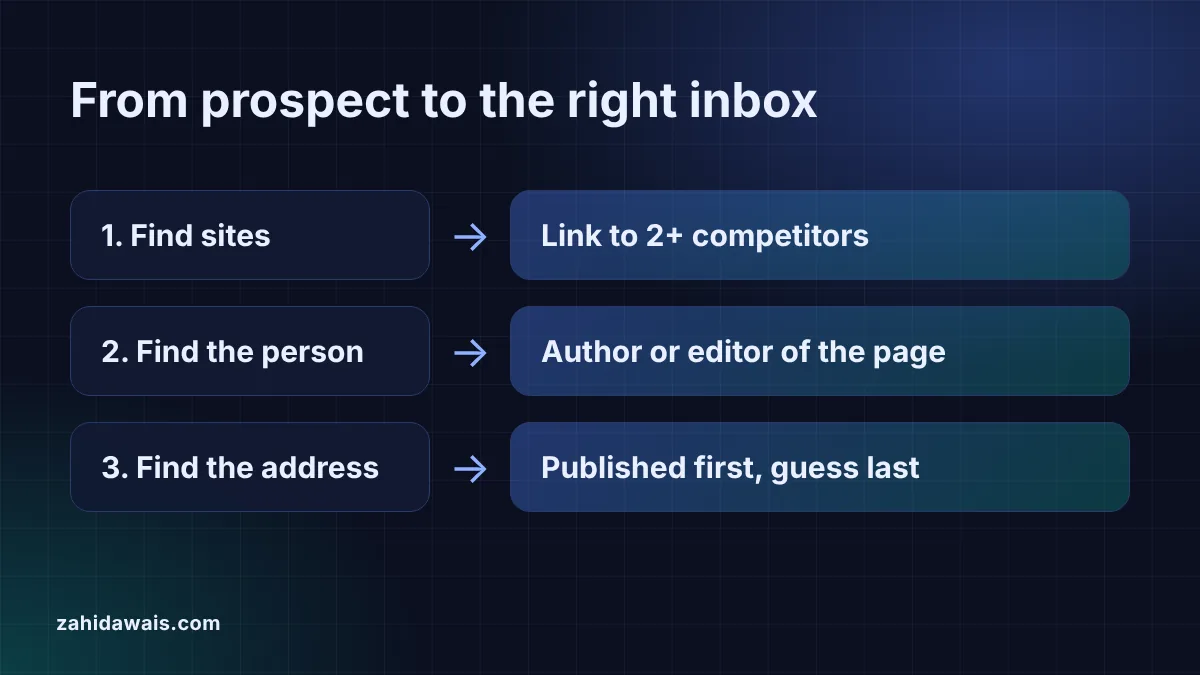
Email the person who can edit the page you want a link on. On a small blog that is usually the owner. On a magazine or company blog it is the author of the article or the section editor, not the sales team, the support desk or a general info@ inbox. A precise, relevant request to the right editor is easier to answer than a vague one forwarded twice.
Decide what you are asking for before you look for anyone. “Please add my link” is not a reason. A broken link you found on their page, an outdated statistic you can update with a cited source, or a resource that fills a gap their readers ask about are reasons. The blogger outreach guide covers how to build that offer.
Start with sites that already link to several of your competitors, because they have shown they cover your topic and cite businesses like yours. Export the referring domains of 2 to 4 competitors from your backlink tool, export your own from Search Console, and paste them into the link intersect tool. It lists the domains that link to two or more competitors but not to you. Add fresh prospects with link prospecting search strings.
Then check every domain by hand. Open the page that links to your competitors, confirm it is real, on topic and still live, and note the author. Remove sites that openly sell followed links: Google’s spam policies list “Buying or selling links for ranking purposes” as link spam, and paid links are acceptable only when “qualified with a rel=”nofollow” or rel=”sponsored” attribute value”.
Look where the site publishes contact details itself. These sources are public, they show how the person wants to be contacted, and they often reveal the company’s address pattern even when the editor’s own address is not listed.
| Where to look | What you usually find | Best use |
|---|---|---|
| Author bio or byline | Name, role, sometimes an email or social profile | Identify who wrote the page |
| Contact or about page | General inbox, editorial address or a form | Use when no personal address is listed |
| Write for us or contributor page | Pitch address and submission rules | Follow their rules exactly |
| Press page, PDFs, job adverts | One staff address that shows the pattern | Confirm the format before guessing |
| The person’s professional profile | Current role and preferred contact route | Check they still work there |
If the site offers only a contact form, use the form. If an editor says on their author page that they do not accept pitches, respect it and move on. Never buy scraped email lists for outreach; you cannot know how the addresses were collected or whether those people expect to hear from you.
Find the pattern first, then apply it to the name. Most companies use one format for every staff address, such as first.last or first initial plus last name. If you can find any one published address on the same domain, from a press page, a PDF or a job advert, you know the pattern. Type the editor’s name and the domain into the email permutator and pick the single address that matches it.
A guessed address is a hypothesis, not a fact. The permutator does not check that a mailbox exists, and sending one message to every possible format is guesswork that reaches strangers and looks like spam. If you cannot confirm the pattern, use the contact form or a general editorial address and ask for the right person by name.
Outreach that promotes a product or service is usually treated as commercial email, and business addresses are not exempt. The FTC’s CAN-SPAM compliance guide says the US law “doesn’t apply just to bulk email”, “makes no exception for business-to-business email”, and requires accurate headers, honest subject lines, “your valid physical postal address” and a clear opt-out that you honour “within 10 business days”. It says each violating email can cost up to $53,088.
In the UK, the ICO’s business to business guidance says the PECR consent rule for marketing email “does not apply to corporate subscribers”, but you must not hide your identity and must give a valid address to opt out. Sole traders and some partnerships count as individuals and need consent or the soft opt-in. A named work address still identifies a person, so UK GDPR applies, and if they object, “you must stop processing their personal data for B2B marketing purposes”. This is general information, not legal advice.
Say who you are, why you chose their page, and what is in it for their readers, in a few short paragraphs. Use their name, mention the exact article, include your real name, business and postal address, and add one line telling them how to opt out. The outreach email template generator builds a first draft from those details, and the follow-up email generator writes one polite reminder.
Never offer money, products or a link swap for a followed link. Google’s spam policies list “Exchanging money for links, or posts that contain links” and “Excessive link exchanges” as link spam. If a placement is paid or sponsored, say so and ask for rel=”sponsored”. Stop after one follow-up if there is no reply, and remove anyone who asks you to stop.
Example: a small agency pastes the referring domains of three competitors and its own into the link intersect tool. Three domains link to two or more competitors but not to the agency; growthweekly.example links to all three. Its relevant article is written by an editor called Sara O’Neill. Her bio lists no email, but the site’s press page shows a colleague’s address in the first.last format. The email permutator lists 16 possible formats for Sara O’Neill at growthweekly.example, and the one that matches the published pattern is sara.oneill@growthweekly.example. The agency sends one personal email about an outdated statistic in her article, with a postal address and an opt-out line, and one follow-up a week later.
It is common, but guess carefully. Confirm the company’s address pattern from a published address first, send one personal message to the single best match, and identify yourself honestly. Never send the same message to every possible format.
Email the author or section editor of the page you want a link on, because they can edit it. On small blogs the owner is usually also the author. Go to the owner only when you cannot find who is responsible for the page.
In the UK, the ICO says the PECR consent rule for marketing email does not apply to corporate subscribers, but sole traders and some partnerships need consent. UK GDPR still applies to named work addresses. In the US, CAN-SPAM requires an opt-out and a postal address.
One polite follow-up after about a week is enough for most outreach. If there is still no answer, stop. Editors receive many pitches, and repeated reminders to someone who has not replied are more likely to be reported than answered.
Not for a followed link. Google’s spam policies treat exchanging money for links that pass ranking credit as link spam. If a placement is sponsored, say so openly and ask for the link to carry rel=”sponsored” or rel=”nofollow”.
Use the form. It is the route the site has chosen, so a short, specific message there is more likely to reach the right person than a guessed address. Ask who handles the page you are writing about.
This guide is part of my link building guide.
Checked 23 Oct 2026. Facts checked against these official pages. Read how I check facts in my editorial policy.
Want outreach handled for you? See my link building service.
How to audit backlinks in a spreadsheet: export your links, group them by referring domain, check anchors and rel values, flag link…
Read article
Capterra and G2 backlinks explained: what review site links are, what the platforms' own docs say about paid links, and their value…
Read article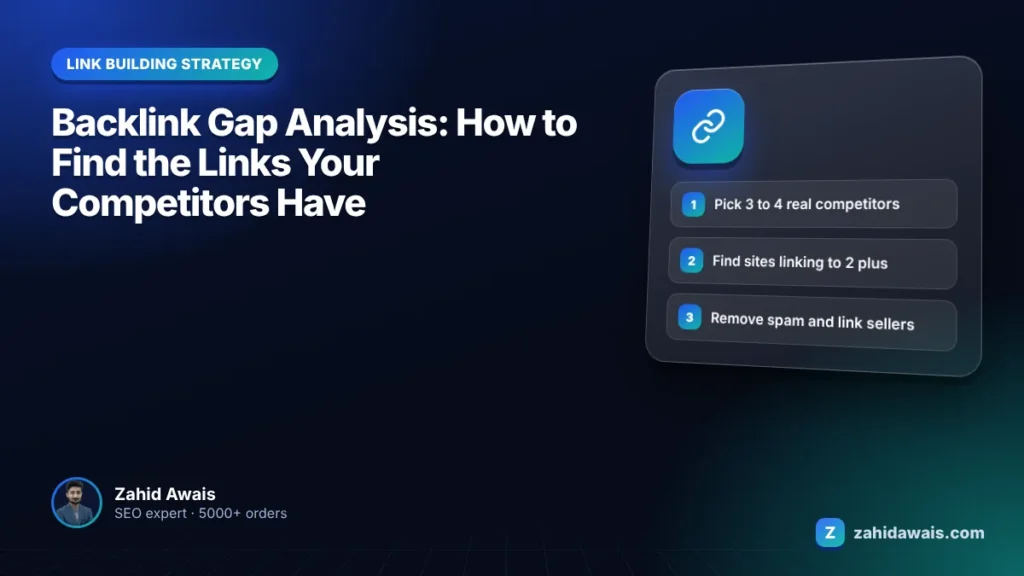
A gap analysis shows which sites link to several competitors but not to you. The skill is filtering that list into real opportunities.
Read articleSend your website and I will reply with a free audit.