AI search (AEO and GEO)
Schema Markup for AI Search: Does It Really Help Citations?
Schema helps machines understand your pages, but Google says no special markup is needed for its AI features. Here is the balanced view.
Read articlePerplexity shows its sources next to every answer. Being one of them starts with letting PerplexityBot in.
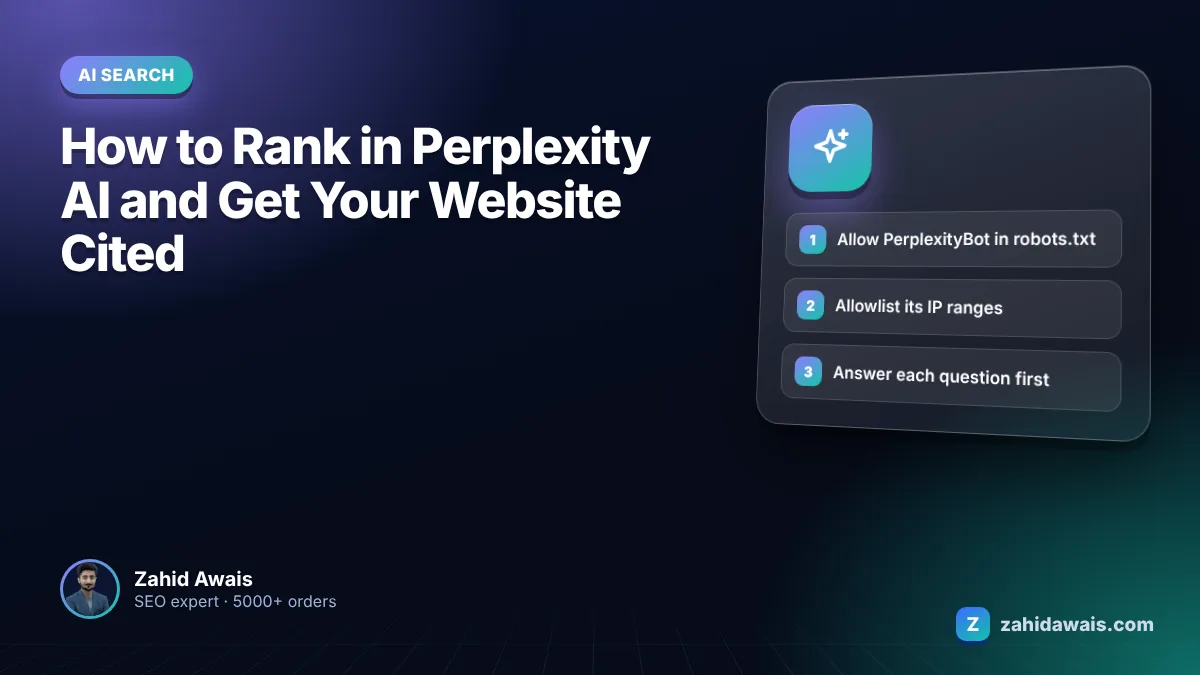
This guide explains how to rank in Perplexity using Perplexity’s own crawler documentation and the content patterns I see cited most often in client checks.
To rank in Perplexity, allow PerplexityBot in robots.txt and your firewall, since Perplexity says it will not index sites that disallow it. Then publish specific, answer-first pages with original detail, keep facts current, and earn mentions on trusted sites in your niche. Perplexity does not sell placement in its answers.
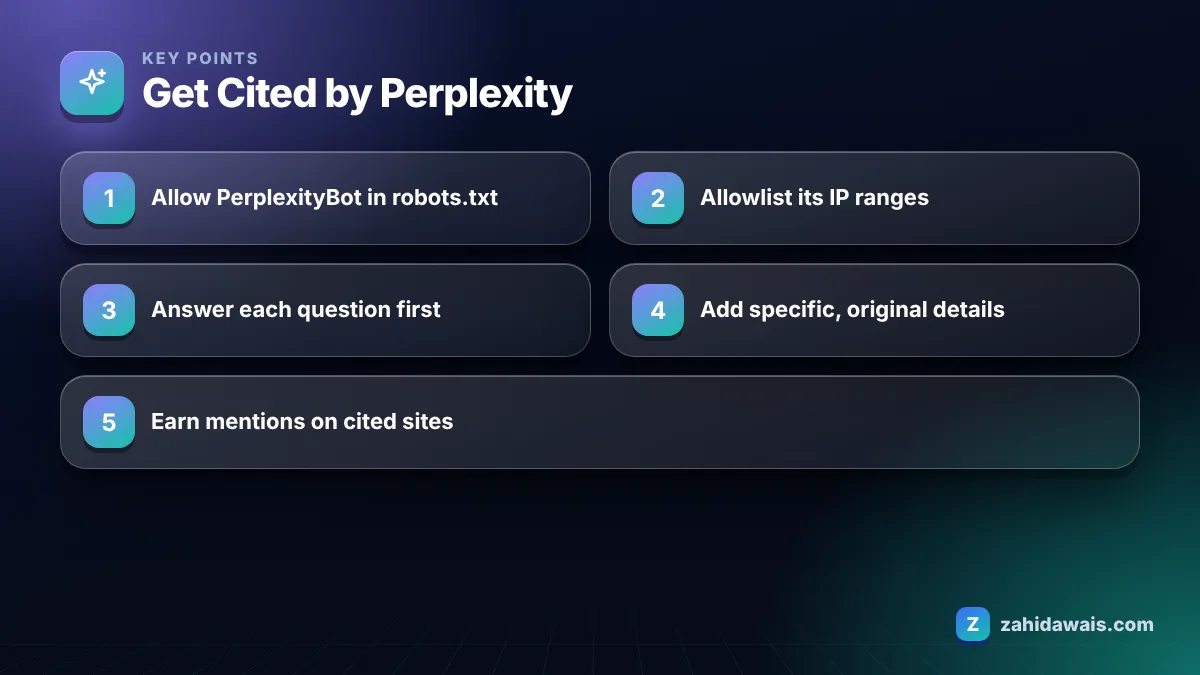
Perplexity chooses sources from its own search index and live web results that best answer the user’s question, and it shows those sources as numbered citations. Perplexity has not published a ranking formula, so anyone claiming to know the exact weights is guessing.
What Perplexity does publish is how its crawler works. Its documentation on Perplexity crawlers says PerplexityBot is designed to surface and link websites in search results on Perplexity, recommends allowing it in robots.txt, and states it is not used to crawl content for AI foundation models. So the first condition for being cited is simple: the bot must be able to read your pages.
From my own prompt checks across service, ecommerce and B2B topics, the cited pages usually share three traits. They answer the exact question in the first lines of a section, they contain concrete details (numbers, names, dates, steps), and they come from sites that are referenced elsewhere in the topic. None of that is unique to Perplexity; it is the same pattern that wins featured snippets.
Yes, PerplexityBot respects robots.txt, but Perplexity-User, the fetcher used when a person asks about a specific page, generally does not. Perplexity’s help article on how it follows robots.txt says PerplexityBot will not index the full or partial text content of any site that disallows it.
That has a practical consequence. If you block PerplexityBot, Perplexity says it may still show your domain, a headline and a brief factual summary, but it will not use your content to build answers. For a business that wants to be cited, blocking it is self defeating.
Check your firewall too. Perplexity publishes IP ranges for PerplexityBot and recommends combining user agent matching with those ranges if you use a web application firewall. It also says robots.txt changes can take up to 24 hours to be reflected. You can test your rules for any user agent with my robots.txt tester.
Ranking in Perplexity differs from Google mainly in what success looks like: in Google you compete for a position in a list, while in Perplexity you compete to be one of a handful of numbered sources inside a written answer. The foundations, crawlable pages and helpful content, are the same.
Three differences matter in practice:
There are also things that do not change. Thin pages, duplicated content and sites with no reputation struggle in both. Spam tactics that might work briefly in one system tend to fail in the other. That is why I never build separate “Perplexity pages”. I improve the real page that already serves customers, and let both systems find it.
One last difference is measurement. Google gives you Search Console. Perplexity gives you no dashboard for site owners, so you rely on referral data in analytics and on a fixed list of prompts checked by hand every month.
Make every important page easy to quote: a direct answer first, specifics second, and proof of experience throughout. These are the changes I make most often, in order of impact:
The same steps lift Google rankings, which is why I treat Perplexity work as part of on-page SEO rather than a separate project.
You get your brand mentioned in Perplexity answers by being mentioned, accurately and repeatedly, on the sites Perplexity already cites for your topic. If every “best X in Y” list and industry roundup names your competitors and not you, an answer built from those sources will do the same.
| Factor | Within your control? | Documented by Perplexity? | Effort |
|---|---|---|---|
| PerplexityBot access | Yes | Yes | Low |
| Firewall allowlisting | Yes | Yes, IP ranges published | Low |
| Answer-first content | Yes | No, observed pattern | Medium |
| Original data and examples | Yes | No, observed pattern | Medium |
| Mentions on cited sites | Partly | No, observed pattern | High |
| Paid placement in answers | No | Not offered | Not possible |
A UK travel company wants to be cited for “best time to visit Lake Garda”. The first prompt check shows 6 cited sources, none of them the company. The crawler check finds PerplexityBot allowed in robots.txt but challenged by the CDN, so it never receives the page text. Step one is allowlisting Perplexity’s published IP ranges. Step two is rewriting the Lake Garda guide: a one sentence answer naming the best months and why, a month by month table with typical weather and crowd levels, and a short section on ferry timetables written from the team’s own trips. Step three is pitching a short expert quote to two travel publications already cited for the query. The team reruns the same prompt monthly and logs the cited domains. The team also tracks perplexity.ai sessions in GA4 and the enquiries they produce, so progress is measured in business terms as well as citations. The goal is to become one of the cited sources over a few months, not to promise the first citation.
If you want help with crawler access, page rewrites and mention outreach together, see my GEO services.
Perplexity does not publish a full list of its data sources. It operates its own crawler, PerplexityBot, and says third party crawlers that help build its index must respect robots.txt. Being well indexed across search engines is still a sensible baseline for visibility.
Perplexity does not offer paid placement inside its organic answers. Be cautious with anyone promising guaranteed Perplexity citations. The documented steps are allowing PerplexityBot, keeping pages accessible, and publishing content that answers questions better than other sources.
Perplexity says PerplexityBot will not index the full or partial text of a site that disallows it. It may still show your domain, headline and a brief factual summary, but your content will not be used to build answers, which removes most citation chances.
Perplexity says PerplexityBot is not used to crawl content for AI foundation models, and that it does not build foundation models itself. The crawler exists to surface and link websites in Perplexity’s search results.
Perplexity says robots.txt changes can take up to 24 hours to be reflected. How quickly updated content is cited depends on recrawling and on whether your page is now the best answer. In my checks, meaningful changes usually show within weeks, not days.
In GA4, look for perplexity.ai as the session source, or add it to a custom AI assistants channel group placed above Referral. Some visits arrive without a referrer and show as direct, so treat the number as a minimum.
Facts checked against these official pages. Read how I check facts in my editorial policy.
Schema helps machines understand your pages, but Google says no special markup is needed for its AI features. Here is the balanced view.
Read article
ChatGPT visits hide inside Referral and Direct by default. A 10 minute channel group setup puts them in their own row.
Read article
Training bots and search bots are different. Block the wrong one and you vanish from AI answers without meaning to.
Read articleSend your website and I will reply with a free audit.