Article Schema Generator
An article schema generator is a tool that writes schema.org Article structured data in JSON-LD. It collects…
Create ProfilePage JSON-LD for author, creator and team profile pages in seconds.
Mark up only what is visible on the profile page. Stats must be real numbers from this site.
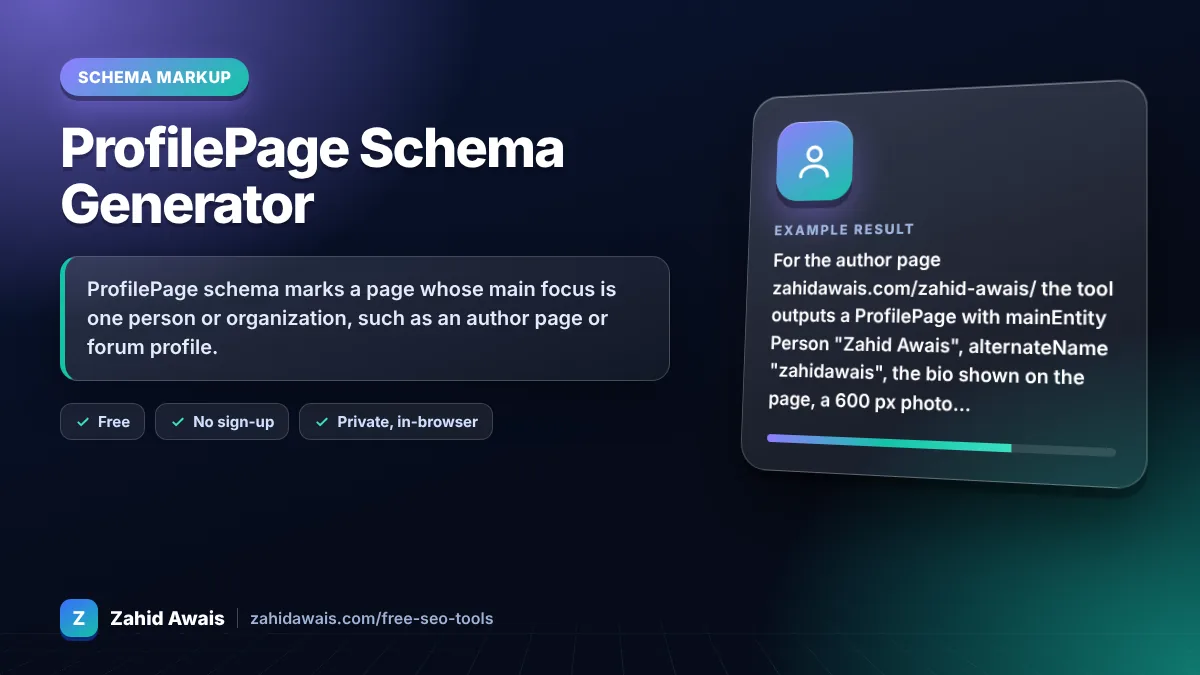
The free profilepage schema runs in your browser, needs no sign-up and never sends what you type anywhere.
ProfilePage schema marks a page whose main focus is one person or organization, such as an author page or forum profile. Google requires mainEntity with a name; dateCreated, dateModified, alternateName, image, sameAs and interaction counts are recommended. It does not create a rich result of its own, but helps Google understand who creates your content.
A ProfilePage schema generator is a tool that writes schema.org ProfilePage markup in JSON-LD. It wraps a Person or Organization as mainEntity, adds the page dates, and can include follower and post counts as InteractionCounter objects, following Google's profile page documentation.
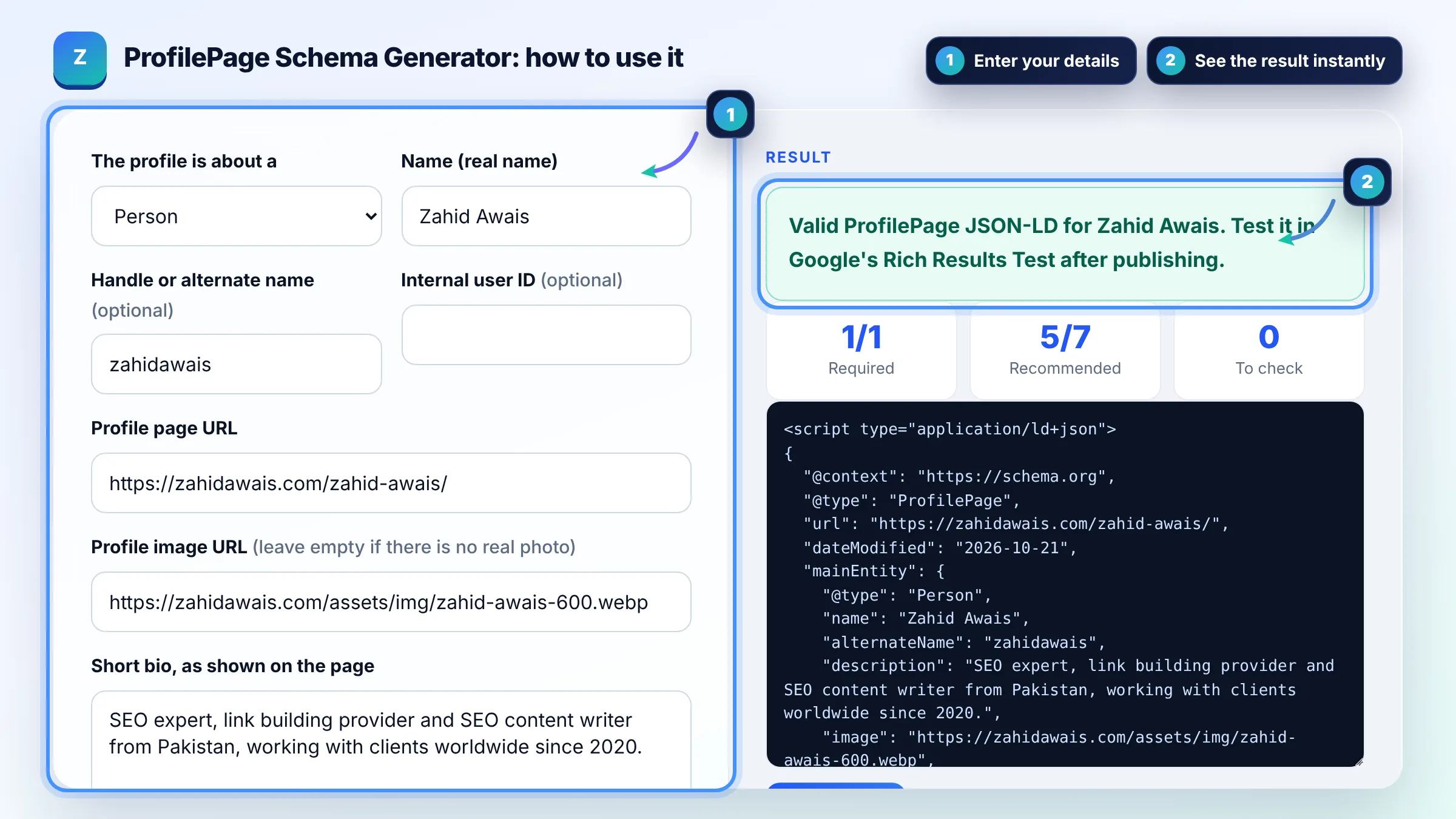
ProfilePage schema tells Google that a page is mainly about one person or organization, usually a creator on your site. Google's profile page documentation says it helps show community content and first hand perspectives better, including in Discussions and forums. Article, Q&A and forum markup can point to the same creator.
No, ProfilePage markup does not create a special rich result such as stars or a card. It helps Google identify creators and connect them with their content. Treat it as an understanding signal for author pages and community profiles, and do not expect a visual change in search results.
It can support E-E-A-T by making the author's identity clear, but the markup alone does not prove expertise. Google evaluates the content and reputation, so the visible profile matters most: real name, photo, experience, links to work and other profiles. The schema simply describes that visible page.
| Property | Status in Google docs | Example |
|---|---|---|
| mainEntity (Person or Organization) | Required | Person: Zahid Awais |
| mainEntity.name | Required (or alternateName) | Zahid Awais |
| dateCreated, dateModified | Recommended | 2026-10-21 |
| alternateName, identifier | Recommended | zahidawais, internal user ID |
| image, description, sameAs | Recommended | Photo URL, bio, LinkedIn URL |
| interactionStatistic, agentInteractionStatistic | Recommended | FollowAction count, WriteAction count |
Example: for the author page zahidawais.com/zahid-awais/ the tool outputs a ProfilePage with mainEntity Person "Zahid Awais", alternateName "zahidawais", the bio shown on the page, a 600 px photo and three sameAs links (LinkedIn, Facebook and Legiit). Follower and post counts stay empty because the site does not show them.
Add it to the profile page itself, such as an author page, team member page or forum user profile. The page's main focus must be that one person or organization, and they must be affiliated with your website.
Person describes the human, while ProfilePage describes the web page that is about them. ProfilePage wraps the Person as mainEntity. Use Person alone in places like an article author, and ProfilePage on the dedicated profile page.
No. Google says to include only stats about the platform where the profile page is hosted. Followers on other networks belong in sameAs links, not in interactionStatistic, and every number must be real.
No. If the profile has no real photo, leave the image empty. Google advises against adding a default image, icon or placeholder, and recommends crawlable, high resolution images that represent the creator.
Change dateModified when the profile itself is edited, such as a new bio, photo or name. New posts by the author or new links pointing to the page do not count as edits to the profile.
Paste the page URL or code into Google's Rich Results Test, which supports profile page markup, or use the Schema Markup Validator. After publishing, check the rich result status reports in Search Console for any errors Google finds.
Facts checked against these official pages. Read how I check facts in my editorial policy.
An article schema generator is a tool that writes schema.org Article structured data in JSON-LD. It collects…
An organization schema generator is a tool that writes schema.org Organization structured data. It gathers…
A person schema generator is a tool that writes schema.org Person structured data. It describes who someone…
Send your website and I will check it for you, free.
One short email when something new goes live: articles, free SEO tools, package updates, discounts and price alerts. No spam, unsubscribe in one click.