
Local SEO
AI SEO for Local Businesses: Show Up in AI Answers
AI SEO for local businesses from Google's own docs: a complete Business Profile, genuine reviews, matching citations and clear service pages for…
Read article
Most lawyers ask what SEO should cost before they ask what work their site needs. That order makes budgets hard to set. This guide explains what really drives law firm SEO cost, which parts you pay for, and a simple way to plan your own number.
Law firm SEO cost depends on the practice areas you target, how many cities you serve, how strong the firms already ranking are, and the state of your site. Most of the budget goes to content, local SEO and link building. Set your spend by the gap to competitors, not by a fixed package.
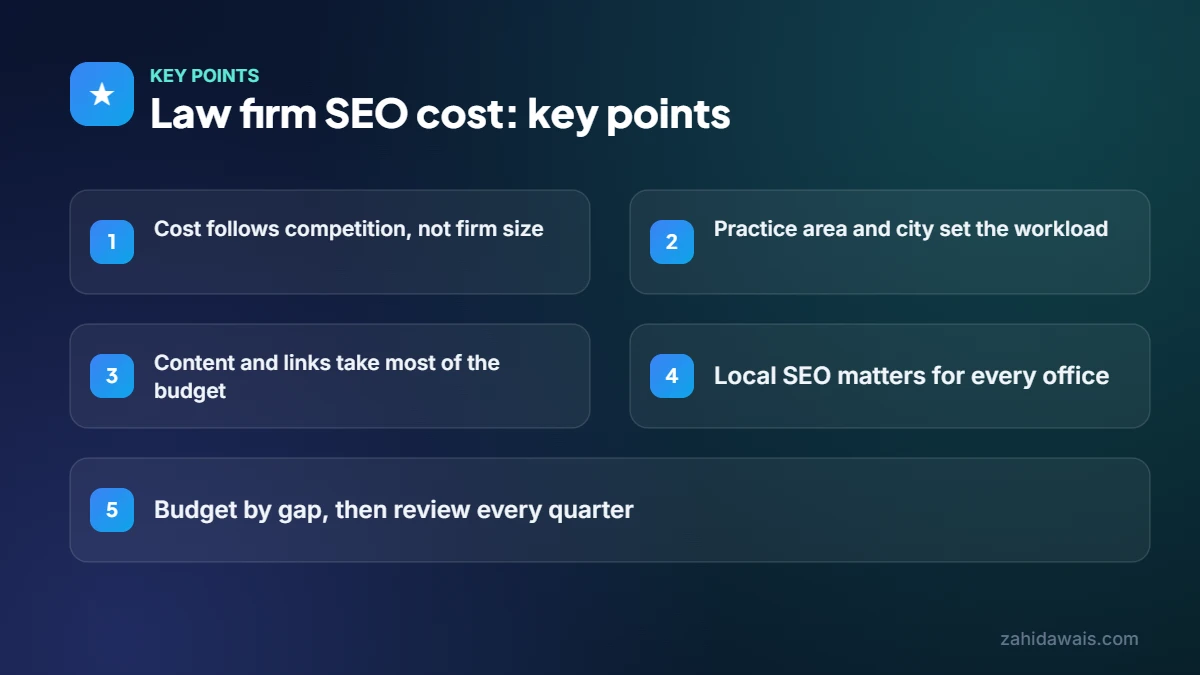
The biggest driver is competition in your practice area and city. A personal injury firm in a large city faces many firms with strong sites. A wills and probate firm in a small town may face very few. The same work produces results faster where fewer firms compete.
Four other factors change the workload:
Firm size matters less than people think. A small firm in a busy niche may need more work than a large firm in a quiet one.
A legal SEO budget usually has five parts: an audit, technical and on-page work, content, local SEO and link building. Each part solves a different problem, so the mix changes from firm to firm.
| Component | What it covers | What makes it cost more |
|---|---|---|
| Audit | Crawl, indexing, page quality, profiles, competitor check | Large sites, many offices, past penalties |
| Technical and on-page | Speed, internal links, titles, schema, page structure | Old themes, duplicate pages, poor URL setup |
| Content | Practice area pages, guides, FAQs, location pages | Many practice areas, legal review time |
| Local SEO | Google Business Profile, citations, reviews process | Several offices, practitioner profiles |
| Link building | Relevant guest posts, niche edits, digital PR | Large authority gap, strict quality standards |
Technical work is often heavy at the start and light later. Content and links are ongoing. Local SEO needs a big setup and then regular upkeep. My SEO pricing guide explains how these parts are usually packaged.
Practice area and city change the price because they decide how strong the competing pages are. A search like “divorce lawyer” plus a big city name brings up firms with years of content and many links. Matching them takes more pages and more links.
Local search adds another layer. Google says local results are mainly based on relevance, distance and prominence. In its tips to improve your local ranking, Google also states: “There’s no way to request or pay for a better local ranking on Google.” So money buys work, not position. The work is verifying the profile, keeping details current, adding photos and replying to reviews.
Lawyers can also have practitioner profiles. Google’s guidelines for representing your business say a practitioner “shouldn’t have multiple Business Profiles to cover all of their specializations.” A firm with many lawyers needs a clear plan for which profiles to keep. That planning is part of local SEO cost.
Budget by measuring the gap between your site and the top results for each practice area and city, then price the work needed to close it.
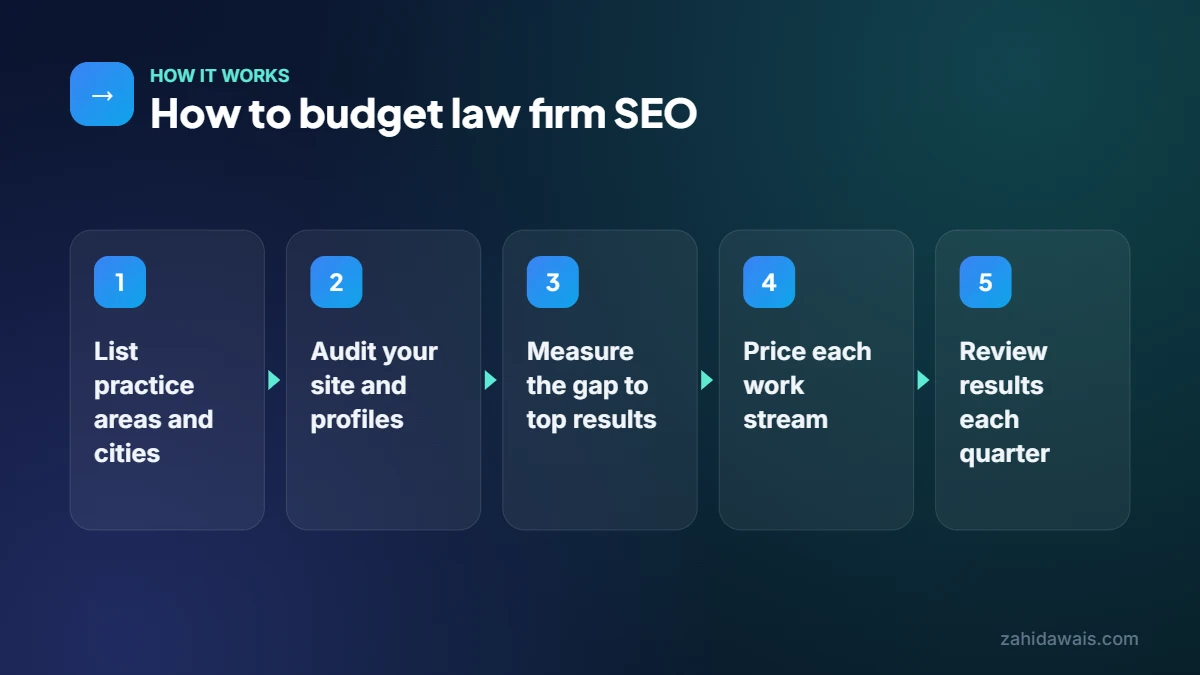
Start with fewer targets if money is tight. Two practice areas done well usually beat six done thinly. Give each target enough time too. Google’s SEO starter guide says some changes “could take several months” to show an effect.
The example below shows the method, not real market prices. The firm and numbers are made up to show how the gap shapes the plan.
Illustrative example: examplelaw.com is a two-office family law firm. It targets “divorce lawyer” and “child custody lawyer” in two cities. The audit finds slow pages, no location pages and one unverified Google Business Profile. The top three competing firms each have far more relevant referring domains than examplelaw.com.
The plan puts most of the first three months into technical fixes, two location pages and four practice area pages. Profile cleanup runs in the first month. Link building starts small and grows from month three, aimed at legal and local sites. After two quarters, the firm sees custody pages moving faster, so it moves part of the content budget to divorce pages. The total budget stays fixed. Only the split changes.
The key point is that the budget comes from the gap and the targets. A fixed package would have spent the same on both cities, even though one needed more work.
Link building should get the share that matches your authority gap, which for competitive practice areas is often the largest ongoing cost. Google’s ranking systems guide says it has systems “that understand how pages link to each other”, including PageRank.
Links must be clean. Google’s spam policies list “Buying or selling links for ranking purposes” as link spam. Paid placements are fine for advertising when they are marked with rel=”sponsored” or rel=”nofollow”. Any vendor who promises guaranteed rankings is a warning sign. Google says plainly: “No one can guarantee a #1 ranking on Google.”
For legal sites, focus on relevance. Links from legal directories, bar related resources, local news and law guides help more than random high metric sites. My page on link building for law firms covers how I pick sites.
The most common hidden cost is lawyer review time for content. Legal pages are YMYL content, so accuracy matters. Someone at the firm must check each page before it goes live.
Other costs to plan for:
If you want a plan built around your practice areas, see my SEO for law firms service.
SEO is often worth it for a small firm when it targets a few profitable practice areas in its own city. Smaller targets are easier to win. Track cases from organic search so you can judge the return, not just traffic or rankings.
Quotes vary because each provider scopes different work. One may include content and links, another only reports. Ask each provider to list tasks, deliverables and how they measure success. Then compare the work, not just the monthly figure.
Google’s starter guide says some changes take hours and others could take several months. In my experience, competitive practice areas usually need three to six months before steady movement. Quieter areas and local terms can move sooner.
No. Google’s Business Profile help says there is no way to request or pay for a better local ranking. You can pay for ads, which are separate. Organic local ranking comes from relevance, distance and prominence.
Either can work. Per link pricing is clear when you know how many links you need. Monthly plans suit ongoing work across content, local SEO and links. What matters most is link quality, relevance and correct rel attributes on paid placements.
Google suggests asking for examples of past work, whether they follow Google Search Essentials, what results they expect and in what timeframe, and their experience in your industry and city. Avoid anyone who guarantees a first place ranking.
Facts checked against these official pages. Read how I check facts in my editorial policy.
AI SEO for local businesses from Google's own docs: a complete Business Profile, genuine reviews, matching citations and clear service pages for…
Read article
How to track Google Business Profile clicks in GA4: tag profile links with UTM values, find them in Traffic acquisition and compare…
Read article
How to make a Google review QR code, where to place it, what to write next to it, and which of Google's…
Read articleSend your website and I will reply with a free audit.