Guest posting and link types
Guest Post Red Flags: 12 Signs a Site Is Not Worth Buying
The 12 warning signs I check on every guest post site before a client's link goes anywhere near it.
Read articleMost marketplace guest posts are sponsored posts. Here is why that matters for links, labels and Google's rules.
This article explains guest post vs sponsored post in plain terms: what each one is, how Google expects the links to be marked, and how to tell which one you are actually buying.
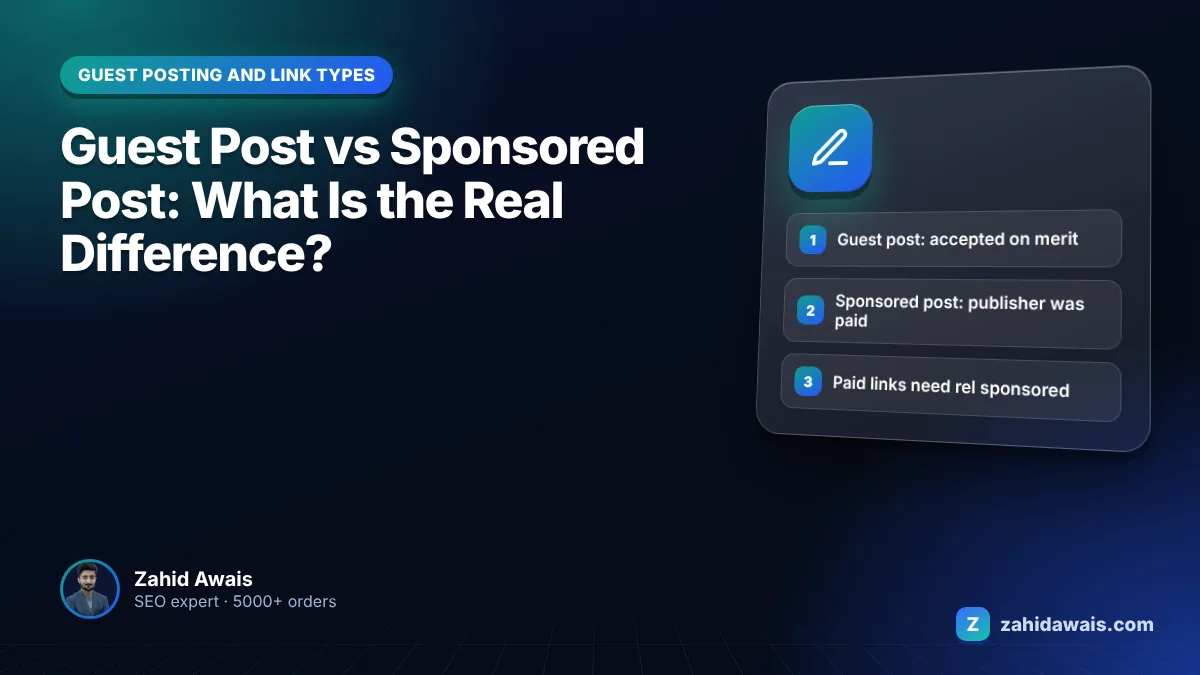
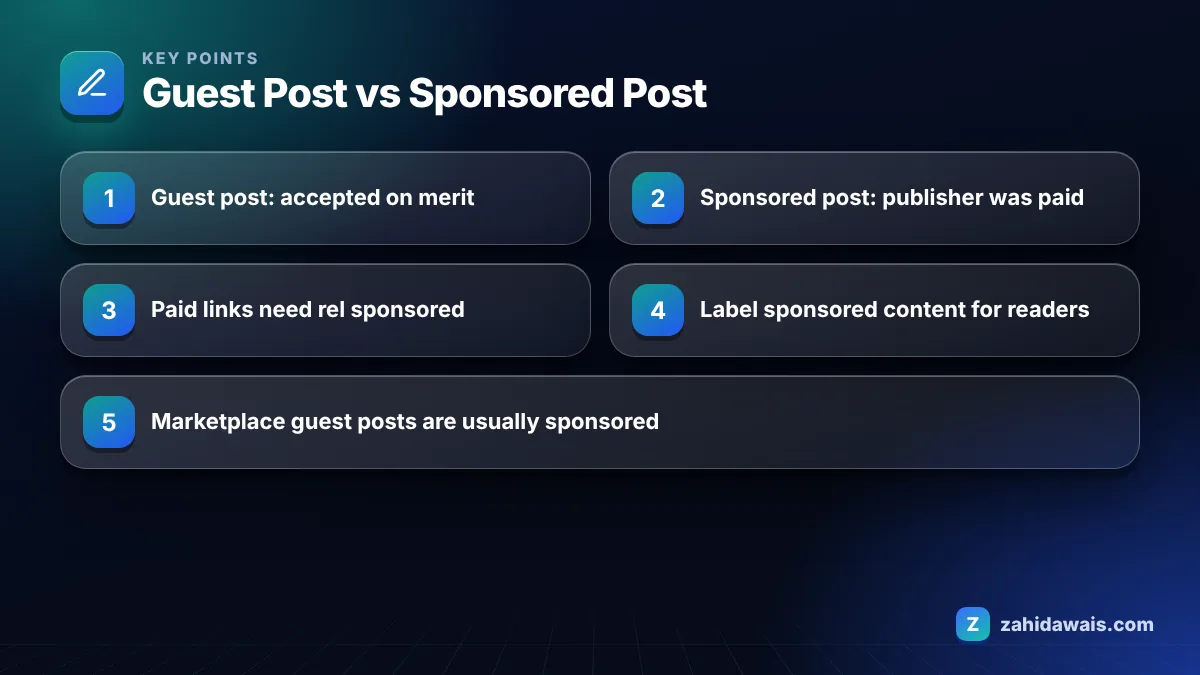
In the guest post vs sponsored post comparison, the key difference is payment. A guest post is an article contributed to another site, ideally accepted on merit. A sponsored post is content the publisher is paid to run. If money, products or services change hands for the link, Google treats it as a paid link that needs rel=”sponsored” or rel=”nofollow”.
No, a sponsored post is not the same as a guest post, although the two often look identical on the page. The difference lies in why the article was published, not in its format or length.
A guest post, in its original sense, is written by an outside author and accepted because the editor thinks it helps their readers. The author gets exposure and perhaps a byline link. Nobody pays the publisher.
A sponsored post is published because someone paid for it. The payment can be cash, free products, a service or a swap. The content might be written by the brand, by a freelancer or by the publisher’s own team, but the reason it exists is the deal.
The confusion comes from marketplaces. On most platforms, including the ones where I have completed thousands of orders, “guest post” is the product name for what is really a sponsored placement: the buyer pays, the publisher posts. That is normal commercial practice, but it means the link is a paid link, whatever the listing calls it.
Guest posts and sponsored posts differ mainly in payment, disclosure and link attributes, while the writing itself can be very similar. This table sums up what I explain to new clients before their first order.
| Point | Editorial guest post | Sponsored post |
|---|---|---|
| Payment to publisher | None | Cash, products, services or a link swap |
| Why it is published | Editor judges it useful | A commercial agreement |
| Link attribute Google expects | Editor’s choice; can be followed | rel=”sponsored” (rel=”nofollow” also accepted) |
| Disclosure to readers | Author bio is usually enough | Clear label such as “Sponsored” or “Partner content” |
| Typical marketplace label | Rare, usually earned by outreach | Often sold as a “guest post” |
| Main value | Authority, audience, relationships | Guaranteed placement, speed, brand reach |
Both formats can be useful. An editorial guest post is harder to get and earns trust. A sponsored post is predictable and quick. Problems start only when a paid placement is dressed up as an editorial one.
Yes, links in sponsored posts should carry rel=”sponsored”, and Google also accepts rel=”nofollow” for them. This applies to links that exist because of a payment or other compensation.
Google’s documentation on how to qualify outbound links with rel values asks site owners to mark links that are advertisements or paid placements with the sponsored value. It also allows several values together, separated by a space or comma, such as rel=”sponsored nofollow”.
Who adds the attribute? The publisher controls the HTML, so it is their job. As the buyer, you should ask how links will be marked before you pay, and check the source code after the post goes live. If a publisher promises “dofollow” links on a paid post, understand what that means: the placement does not follow Google’s guidance on paid links.
Readers also deserve a clear label. Many publishers add “Sponsored” or “In partnership with” at the top. Google News, for example, has a policy in its Google News content policies that does not allow sponsored content to be presented as independent editorial content.
Paid guest posts are against Google’s guidelines when the links pass ranking credit; they are acceptable when the links are qualified with rel=”sponsored” or rel=”nofollow”. Paying for exposure is fine. Paying for unqualified links is the problem.
Google published a reminder about links in large-scale article campaigns in 2017. It made clear that Google does not object to guest articles that inform users or raise awareness of a brand. It warned against campaigns where the main aim is links, with signs such as keyword-rich anchors, the same or similar articles spread across many sites, and authors with little knowledge of the topic.
From my own work, here is how I read that guidance for paid placements:
If you want the bigger picture on safe tactics, my link building guide sets out how I plan placements, and my comparison of guest posts and PBN links explains why private blog networks fall outside acceptable practice.
Before paying for a sponsored post, check that the site is relevant, has real readers, labels paid content and qualifies paid links. These checks take ten minutes and save most of the money that gets wasted on placements.
If a publisher refuses to label or qualify paid links, that tells you how they treat every other buyer too. Sites that sell unmarked links in volume are the ones most likely to lose visibility later.
A software company receives two offers. Offer A: a marketing blog’s editor agrees to publish an expert article from the company’s head of product after a pitch, with a byline link and no payment. Offer B: a marketplace listing sells a “guest post” on a general news site for a fixed fee, with “dofollow link guaranteed” in the description.
Offer A is an editorial guest post. The editor chose it on merit, so the link reflects a real editorial decision. Offer B is a sponsored post, whatever its label says. The fee means the link should carry rel=”sponsored” or rel=”nofollow”, and the article should be labelled. The right move is to accept B only if the site is relevant and the publisher marks the link correctly, and to keep pitching for more offers like A.
Most real link plans use both. Earned guest posts build reputation over time, while sponsored placements give reach on schedule. On my high DA guest posts page you can see how I describe paid placements openly, so clients know exactly what they are getting.
The short rule I give everyone: name the thing honestly. If you paid, it is sponsored, and the link and label should say so.
A sponsored post is content a publisher runs because it received payment, free products, services or another benefit. It can be written by the brand or the publisher. Links in it should be marked rel=”sponsored” or rel=”nofollow” and readers should see a clear label.
Yes. If the publisher is paid in any form to publish the article or include the link, it is a sponsored placement, even when a marketplace calls the product a guest post. The link should be qualified accordingly.
The publisher adds it, because they control the page’s HTML. As the buyer you should ask how links will be marked before ordering and check the live page source afterwards to confirm the attribute is present.
Yes. Google prefers rel=”sponsored” for paid links but says rel=”nofollow” is still acceptable for them. You can also combine values, for example rel=”sponsored nofollow”, separated by a space or comma.
They can. A well written sponsored article on a relevant site can bring referral visitors, brand awareness and mentions that people search for later. Its value comes from the audience, not from passing ranking credit through the link.
Use a clear label near the top, such as Sponsored, Paid partnership or In partnership with a named brand. Readers should understand the commercial relationship before they read, not discover it in small print at the end.
Facts checked against these official pages. Read how I check facts in my editorial policy.
The 12 warning signs I check on every guest post site before a client's link goes anywhere near it.
Read article
Three fast checks I run before paying a premium for any site sold as Google News approved.
Read article
An honest answer from 5000+ link orders: guest posts work when they reach real readers, not when they chase link counts.
Read articleSend your website and I will reply with a free audit.