Guest posting and link types
Guest Post vs Sponsored Post: What Is the Real Difference?
Most marketplace guest posts are sponsored posts. Here is why that matters for links, labels and Google's rules.
Read articleThe 12 warning signs I check on every guest post site before a client's link goes anywhere near it.
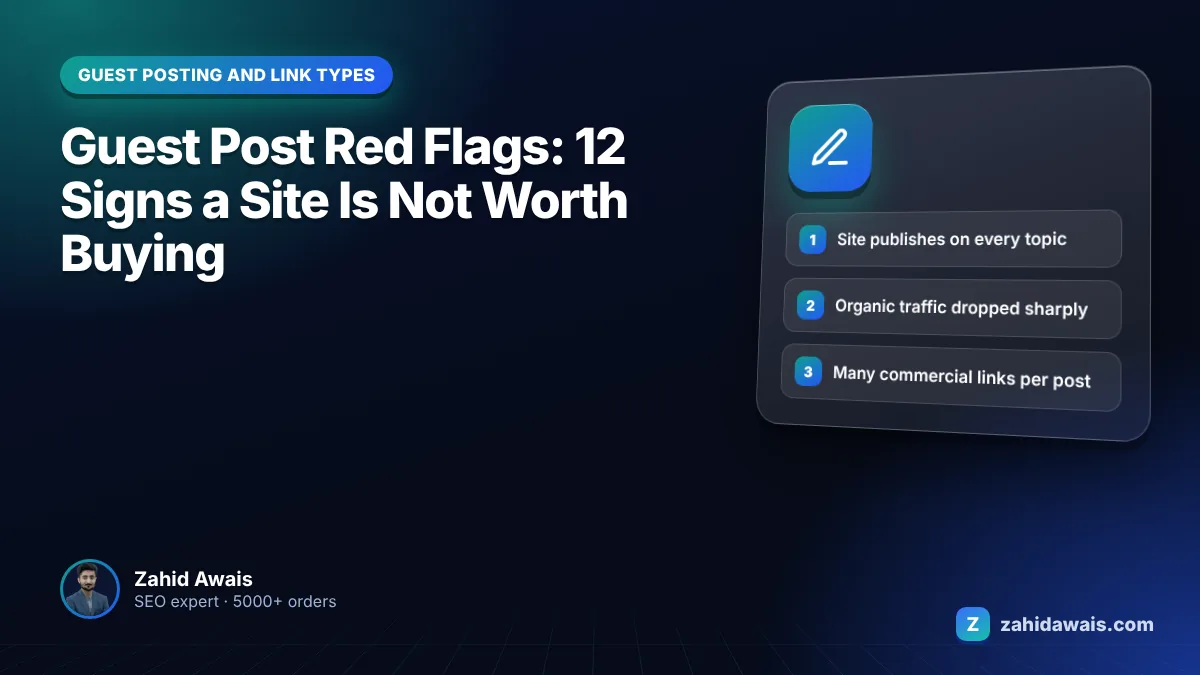
This checklist shows you the guest post red flags I look for before placing a client’s link, how to check each one in a few minutes, and which ones should stop an order outright.
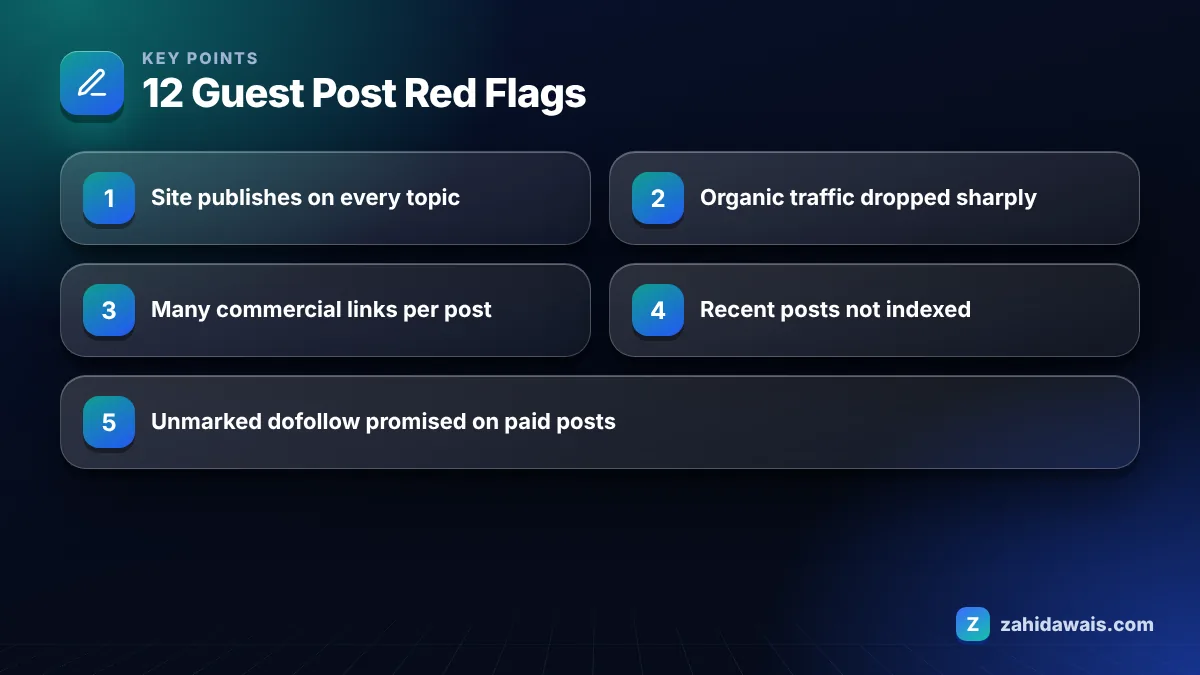
The main guest post red flags are a site that publishes on every topic, traffic that comes from odd countries or collapsed suddenly, posts stuffed with outbound commercial links, a “write for us” page aimed at sellers, no real authors, and publishers promising unmarked dofollow links on paid posts. Any one deserves a closer look.
A good guest post site has a clear topic, real readers who come from search or other sources, named authors, and editorial standards that reject weak or off-topic content. If you would happily send a customer to read it, that is a strong start.
After more than 5000 orders across Adsy, Legiit, NicheRanker and other marketplaces, I have learned that metrics alone fool buyers. A site can show a high authority score while its organic traffic has fallen to almost nothing. So I start with the site itself: open the homepage, read the latest five posts, and ask whether a real audience would want them.
Google’s spam policies also matter here. The site reputation policy in Google’s spam policies covers third-party pages published on a host site mainly to benefit from that site’s ranking signals. Sites that sell space for anything to anyone are exactly the ones where that risk is highest.
The publisher’s behaviour tells you as much as the site does. Watch how they answer simple questions. A good publisher asks about your topic, may reject an angle that does not suit their readers and explains how sponsored content is labelled. A weak one replies within seconds with a price list, accepts any niche, offers “permanent dofollow” without being asked and pushes you to buy in bulk. I have also learned to be careful with sellers who refuse to share the exact domain until after payment. A site you cannot vet is a site you should not buy.
The twelve red flags below cover content, traffic, links and the publisher’s behaviour; I check all of them before any order, and the table shows how to check each one and how serious it is.
| # | Red flag | How to check | Severity |
|---|---|---|---|
| 1 | Publishes on every topic | Scan the last 20 posts and categories | High |
| 2 | Organic traffic dropped sharply | Traffic trend in Semrush or Ahrefs | High |
| 3 | Traffic from countries unrelated to the content | Country split in a traffic tool | Medium |
| 4 | Many outbound commercial links per post | Count links in recent posts | High |
| 5 | Casino, CBD and loan posts mixed with general topics | Search the site for those words | High |
| 6 | “Write for us” page listing prices for SEO links | Read the contribution page | Medium |
| 7 | No real author names or profiles | Check bylines and author pages | Medium |
| 8 | Thin, spun or obviously AI-generated posts | Read two posts in full | High |
| 9 | Promises of unmarked dofollow links on paid posts | Read the listing and ask | High |
| 10 | Posts not indexed in Google | site: search for recent post URLs | High |
| 11 | Same site sold under many seller names at very different prices | Compare marketplace listings | Low |
| 12 | No contact page, about page or company details | Look at the footer and about page | Medium |
One medium flag is not a reason to reject a site. Two or more high flags usually are. Flag 9 deserves special attention: Google’s link spam policy lists buying links that pass ranking credit as a violation, and says paid links should be qualified with rel=”sponsored” or rel=”nofollow”. A publisher who promises the opposite is selling you a risk.
You check for fake traffic by looking at the shape and source of the traffic rather than the headline number. Real traffic follows the topics of the site and the countries it writes for; fake or inflated traffic rarely does.
These are the checks I use, all available in common SEO tools:
No single check proves fraud. Together they show whether the traffic is likely to include people who could read your article.
The metrics that matter most are topical relevance, organic traffic trend, indexing of recent posts and the number of outbound links per post; third party authority scores are useful filters but poor final judges.
Authority scores such as DA, DR or AS are calculated by tool vendors, not by Google. They can be pushed up with cheap links, and they do not show whether a site is still visible in search. I use them only to shortlist.
My order of priority is simple:
If you want a done-for-you option, my guest posts on high DA blogs are vetted against this list before I offer them. For a printable list of on-site checks you can run on your own website too, grab the free SEO audit checklist.
A client sends me two shortlisted sites for a home cleaning service. Site A shows an authority score of 60, but its last 20 posts cover crypto, dating, kitchen tips and online casinos, and its organic traffic fell by around 90 percent over the past year in Semrush. That is flags 1, 2 and 5: three high flags, so I reject it.
Site B shows an authority score of 32, but it only writes about home and family topics, has named authors, steady traffic from the UK and US, and its recent posts are indexed. It labels sponsored posts and marks the links with rel=”sponsored”. Site B is the better buy, even though its score is roughly half.
This is the pattern I see again and again. The lower score with real relevance beats the higher score with no editorial standards. If you are new to these terms, the SEO glossary explains DA, DR, dofollow and nofollow in plain language.
Keep a log of every site you reject and why. After a few months you will spot the same networks reappearing under new names, and you will vet new offers much faster. That habit alone has saved my clients from many poor placements.
A site that publishes on every topic for anyone who pays is the biggest warning sign. It usually means weak editorial standards, many outbound commercial links and a higher chance of losing search visibility, which would make your placement worth very little.
No. DA and similar scores are vendor metrics that can be inflated with cheap links and do not show whether a site still gets organic traffic. Always check relevance, traffic trend and indexing before trusting a high score.
There is no official number, but posts with many unrelated commercial links are a common sign of a site that sells links in bulk. I prefer sites where each post links to a few relevant sources only.
Yes. Ask for a recent Search Console or analytics screenshot with visible dates and compare it with third party estimates. Honest publishers rarely object, and refusals or blurred screenshots are useful signals in themselves.
Search Google for site: followed by the domain, then search the exact URLs of a few recent posts. If recent posts do not appear, new articles may not get indexed either, and your link may never be discovered.
No, labels are a good sign. A publisher that labels sponsored content and marks paid links with rel=”sponsored” follows Google’s guidance and is usually more careful about what it publishes overall.
Facts checked against these official pages. Read how I check facts in my editorial policy.
Most marketplace guest posts are sponsored posts. Here is why that matters for links, labels and Google's rules.
Read article
Three fast checks I run before paying a premium for any site sold as Google News approved.
Read article
An honest answer from 5000+ link orders: guest posts work when they reach real readers, not when they chase link counts.
Read articleSend your website and I will reply with a free audit.