Link building strategy
Link Building for New Websites: A Practical 6 Month Plan
A new site needs a few trusted links, not a big package. This month by month plan shows what to build and when.
Read articleA backlink is a link from another website to yours. Here is why Google still counts them, which ones help, which ones hurt, and how to earn good ones.
This guide explains what a backlink is, why Google still uses links to rank pages, and how to tell a helpful link from a risky one. It is part of my complete link building guide.
A backlink is a clickable link on another website that points to a page on your website. Google uses links to discover pages and as one signal of how trusted and relevant a page is. One link from a real, relevant site is worth more than hundreds of links from spam sites.
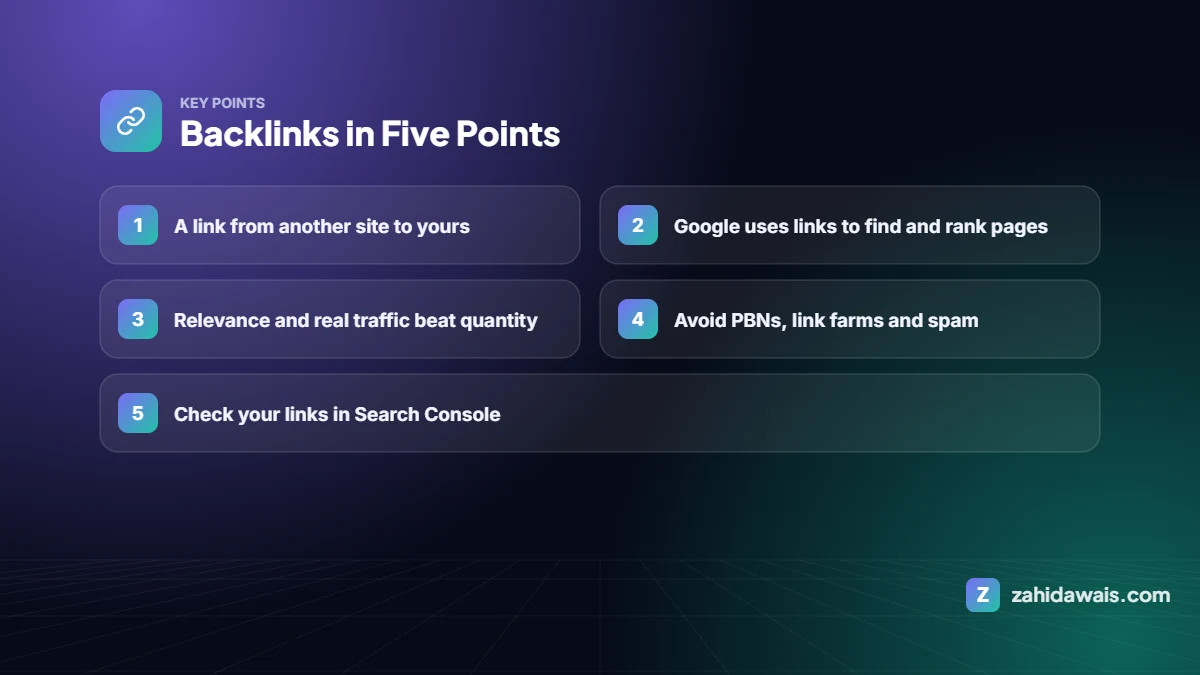
When site A links to a page on site B, site B has gained a backlink. People also call it an inbound link or an incoming link. From site A’s point of view, the same link is an outbound link.
A backlink has three parts you should always look at:
nofollow, sponsored or ugc.Google’s own starter guide says it finds most new pages through links, and it uses links as one of many signals to judge a page. A link from a trusted page in your topic works like a recommendation: “this page is worth reading”.
In my work on more than 5000 link building orders, the pattern is the same every time. Pages that earn a few strong, relevant links climb faster than pages with many weak links. Links do not replace good content, but good content without links often sits on page two.
Backlinks help in three ways:
| Type | What it is | SEO value |
|---|---|---|
| Editorial link | A writer links to you because your page is useful | Highest |
| Guest post link | A link inside an article you write for another site | High, if the site is real and relevant |
| Niche edit | A link added to an existing, already indexed article | High on aged, relevant pages |
| Brand mention / citation | Your name or site mentioned, sometimes with a link | Medium, strong for AI search and local SEO |
| Directory / profile link | Business listings and profiles | Low, but useful for local trust |
| Comment / forum link | Links in comments and forums, usually ugc or nofollow | Low |
| PBN or link farm link | Links from sites built only to sell links | Risky, can cause a penalty |
For a side by side comparison of the two most common paid options, read guest posts vs PBN links.
Not every link helps. Before you build or buy any link, check these five things:
A link from a home improvement blog with 20,000 monthly visitors, inside a relevant article about kitchen remodels, to a kitchen renovation company is a strong backlink. A link from a “general news” site that publishes unrelated articles on every topic every day, with no real traffic, is weak or risky, even if its DA is 70.
Google’s spam policies treat links made mainly to manipulate rankings as link spam. That includes buying or selling links that pass ranking value without a rel="sponsored" or rel="nofollow" label, large scale article marketing and automated link programs.
In practice, safe link building means: real sites, real editorial content, links that would make sense to a reader, and no networks built only to sell links. That is the standard I follow for every client order.
There is no fixed number. It depends on how many quality links the pages already ranking for your keyword have. A practical method: look at the top 5 results, count their linking domains from relevant sites, and aim to match the average over a few months, growing at a steady pace rather than in one burst.
For budgeting, my link building cost guide shows typical prices per link type, and the link building cost calculator gives you a monthly estimate.
Use Google Search Console (Links report) for free data straight from Google. Tools like Ahrefs, Semrush and Moz show competitors’ links too. Review new links every month, and if you see a sudden wave of spammy links you did not build, read up on disavowing before you act.
I have placed 5000+ links for clients, including brands like Capterra UK, Adobe and OKX. I only use real sites with real traffic, and every link is checked live for 6 months.
Yes. Google still uses links to discover pages and as one of many ranking signals. Quality and relevance matter far more than the number of links.
A backlink comes from another website. An internal link points from one page of your site to another page of the same site. Both help, but only backlinks bring outside authority.
Google treats nofollow, sponsored and ugc as hints, so they can still help with discovery, traffic and brand signals. Dofollow links from relevant sites usually pass more ranking value.
Google mostly ignores spam links, but building or buying manipulative links on purpose can lead to a manual action. Avoid PBNs and link farms.
Most links start to show an effect after Google crawls and indexes the linking page, usually within 4 to 12 weeks.
Facts checked against these official pages on 10 October 2026. Read my editorial policy.
A new site needs a few trusted links, not a big package. This month by month plan shows what to build and when.
Read article
A link on a page Google has not indexed does little for you. Here is why linking pages go unindexed and the safe ways to help Google find them.
Read article
Most sites never need the disavow tool. Here is how to spot genuinely harmful links, when Google says disavowing makes sense, and how to build the file correctly.
Read articleSend your website and I will reply with a free audit.