This guide gives you a complete keyword cannibalization fix: how to confirm the problem with your own Search Console data, a decision table for each competing page, and the exact steps to merge, redirect or separate pages safely. It is the process I use when a client says “our rankings keep jumping between two URLs”.
Quick answer
Keyword cannibalization happens when two or more of your pages target the same search intent and Google keeps switching between them. The usual keyword cannibalization fix is to pick one main page, merge the useful content from the others into it, 301 redirect the weaker URLs, and update internal links to point at the winner.
Fixing Keyword Cannibalization
How do I know if my pages are cannibalizing each other?
You know pages are cannibalizing each other when Search Console shows two or more of your URLs getting impressions for the same query, and the ranking URL keeps changing while positions stay unstable. Sharing a keyword alone is not proof.
Here is the check I run:
Open the Performance report in Search Console and set the date range to the last 3 to 6 months.
Filter by one query that matters to the business, using the exact query option.
Click the Pages tab. If two or more URLs have meaningful impressions for that query, note them.
Compare by date. Use the compare option or narrow the date range week by week. If the top URL swaps often and the average position bounces, you have a real case.
Read both pages. Ask whether a searcher would be happy landing on either one. If yes, they serve the same intent.
A quick extra test is a site search such as site:example.com plus the keyword. It is not precise, but it often reveals old posts you forgot existed.
Is keyword cannibalization always bad?
No, keyword cannibalization is not always bad. If two of your pages rank on page one together for a query and both get clicks, that is a strong result, not a problem.
It is also normal for a category page and a product page, or a guide and a tool, to appear for the same broad keyword because they serve different needs. Google’s own SEO Starter Guide notes that content available under multiple URLs is inefficient but will not cause a manual action. Cannibalization is a performance issue, not a penalty.
It becomes a problem when:
Neither page reaches the top positions because signals are split between them.
Google ranks the weaker or outdated page instead of the one that converts.
Backlinks are spread across several similar URLs instead of one strong page.
You keep publishing new posts on the same topic instead of improving the existing one.
Should I merge or redirect cannibalizing pages?
Merge and redirect when the pages serve the same intent; keep both and differentiate them when the intents are different. Most real cases need a merge followed by a redirect.
Google’s guide to consolidating duplicate URLs describes redirects as a strong signal that the target should become the canonical URL, and rel=”canonical” as a strong signal as well, while sitemap inclusion is a weak one. Consolidation helps combine signals, such as links, from similar pages into the preferred one. This decision table is what I use for each competing pair:
Situation
Best action
Why
Same intent, one page clearly stronger
Merge useful parts, 301 redirect the weaker URL
One page collects all links and relevance
Same intent, both pages thin
Write one new complete page, redirect both old URLs
Two weak pages rarely beat one strong one
Near duplicates that must stay live (filters, print versions)
rel=”canonical” to the main version
Users still need both URLs
Different intent, overlapping keywords
Keep both, retarget titles, H1s and anchors
Each page should own its own query
Old page with no traffic, links or value
Remove or noindex, or redirect if it has links
Nothing worth keeping except possible links
Both rank top 5 and both get clicks
Leave alone
It is working; changes add risk
For redirects, Google’s documentation on redirects recommends a permanent server-side redirect whenever possible. A 301 or 308 tells Google the move is permanent, and its indexing pipeline uses that as a signal the target should be canonical.
How do I fix keyword cannibalization step by step?
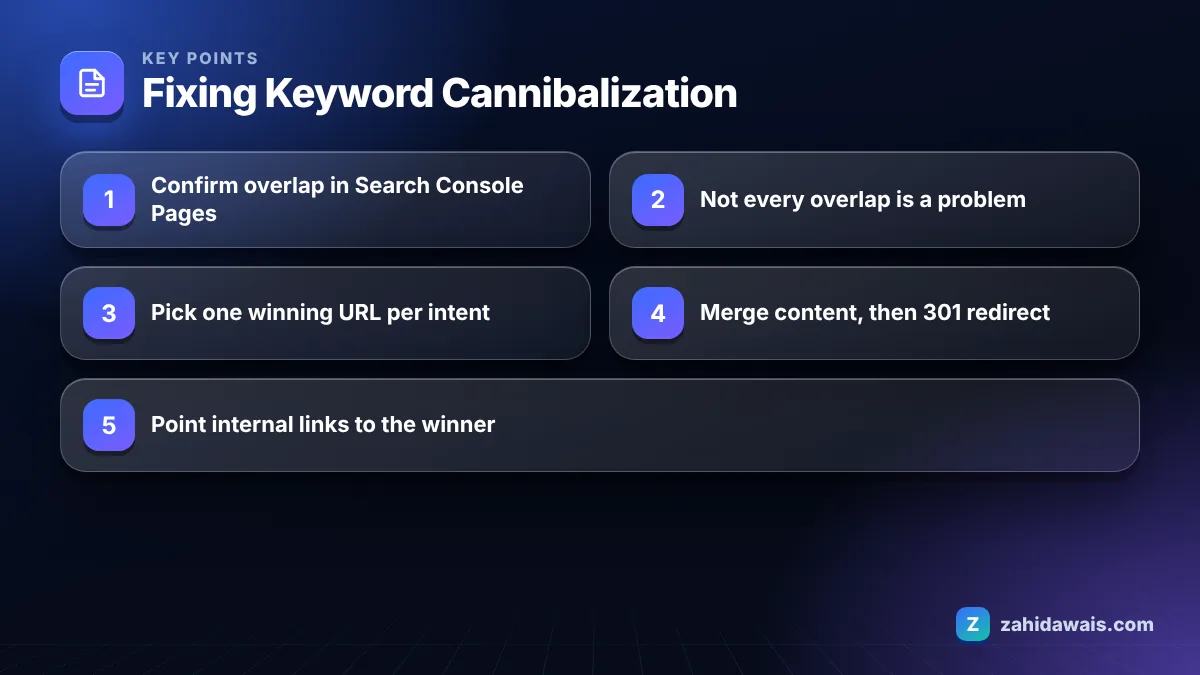
You fix it by choosing one winning URL per intent, moving the best content into it, redirecting the rest and cleaning up internal links. These are the steps in order:
Pick the winner. Choose the page with the most links, the best conversion rate or the cleanest URL. Traffic alone can mislead.
Merge content. Copy unique sections, examples and data from the losing pages into the winner. Drop anything outdated.
Update the winner’s title and H1 so they clearly cover the merged topic.
Add 301 redirects from each losing URL to the winner. Never redirect everything to the home page.
Update internal links. Change menus, related posts and in-text links so they point straight to the winner, not through the redirect.
Update your sitemap so it lists only the winning URL.
Monitor for 4 to 8 weeks in Search Console, filtering by the same query.
After a merge, it is normal to see the old URLs reported as “Page with redirect” in Search Console. My guide on the Page with redirect status explains why that needs no action. If Google instead picks a canonical you did not choose, see duplicate without user-selected canonical.
How do I prevent keyword cannibalization in the future?
You prevent it by keeping a simple keyword map, one row per URL with its main query and intent, and checking it before anyone publishes a new page. Most cannibalization I see is not a technical mistake; it is a planning gap.
Keep a keyword map. A spreadsheet with URL, primary keyword, intent and last update date is enough for most sites.
Search your own site first. Before writing a new post, check whether an existing page already covers the topic. Updating it is often better than starting again.
Brief writers with the map. When several writers or agencies work on one site, overlaps multiply quickly.
Use consistent internal anchors. If every link about a topic points to the same URL with similar anchor text, Google gets a clear signal about which page you prefer.
Review twice a year. Filter Search Console by your top 20 queries and look for new pages appearing next to the main one.
What does a cannibalization fix look like with real numbers?
Example
An online furniture shop had three blog posts: “Best Sofa Fabrics” (2021), “Sofa Fabric Guide” (2023) and “Which Sofa Fabric Is Best for Pets” (2024). For the query “best sofa fabric”, Search Console showed the first two swapping every few weeks, both stuck between positions 9 and 16. The 2021 post had 14 referring domains; the 2023 post had 3.
Decision: the first two served the same intent, so the 2021 URL became the winner because it held most of the links. The 2023 content was merged in, the post was refreshed and the 2023 URL was 301 redirected. The pets article stayed, because it answers a narrower question, and its title was sharpened to own the “pets” query. Seven internal links were updated. Over the following weeks only one URL appeared for the main query and its position became stable. That stability, not a guaranteed jump to number one, is the realistic goal.
It is when two or more pages on the same site target the same search intent, so Google has to choose between them. Signals such as links and relevance get split, and the ranking URL often switches, which can hold all of them back.
Can keyword cannibalization cause a Google penalty?
No. Google does not penalize sites for having several pages on similar topics. Its documentation says content available under multiple URLs is inefficient but will not cause a manual action. The cost is weaker, unstable rankings, not a penalty.
Should I use a canonical tag or a 301 redirect?
Use a 301 redirect when the weaker page no longer needs to exist for users. Use rel canonical when both URLs must stay accessible, such as filtered or printable versions. Google treats both as strong signals for the preferred URL.
How long does it take to see results after merging pages?
It depends on how often Google recrawls your site. Many merges settle within a few weeks, but larger sites can take longer. Request indexing for the winning page and track the main query in Search Console for 4 to 8 weeks.
Do two pages need the same keyword to cannibalize?
Not exactly. Cannibalization is about intent, not identical wording. Two pages with different keywords can compete if they answer the same need, while pages sharing a keyword can coexist if they serve different needs.
Will deleting a cannibalizing page lose its backlinks?
If you delete it without a redirect, links pointing to it lead to a 404 and their value is not passed on. Redirecting the deleted URL to the closest relevant page with a 301 helps consolidate those signals into it.
Sources
Facts checked against these official pages. Read how I check facts in my editorial policy.
E-E-A-T is how Google's quality raters judge whether content comes from someone who knows the topic. It is not a single ranking factor, but the signals behind it shape what ranks.
Good keyword research finds searches your buyers make that your site can realistically win. Here is the process I use, from seed list to a prioritised plan.
Headings are the outline of your page for readers, Google and AI tools. Here is how many H1s you need, how to nest H2 to H6 and the mistakes that confuse everyone.