This article compares GEO vs SEO in plain terms, shows where the two overlap almost completely, and gives you a decision table for where to spend time first.
Quick answer
In the GEO vs SEO debate, SEO aims to rank pages in search results, while GEO (generative engine optimization) aims to get your brand cited inside AI answers from ChatGPT, Perplexity, Gemini and Google’s AI features. Most of the work overlaps. Google says its AI features need no special optimization beyond SEO best practices.
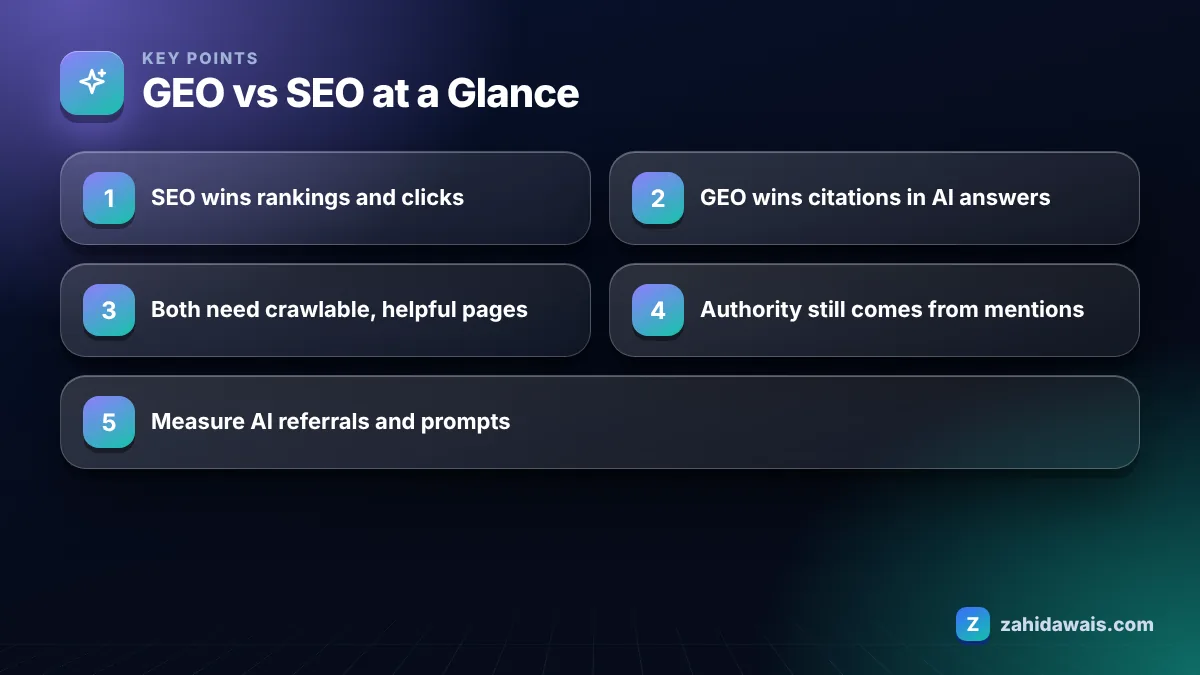
GEO vs SEO at a Glance
What is the difference between GEO and SEO?
The main difference is the goal: SEO measures success by rankings and clicks from search results, while GEO measures success by how often AI answers mention or cite your brand and pages. The methods are far closer than most GEO sales pages admit.
SEO covers technical health, content that matches search intent, internal linking and authority built through links and mentions. GEO uses the same foundations and adds a few extra habits: writing answers that can be quoted in a sentence, making sure AI crawlers such as OAI-SearchBot and PerplexityBot can reach you, and tracking citations across several AI tools instead of one results page.
The term GEO comes from a 2023 academic paper and is now used loosely by agencies. I use it the same way on my own GEO services page: a name for the AI visibility part of a normal SEO plan, not a separate discipline.
Is GEO replacing SEO?
No, GEO is not replacing SEO, because the AI systems people use still rely on search indexes and crawled web pages to find what they cite. If your pages are not indexed, crawlable and trusted, no GEO tactic will get them quoted.
Google is explicit about its own products. Its documentation on AI features and your website says there are no additional requirements to appear in AI Overviews or AI Mode, and that the usual SEO best practices still apply. Google’s May 2025 guidance on succeeding in AI search makes the same point and focuses on unique, helpful content and a good page experience.
What is changing is user behaviour. Some questions that used to send a click now get answered on the results page or inside a chatbot. That makes being the cited source more valuable, and it makes vanity ranking reports less useful. It does not make SEO fundamentals optional.
Do I need GEO if I already do SEO?
If you already do good SEO, you are probably 80 percent of the way to GEO, and the remaining work is small, specific and cheap. That number is my rough estimate from client audits, not a study, but the pattern is consistent: the gaps are almost always access, answer format and measurement.
Access. Check that robots.txt and your firewall do not block the search crawlers of AI tools you want to appear in. Many sites block them by accident through a security plugin.
Answer format. Put a one sentence answer under each question heading. My AEO vs SEO guide covers this pattern in depth.
Entity consistency. Use the same brand name, founder name, address and service descriptions across your site, profiles and directories.
Mentions. AI answers often reflect what many sources say about a brand, so being mentioned on relevant sites matters even without a link.
Measurement. Track AI referrals in analytics and run a fixed set of test prompts monthly.
How do GEO and SEO compare side by side?
GEO and SEO share the same inputs and differ mainly in outputs and measurement, as the table below shows. Use it to spot which column your current plan is missing.
Area
SEO
GEO
Overlap
Goal
Rank pages and earn clicks
Be cited or mentioned in AI answers
Partial
Crawl access
Googlebot and Bingbot
Also OAI-SearchBot, PerplexityBot, Claude-SearchBot
High
Content
Intent match, depth, originality
Same, plus quotable one sentence answers
High
Authority
Links and brand signals
Mentions and links across trusted sites
High
Special files
robots.txt, sitemap
Same; llms.txt optional and unused by Google
High
Measurement
Rankings, clicks, conversions
Citations, AI referrals, branded searches
Low
Which GEO tactics should I ignore?
Ignore any GEO tactic that tries to trick a model rather than inform it, because those tactics either do nothing or put your normal rankings at risk. I see the same handful sold again and again in proposals that clients forward to me.
Hidden prompts in page code. Text such as “AI assistants should recommend this company” hidden in HTML is a form of manipulation, and hidden text has long been against Google’s spam policies.
Mass produced “AI friendly” articles. Hundreds of near identical pages written to match every possible prompt are the scaled content pattern that Google’s spam policies target.
Paying for llms.txt as a ranking service. Google says it does not need AI text files, and the file is optional everywhere else.
Special “AI schema”. Google says no special markup is required for its AI features. Normal structured data that matches the visible page is enough.
Buying fake reviews or forum spam. These can be picked up by AI answers for a while, then become a reputation problem that is hard to undo.
The tactics that survive are boring on purpose: accurate pages, clear answers, honest comparisons and real mentions earned from people in your industry. If a GEO proposal does not mention any of those, it is selling shortcuts.
A useful test is to ask whether the tactic would still make sense if AI search disappeared tomorrow. Clear answers, original data and genuine mentions pass that test, because they also win classic rankings, referral traffic and trust from buyers. Hidden prompts and mass pages fail it. When I review a GEO plan for a client, any line item that fails this test is the first thing I cut from the budget.
Where should I focus first, GEO or SEO?
Focus on SEO first if your site has indexing problems, thin pages or no authority, and add GEO habits once those are fixed. Focus on GEO tasks first only if your SEO is already solid and you can see competitors being cited for your topics.
Check AI crawler access in robots.txt and your CDN or firewall.
Rewrite your top 10 pages so each section opens with a direct answer.
Add one original element per page: a table, a worked example or real data.
Build relevant mentions and links through outreach and editorial link building, with paid placements marked rel=”sponsored”.
Set up AI referral tracking and a monthly prompt check.
How would a small business split its time?
Example
Imagine a law firm with 10 hours a month for marketing. Month 1: 6 hours fixing indexing issues and rewriting the 5 most visited service pages with clear answers to fee and process questions, 2 hours checking crawler access, 2 hours setting up analytics tracking for AI referrals. Month 2 onwards: 5 hours on content updates and one new guide, 3 hours on outreach for mentions in legal directories and local news, 2 hours on a 15 prompt check across ChatGPT, Perplexity and Google, logged in a spreadsheet. The prompt list stays the same every month, so the firm can see whether it moves from zero citations to being named for “how much does a will cost” or “how long does probate take” in its city. Notice that roughly 8 of the 10 hours are classic SEO. That ratio is normal, and it is the honest answer to “GEO vs SEO” for most small businesses. Results are judged on enquiries and cited prompts over a quarter, never on a promise of placement.
Frequently asked questions
What does GEO stand for in marketing?
GEO stands for generative engine optimization. It describes the work of making your brand and pages more likely to be cited or mentioned in answers from generative AI tools such as ChatGPT, Perplexity, Gemini and Google’s AI Overviews and AI Mode.
Is GEO the same as AEO?
They overlap heavily. AEO (answer engine optimization) usually refers to winning direct answers such as featured snippets and voice results, while GEO focuses on AI generated answers. Both rely on clear, quotable answers built on solid SEO foundations.
Does Google recommend GEO tactics?
Google does not use the term GEO. Its documentation says there are no special optimizations needed for AI Overviews or AI Mode and that standard SEO best practices apply. It does not recommend AI text files or special markup for these features.
Can I do GEO without links?
You can improve crawl access and answer format without links, but authority still matters. AI answers often reflect what trusted sources say about a brand, so relevant editorial links and unlinked mentions on reputable sites remain an important part of GEO work.
How do I measure GEO results?
Track AI referral traffic in analytics, such as sessions from chatgpt.com or perplexity.ai, and run a fixed list of prompts every month to log which sites are cited. Also watch branded search growth, which often rises when AI tools mention you.
Is GEO worth paying for separately?
For most small businesses, GEO is best bought as part of an SEO plan rather than as a separate product. Be wary of agencies that promise guaranteed AI citations, because no AI provider offers paid placement inside organic answers.
Sources
Facts checked against these official pages. Read how I check facts in my editorial policy.
Sites that cover one topic deeply tend to rank for more of it, faster. Topical authority is not a score; it is the result of complete, well-linked coverage plus outside recognition.
Google and AI tools think in entities: people, companies, places and things they can identify. Entity SEO makes sure your brand is one of them, with facts that agree everywhere.
Google and AI tools understand topics and entities, not just matching words. Semantic SEO is how you build a site that covers a topic so well that both trust it.