Content SEO and writing
Helpful Content Checklist: 20 Questions to Ask Before You Publish
Twenty yes or no questions drawn from Google's guidance, grouped into five areas, with a simple scoring method you can use on every draft.
Read articleFifteen concrete ways to show experience, expertise, authority and trust, with before and after rewrites you can apply to any page today.
This article gives you 15 practical E-E-A-T examples with before and after rewrites, so you can see exactly how experience and trust look on a real page instead of reading another definition.
Good E-E-A-T examples include a named author with relevant background, first-hand photos or test results, clear sources for facts, an honest “how we made this” note, accurate update dates, real contact details and transparent pricing. Trust matters most. These signals help readers believe you, and that is what Google’s systems try to reward.
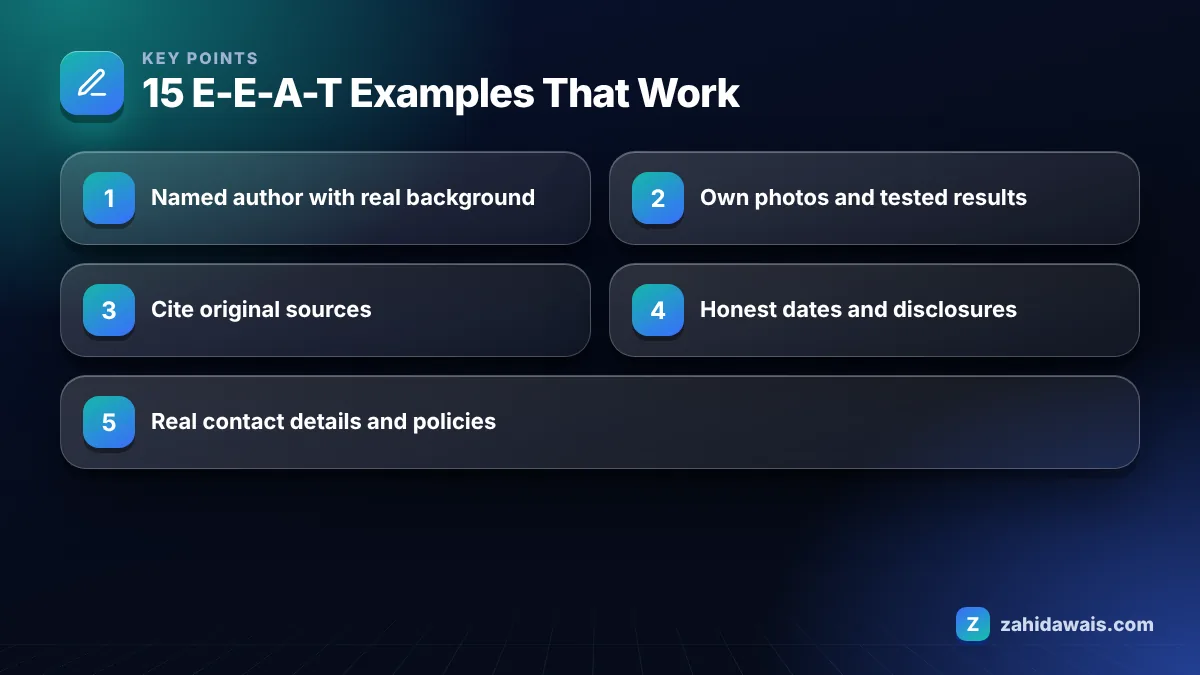
A simple example of E-E-A-T is a dental implant cost page written by a named dentist, showing the clinic’s real price range, explaining what changes the price, and citing official guidance on risks. Each part covers one letter: the dentist provides expertise, the price range from their own clinic shows experience, citations support trust and the clinic’s reputation supports authority.
E-E-A-T stands for experience, expertise, authoritativeness and trustworthiness. In its guide to creating helpful, reliable, people-first content, Google explains that its systems look for signals aligned with these qualities and that trust is the most important of the four. Experience, expertise and authority all feed into whether a reader can trust the page.
No, E-E-A-T itself is not a specific ranking factor, and Google says so directly. Instead, Google uses a mix of signals that align with E-E-A-T, and it gives more weight to these qualities on topics that could affect health, finances, safety or wellbeing.
That distinction matters. You cannot add an “E-E-A-T score” with a plugin or a badge. You improve it by making your content genuinely more credible, which also tends to improve conversions because real customers look for the same proof. I treat it as a reader trust checklist rather than an SEO trick.
How much effort to spend depends on the topic. Google calls topics that could significantly affect someone’s health, financial stability or safety “Your Money or Your Life” topics, and says its systems give even more weight to strong E-E-A-T there. A recipe blog and a page about loan interest rates both benefit from trust signals, but the loan page needs far more: expert authorship, cited regulations, clear risk warnings and a visible company behind it. When I plan content for law firms or clinics, every page gets an expert review step. For a hobby blog, a clear author and honest first-hand detail are usually enough.
The 15 examples below are the changes I make most often when I review client content, grouped by the letter they support most. Each one shows a typical weak version and a stronger rewrite.
| # | Signal | Before | After |
|---|---|---|---|
| 1 | Experience: own photos | Stock photo of a smiling plumber | Photo of the actual boiler fault the team fixed, with caption |
| 2 | Experience: tested results | “This tool is fast” | “It audited a 400 page site in about 6 minutes on my laptop” |
| 3 | Experience: mistakes shared | Only success tips | A section on what went wrong the first time and why |
| 4 | Experience: process shown | “We follow best practice” | Numbered steps of the real workflow, with screenshots |
| 5 | Expertise: named author | “By Admin” | Author name, role and a link to a full author page |
| 6 | Expertise: relevant credentials | Generic bio about loving writing | Bio stating qualifications or years in the specific field |
| 7 | Expertise: expert review | No reviewer on a health page | “Medically reviewed by” a named, qualified reviewer |
| 8 | Expertise: precise detail | “Costs vary” | A price range with the three factors that move it |
| 9 | Authority: citations | “Studies show…” | A link to the original study or official documentation |
| 10 | Authority: earned mentions | Self-written praise | Links to genuine press coverage or industry listings |
| 11 | Authority: depth on the topic | One thin post on a subject | A connected set of guides covering the topic properly |
| 12 | Trust: real contact details | Contact form only | Address, phone, email and business registration where relevant |
| 13 | Trust: honest dates | Date changed with no edits | “Last updated” date that reflects a real, described change |
| 14 | Trust: disclosure | Hidden affiliate links | Clear note on affiliate links, sponsorship or AI assistance |
| 15 | Trust: editorial policy | No explanation of standards | A public page explaining how content is researched and corrected |
On my own site, the editorial policy and the about page exist for exactly the reasons in rows 5 and 15. Readers, clients and search engines can see who writes the content and how it is checked.
You show experience by including details that only someone who did the thing would know: original photos, real numbers, specific problems and what you did about them. Google’s guide asks whether content clearly demonstrates first-hand expertise and depth of knowledge, for example from having used a product or visited a place.
In my link building and content orders, the fastest win is usually rewriting generic paragraphs into specific ones. The facts stay the same, but the page starts to read like it came from someone who has done the work.
A local roofing company had a page titled “Roof Repair Tips” written by “Admin”, with stock images, no prices and a date changed every month without edits. It read like any other roofing page in the country.
The rewrite: the owner became the named author with a short bio and years in the trade. Stock photos were replaced with photos from three recent jobs, each with a caption explaining the fault. A table showed the typical price range for common repairs in their area and what pushes the cost up. A short section explained when a repair is not worth it and a replacement makes more sense. The update date now changes only when prices or advice change, and the change is noted at the bottom.
No word was written to please an algorithm. Every change answers a question a homeowner has before calling a roofer, which is why the page earns more trust from both visitors and search systems.
The biggest mistake is faking signals, such as invented authors, stock photos presented as your work, or update dates that change without real edits. Google’s guide lists changing dates to make pages seem fresh as a warning sign, and its guidance on byline dates asks that dates reflect when a page was actually published or updated.
If you want help applying these examples to your own pages, my on-page SEO service includes an E-E-A-T review, and the SEO glossary explains related terms such as YMYL in plain English.
E-E-A-T stands for experience, expertise, authoritativeness and trustworthiness. Google uses the concept to describe the qualities of reliable content, and its documentation says trust is the most important of the four. Experience was added to the original E-A-T to reflect first-hand knowledge.
Yes. Small businesses often have strong experience signals they never show, such as real job photos, local prices and owner expertise. Adding a named author, genuine contact details and specific examples helps both visitors and search systems understand that the business is real and knowledgeable.
Author bios help readers judge whether to trust the content, which Google’s guidance encourages. They are not a direct ranking factor on their own. A bio is useful when it is accurate, relevant to the topic and linked to a fuller author page with real background.
YMYL means Your Money or Your Life: topics that could affect health, finances, safety or wellbeing. Google says it gives even more weight to content that aligns with strong E-E-A-T on these topics, so expert review and clear sourcing matter most there.
AI can help draft content, but it cannot supply your first-hand experience, photos or real results. To meet E-E-A-T, a knowledgeable person needs to add genuine experience, verify facts and take responsibility for the page. Disclose AI use where readers would expect to know.
Page level changes such as adding authors, sources and real examples can be done in days. How search systems respond varies and there is no set timeline. Broader authority, such as earned mentions and a strong body of content, builds over months of consistent work.
Facts checked against these official pages. Read how I check facts in my editorial policy.
Twenty yes or no questions drawn from Google's guidance, grouped into five areas, with a simple scoring method you can use on every draft.
Read article
Google judges content by quality and purpose, not by the tool used, but mass produced, unreviewed AI pages can breach its spam policies.
Read article
Google does not reward word count, so set length by search intent, the questions you must answer and what ranking pages actually cover.
Read articleSend your website and I will reply with a free audit.