Guest posting and link types
Brand Mentions vs Backlinks: Which Matters More in 2026?
Links help Google find and understand you. Mentions help people and AI tools recognise you. Here is how to balance both.
Read articleAn honest answer from a provider who sells them: useful in a small supporting role, harmful when built in bulk.
This article gives you an honest answer to do Web 2.0 backlinks still work, from someone who sells them: what they can do, where they fail, and how to use them without crossing into link spam.
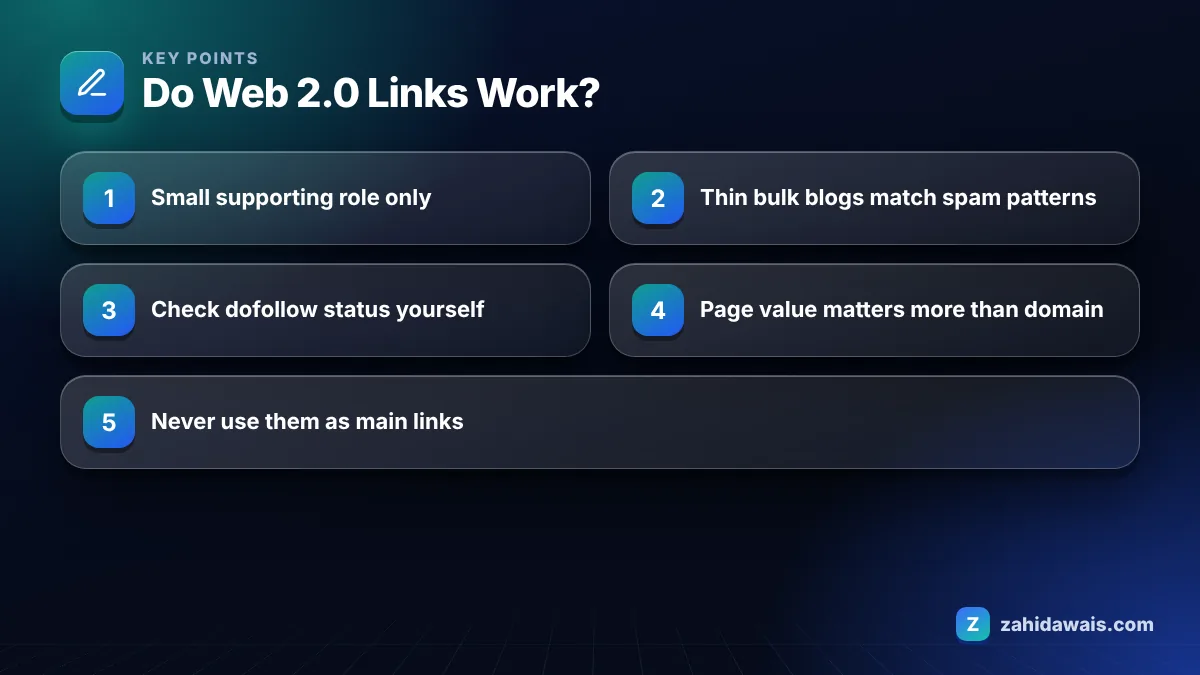
Do Web 2.0 backlinks still work? Only in a small supporting role. A Web 2.0 page with genuinely useful content can add variety to a link profile and help a new brand show up on more platforms. Mass produced, thin Web 2.0 blogs built just for links do not work well and match patterns Google calls spam.
Web 2.0 backlinks are links from content you publish on free or freemium platforms where users create their own pages, such as hosted blogs, publishing sites and site builders. You control the content, so the link is self-placed rather than earned from an editor.
That last point shapes everything else. A link from an independent editor shows that someone else chose to reference you. A link from a page you made yourself on a hosted platform shows only that you created the page. Search engines have known about this for a long time.
Web 2.0 pages also sit on domains with enormous authority scores, because the platform’s main domain has millions of links. Sellers often quote that domain score, but your page is one of millions of user pages on it. The page itself usually has no links and no visitors, unless you give it reasons to have both.
Web 2.0 backlinks are low risk when they are a few useful pages with natural links, and higher risk when they are built in bulk with spun or AI-generated filler and keyword anchors. The tactic is not banned; the abusive version is.
Google’s link spam policy lists using automated programs or services to create links to your site as a violation, along with other link schemes designed to manipulate rankings. Its scaled content abuse policy covers generating many pages mainly to manipulate rankings, including spreading content across multiple sites to hide the scale of it. A network of thin Web 2.0 blogs built by software touches both.
Platforms also act on their own. Many hosted platforms delete blogs that look like link farms, and some suspend whole accounts. In my experience, the pages that survive are those that look and read like a real person’s or company’s content.
| Web 2.0 approach | Risk level | Likely value |
|---|---|---|
| A few pages with original, useful articles and natural links | Low | Small: variety, brand presence, occasional visits |
| Brand profile pages kept up to date | Low | Brand searches show more of your own properties |
| Dozens of thin blogs with spun or AI filler | High | Little to none; pages often deleted or ignored |
| Software-built networks with exact match anchors | High | Matches automated link and scaled content patterns |
| Web 2.0 as the only link source | Medium | Weak profile with no editorial links |
Some Web 2.0 platforms leave links in posts followed and many add nofollow or ugc to user content, and the policy changes over time, so you need to check each platform yourself. Do not rely on old lists that claim a platform is dofollow.
The check takes a minute. Publish a test post, open the live page, view the source code, and look at the rel attribute on your link. If you see nofollow or ugc, the platform is qualifying user links, which is exactly what Google’s guidance suggests for user-generated content.
Even a followed Web 2.0 link is still a link you placed yourself. That is why I never present these links as a replacement for links from independent sites, whatever the attribute says.
A followed link on a Web 2.0 page can pass some value, but usually very little, because the specific page carries few or no links of its own. The platform’s high domain authority does not transfer to every user page on it.
Think of it this way: a page with no visitors and no links pointing to it has little to share. Some people try to fix that by building more links to their Web 2.0 pages. That approach quickly becomes the kind of manufactured link structure Google’s link spam policy describes, and I do not recommend it.
The better approach is to treat a Web 2.0 page as a small content asset. Write something useful, keep it on topic, link to your site where it helps, and share the page through your own channels if it deserves readers.
When I build a Web 2.0 page for a client, I follow the same short checklist every time:
Web 2.0 backlinks make sense for brand new sites on small budgets, for adding variety alongside stronger links, and for claiming brand profiles on popular platforms. They do not make sense as a main strategy for competitive keywords.
That is how I describe my own Web 2.0 backlinks service: unique articles that support your stronger links, never your only links. For the main links that move important pages, see my guest posts on established blogs, and read guest posts vs PBN links to understand why networks of self-made sites are a different and riskier thing.
A new bakery supply shop has a monthly link budget of $400. A sensible plan is to spend about $300 on two relevant guest posts on baking and small food business blogs, and about $100 on three Web 2.0 articles. Each Web 2.0 article covers a real topic, such as choosing cake boxes for delivery, runs to around 700 words, and links once to the most relevant page using a natural anchor.
A poor plan would put the full $400 into 40 Web 2.0 blogs built by software, each with one spun paragraph and the anchor “cheap cake boxes wholesale”. The first plan adds relevant links plus a little variety. The second creates a pattern that matches Google’s descriptions of automated links and scaled content, and many of the pages would likely be removed by the platforms anyway. The figures are illustrative.
The rule I follow is simple: if a Web 2.0 page would be embarrassing to show the client’s customers, it should not exist. Build fewer, better pages, check the link attributes yourself, and let your editorial links do the heavy lifting.
A Web 2.0 backlink is a link from content you publish yourself on a hosted platform where users create pages, such as a hosted blog or publishing site. Because you place it yourself, it is not an editorial link from an independent site.
Large numbers of thin, automated Web 2.0 blogs with keyword anchors can match Google’s link spam and scaled content patterns. A handful of genuine, useful pages with natural links is a very different and much lower risk activity.
There is no safe number to aim for. I suggest a few quality pages that support stronger links from real sites. If Web 2.0 pages make up most of your links, the profile is unbalanced and depends on self-made links.
Not much on its own. The platform’s main domain has many links, but your individual page usually has none. The value of a link depends heavily on the page it sits on, not just the domain.
Using AI to mass produce pages without adding value is listed by Google as an example of scaled content abuse. If you use AI tools at all, edit the result carefully so each page is genuinely useful and accurate.
Some do and many do not, especially thin pages on large platforms. Check each URL with a site: search after a few weeks. A page that is not indexed cannot help you, which is another reason to write genuinely useful content.
Facts checked against these official pages. Read how I check facts in my editorial policy.
Links help Google find and understand you. Mentions help people and AI tools recognise you. Here is how to balance both.
Read article
A practical comparison from 5000+ link orders, with a decision table and a real world style example.
Read article
The due diligence checklist I run on every expired domain before I use it or recommend it to a client.
Read articleSend your website and I will reply with a free audit.