AI search (AEO and GEO)
GEO vs SEO: The Real Differences and Where to Focus First
GEO is mostly SEO with a different scoreboard. Here is what actually changes, what does not, and where to start.
Read articleChatGPT product results are not ads. Stores get in through crawlable product pages and, for many merchants, a product feed.
This guide explains how to show up in ChatGPT shopping: the two ways products get in, what OpenAI says it uses to choose products, and the product page fixes I make for ecommerce clients.
To show up in ChatGPT shopping, let OAI-SearchBot crawl your product pages and, where available, share a product feed with OpenAI. Shopify and Etsy catalogs are already integrated. OpenAI says product results are chosen by relevance, not paid, so complete product data, clear prices and genuine reviews matter most.
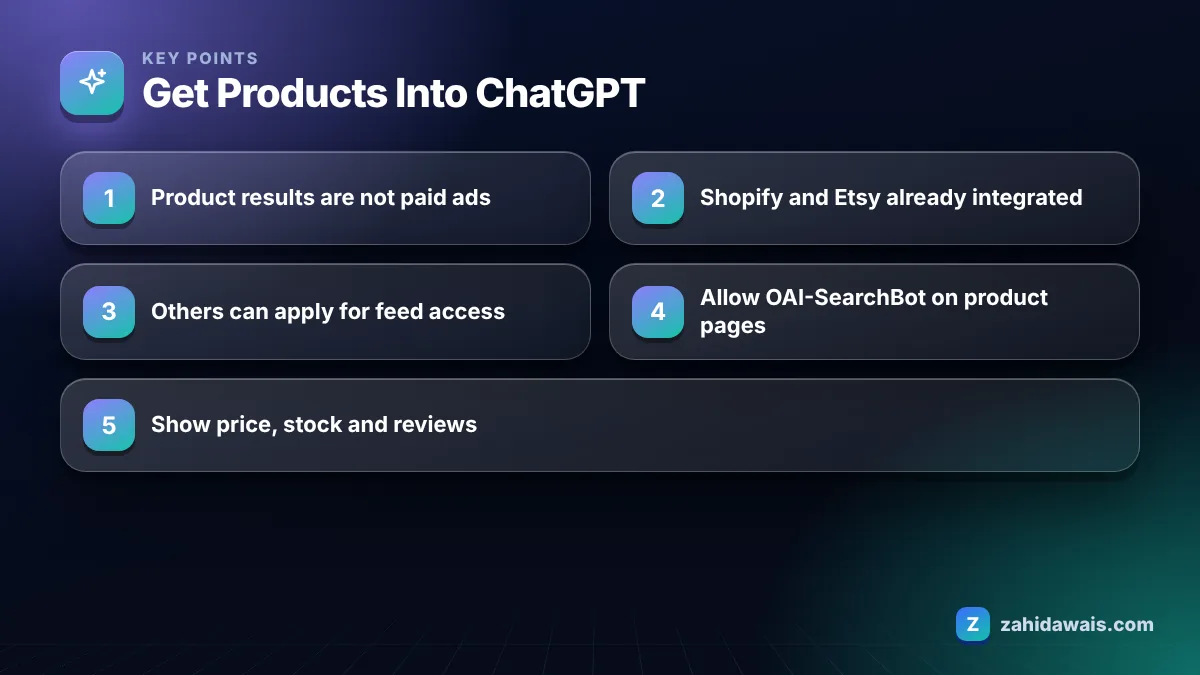
ChatGPT chooses products based on the user’s request and context, using structured metadata from first and third party providers, and OpenAI says the results are not ads. OpenAI’s help article on shopping with ChatGPT search states that product results are selected independently by ChatGPT and are not influenced by OpenAI partnerships.
The same article says a product appears when ChatGPT judges it relevant to the user’s intent, and that factors such as price matter more when the user states a budget. It also notes that prices come from third party providers and may lag behind merchant updates, and that review summaries are model generated from public reviews, which OpenAI does not verify.
In practice, that means three inputs decide whether your products appear: whether ChatGPT can get your product data at all, whether that data is complete and current, and whether your product is a strong match for what the shopper described.
You submit products either through a supported commerce platform or by applying to share a direct product feed with OpenAI; there is no single “submit” button for every store. OpenAI’s merchant page for ChatGPT product discovery says Shopify and Etsy sellers are already integrated and need no extra setup, while other merchants can apply for feed access through a form that asks for company details, website, main product category and catalog size.
A feed is not the only route. OpenAI says ChatGPT can crawl a site without a feed, but that feeds give merchants more control over how products appear. For crawling, your product pages must be reachable by OAI-SearchBot, which OpenAI describes in its crawler documentation.
| Route | Who it suits | What you control | Main risk |
|---|---|---|---|
| Shopify or Etsy integration | Stores on those platforms | Catalog data in your platform admin | Thin titles and descriptions carried over |
| Direct product feed | Larger or custom built stores | Titles, prices, availability, media, variants | Feed falling out of sync with the site |
| Crawled product pages | Any store allowing OAI-SearchBot | On-page content and visible product details | Bots blocked by firewall or robots.txt |
OpenAI’s feed specification lists required header fields and product and variant identifiers, with title, description, link, media, price and availability as optional fields. Optional does not mean unimportant. A product with no price or availability gives ChatGPT very little to match against a shopper’s budget or delivery needs.
Yes, inclusion is free: OpenAI’s merchant page says there are no fees on purchases that start in ChatGPT, and product results are not paid placements. Ads in ChatGPT are a separate product and are handled separately from organic product results.
Checkout has also changed. OpenAI’s merchant page says it is moving away from a standalone Instant Checkout experience and that purchases are completed on merchant websites or apps. That makes your own product page and checkout more important, not less, because that is where the sale happens. At the time of writing, OpenAI describes shopping as live for users in the US, so check the merchant page for the latest country coverage before planning around it.
Fix the product details a shopper would ask about in a sentence: what it is, who it is for, the key specs, price, availability, delivery and what other buyers say. These are the changes I make most often on ecommerce audits, in the order I make them:
Most of this overlaps with good ecommerce SEO, which is the point: one well built product page serves Google, ChatGPT and the customer. For category pages and buying guides, the same answer-first writing I describe in my AEO vs SEO guide helps ChatGPT match your store to broader questions like “best running shoes for flat feet under $150”.
Check by asking ChatGPT the kinds of shopping questions your customers ask, with search enabled, and recording whether your store or products appear in the results. There is no merchant dashboard for organic product results at the time of writing, so a structured manual test is the most reliable method you have.
Write 10 to 20 prompts that mix three types of request:
Run them monthly from a fresh session, note which stores and products appear, and keep a simple log. Pay attention to the details ChatGPT shows for competitors: if it lists price, rating and delivery for them but not for you, your data is incomplete somewhere.
Then confirm the technical side. In your server logs, look for OAI-SearchBot requests to product URLs and check they return 200. In Google Analytics, track sessions where the source is chatgpt.com and look at which product and category pages they land on. Those landing pages tell you what ChatGPT already trusts, and they are the best templates for improving the rest of your catalog.
A small homeware store sells a cast iron casserole dish. Before: title “CI-24 Red”, no visible price until the cart, description copied from the supplier, no reviews shown, and a security plugin blocking unknown bots. After: title “Enamelled Cast Iron Casserole Dish, 24 cm, 3.8 L, Red”, price and “ships in 2 days” visible near the title, a “best for slow cooking for 4 to 6 people” line, a spec table with weight, oven safe temperature and hob compatibility, 23 genuine customer reviews displayed, Product structured data matching the page, and OAI-SearchBot allowed. The store also applied for feed access. None of this guarantees a recommendation for “best casserole dish for induction hob under $100”, but before the fix the product was effectively invisible to ChatGPT, and now it is a complete, crawlable candidate.
For a full product and category page review, see my SEO for ecommerce stores page.
No. OpenAI says product results are selected independently by ChatGPT and are not ads or influenced by partnerships. ChatGPT ads are a separate product. You cannot pay to be placed in the organic product results.
OpenAI’s merchant page says Shopify and Etsy sellers are already integrated and need no extra setup or application. You should still improve product titles, descriptions, prices and reviews in your store admin, because that data is what ChatGPT works with.
Yes. OpenAI says ChatGPT can crawl a site without a feed, but feeds give merchants more control over how products appear. For crawling to work, OAI-SearchBot must be allowed in robots.txt and not blocked by your firewall or CDN.
OpenAI notes that prices come from third party providers and may not reflect the latest merchant updates. Keep your feed and visible page prices in sync, update them quickly after changes, and make sure the current price is in the page HTML.
OpenAI’s merchant page says it is moving away from a standalone Instant Checkout experience and that purchases are completed on merchant websites or apps. Check OpenAI’s merchant page for the current situation, as this area changes often.
OpenAI says ChatGPT summarizes public reviews and that these are not verified by OpenAI. Genuine, detailed reviews give the model more to work with. Never fake or buy reviews, as that creates legal and reputation risk.
Facts checked against these official pages. Read how I check facts in my editorial policy.
GEO is mostly SEO with a different scoreboard. Here is what actually changes, what does not, and where to start.
Read article
Sites that cover one topic deeply tend to rank for more of it, faster. Topical authority is not a score; it is the result of complete, well-linked coverage plus outside recognition.
Read article
Google and AI tools think in entities: people, companies, places and things they can identify. Entity SEO makes sure your brand is one of them, with facts that agree everywhere.
Read articleSend your website and I will reply with a free audit.