Guest posting and link types
Niche Edits vs Guest Posts: Which One Should You Buy?
A practical comparison from 5000+ link orders, with a decision table and a real world style example.
Read articleLinks help Google find and understand you. Mentions help people and AI tools recognise you. Here is how to balance both.
This article compares brand mentions vs backlinks: what each one does for classic search and AI search, what Google actually documents, and how to split your budget between them in 2026.
In brand mentions vs backlinks, backlinks matter more for classic Google rankings because Google documents links as a signal. Brand mentions matter more for reputation, brand searches and how often AI tools name you. Most businesses need both: links to be found and understood, mentions to be recognised and trusted.
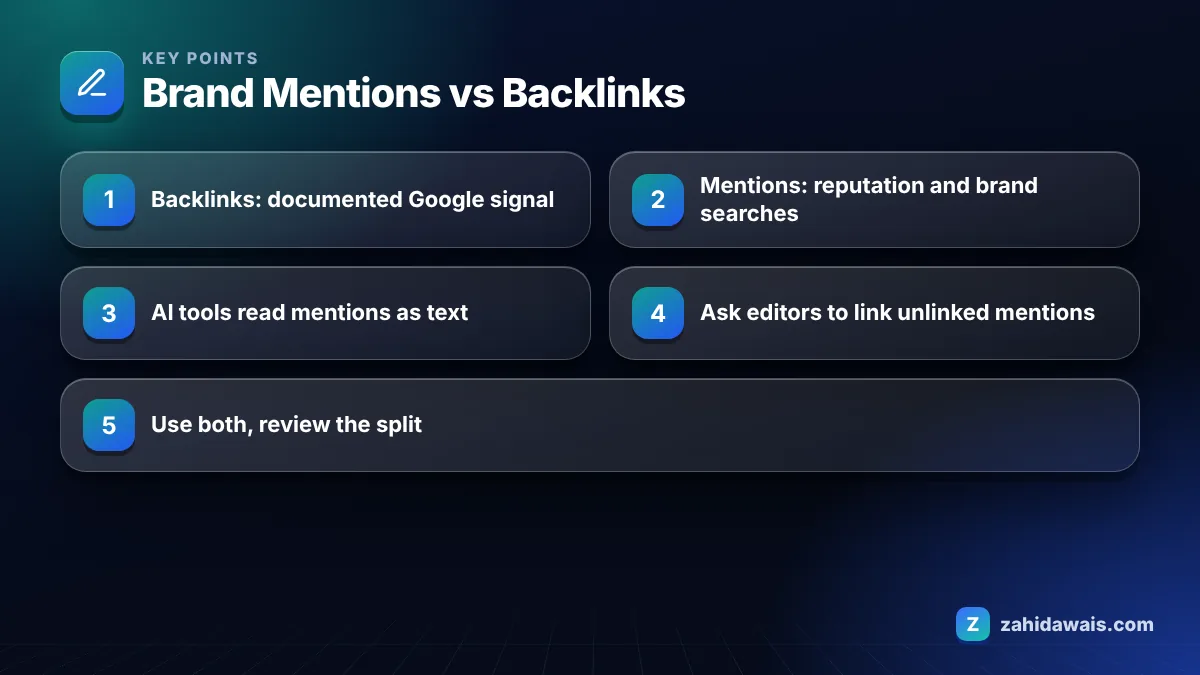
A backlink is a clickable link from another site to yours, while a brand mention is any reference to your brand name, linked or not. Every backlink with your brand as anchor is also a mention, but most mentions have no link.
Google’s link best practices say Google uses links as a signal when determining the relevancy of pages and to find new pages to crawl. Links are something Google can follow. A plain text mention gives a crawler no path to your site.
Mentions still matter, just in a different way. When a respected publication names your company in an article about your industry, readers notice, some search for you, and that coverage becomes part of what the web says about your brand.
| Aspect | Backlink | Unlinked brand mention |
|---|---|---|
| Can Google crawl to your site through it? | Yes, if it is a standard link | No |
| Documented by Google as a signal? | Yes, links are described as a signal | Not documented as a ranking signal |
| Sends referral visits? | Yes, by clicks | Only indirectly, through searches |
| Builds brand recognition? | Sometimes | Yes, that is its main value |
| Feeds what AI tools read about you? | Yes, as part of the page text | Yes, as part of the page text |
| Rules for paid placements | rel=”sponsored” or rel=”nofollow” | Disclose sponsored content to readers |
Unlinked brand mentions are not documented by Google as a ranking signal, so nobody can honestly say they boost rankings directly; their proven value is in reputation, demand and trust. That indirect value is real and often underrated.
Google’s guide to creating helpful, reliable, people-first content describes E-E-A-T and says trust is the most important part of it. Google describes E-E-A-T as something its systems look for through a mix of signals rather than a single ranking factor. Coverage on reputable sites is one of the ways people, and quality raters, learn whether a business is trustworthy.
There is also a practical effect I see across client work. When a brand gets covered in its industry, more people search for it by name. Branded searches lead to visits, reviews and further coverage. Mentions start that cycle even when they carry no link.
So I describe mentions to clients as reputation work with SEO side effects, and links as SEO work with reputation side effects.
Unlinked mentions can shape AI answers because AI tools read and summarise page text, and a mention is text whether it is linked or not. The more consistently reputable sources describe your brand, the more material an AI system has to draw on.
For Google specifically, its page on AI features and your website says there are no additional requirements to appear in AI Overviews or AI Mode, and no special optimisation is necessary. A page needs to be indexed and eligible to be shown with a snippet. In other words, the same SEO fundamentals apply, including being cited by credible sites.
Other AI assistants work differently and document their sources in their own ways. What I can say from practice is modest: brands that are discussed on many relevant sites tend to be named more often when people ask AI tools for recommendations in that category. That is an observation, not a guarantee. My GEO services page explains how I approach visibility in AI answers, and the article on AEO vs SEO covers how answer engines differ from classic search.
You turn brand mentions into backlinks by finding unlinked mentions, then politely asking the author to add a link where it helps their readers. It is one of the simplest outreach tasks because the publisher already knows your brand.
In my experience, the best success rate comes from mentions that reference something specific, such as a statistic, a tool or a guide. Linking to that exact page is clearly useful to the reader, so editors say yes more often.
Prioritise backlinks when your important pages lack relevant links compared with the sites that outrank you, and prioritise mentions when your pages are strong but few people know or search for your brand. The answer depends on which gap is bigger.
A quick way to see the gap:
Most businesses I work with have both gaps, just in different sizes. Fix the bigger one first, and revisit the comparison every quarter.
A new online legal services company has $1,000 a month for off-site work. Its pages are well built but few people know the brand. A sensible split for the first three months: $600 on relevant guest posts and link insertions pointing to its two most important service pages, and $400 on brand mentions in legal and business news coverage that describe what the company does.
From month four, the company reviews results. If branded searches and referral visits from news coverage are growing, it can shift toward 50/50. If key pages still lack relevant links compared with competitors, it keeps links as the larger share. The split follows the gap, not a fixed formula. These figures are an illustration, not a benchmark.
The point of the example is the review step. Links and mentions work together, and the right balance changes as the brand grows. If you want help with the mention side, my brand mentions service places your name on established news and industry sites, with sponsored content labelled as it should be.
For the link side, start with the process in my link building guide, then add mentions once your core pages have the support they need.
Only if it includes a clickable link to your site. A brand mention is any reference to your brand name. Many mentions are plain text with no link, which means they cannot pass link signals or send clicks directly.
Google does not document unlinked brand mentions as a ranking signal. Its documentation describes links as a signal. Mentions still support reputation and brand searches, which matter for how people and businesses judge trust.
Google says there are no special requirements or optimisations for AI Overviews beyond normal SEO fundamentals. Mentions on reputable sites support your overall reputation, which is part of those fundamentals, but no one can guarantee inclusion.
Yes, if handled openly. Sponsored articles should be labelled for readers, and any links in them should carry rel=”sponsored” or rel=”nofollow”. Presenting paid content as independent editorial is the part to avoid.
Link reclamation means finding pages that mention your brand without linking, or that link to broken pages on your site, and asking the publisher to add or fix the link. It is low risk outreach because the publisher already knows you.
Most new businesses benefit from relevant links to core pages first, because links help Google find and understand them. Mentions become more valuable once there is a clear offer and pages worth visiting after people search your name.
Facts checked against these official pages. Read how I check facts in my editorial policy.
A practical comparison from 5000+ link orders, with a decision table and a real world style example.
Read article
The due diligence checklist I run on every expired domain before I use it or recommend it to a client.
Read article
What Google says about image file names, a naming formula that works for blogs and shops, and how to handle images already uploaded.
Read articleSend your website and I will reply with a free audit.