Link building strategy
How Long Do Backlinks Take to Work? A Realistic Timeline
Backlinks pass through crawling, indexing and re-evaluation before rankings move. Here is what each stage looks like in practice.
Read articleWhen links go live but positions stay flat, the cause is usually the links, the page or the timeline. Here is how to tell.
This article helps you diagnose backlinks not improving rankings with ten real reasons I see in client campaigns, a quick diagnostic table, and the fixes that actually move a stuck page.
Backlinks not improving rankings usually comes down to three things: the links are not counted (unindexed, irrelevant, nofollow or ignored spam), the target page does not satisfy search intent as well as competitors, or not enough time has passed. Check indexing first, then compare your page honestly with the top results.
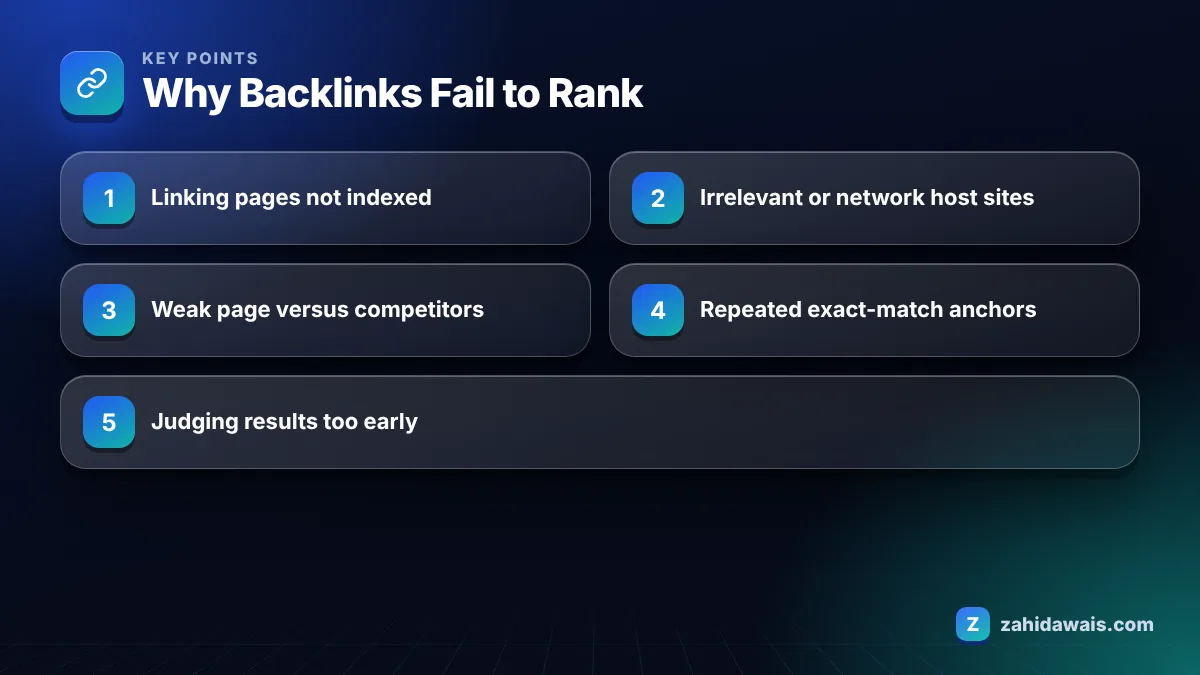
Your backlinks are most often not working because Google is not counting them, either because the linking pages are not indexed or because the links come from sites and patterns Google ignores. Before you blame the algorithm, confirm that each linking page is indexed and the link is a normal, crawlable anchor.
Here are the ten reasons I check, roughly in order of how often they cause the problem:
Your site may not rank even with backlinks because links help Google rank pages that already deserve to rank; they rarely lift a page that does not match the query well. Google’s guidance on creating helpful, people-first content says its ranking systems aim to reward helpful, reliable content made for people, and that easily verified factual errors or mass-produced content work against you.
Open the top three results for your keyword and ask honest questions. Do they answer the question faster? Do they include original data, pricing, photos or first-hand experience? Are they a different format, such as a list, a tool or a local page? If yes, no link package will close that gap alone.
Technical issues also block rankings. If the target page is not indexed, check reports like discovered, currently not indexed in Search Console before buying anything else.
Bad backlinks usually do not stop a site from ranking on their own, because Google says in its disavow links documentation that it can usually assess which links to trust; but paid or manipulative links can lead to a manual action, which does hurt. If you have no manual action in Search Console, spam links pointing at you are most likely just ignored.
The real cost of bad links is wasted money. Every dollar spent on a link Google ignores is a dollar not spent on content or a relevant placement. Google’s link spam policies list buying links for ranking purposes, excessive link exchanges, keyword-rich guest post anchors and automated link building as violations, and a profile built that way is fragile.
If you are comparing approaches, my article on guest posts vs PBN links explains why network links often fail to deliver.
You diagnose the cause by checking links, page and timing in that order, because unindexed or ignored links make every other fix pointless. This table maps the symptom to the likely cause and the fix.
| Symptom | Likely cause | Fix |
|---|---|---|
| Linking pages not found when you search their titles | Unindexed links | Ask publishers for internal links; replace weak placements |
| Impressions up, position flat | Page not as strong as competitors | Improve content, intent match and on-page signals |
| Homepage rises, service page does not | Links pointing to the wrong URL | Point new links to the target page; improve internal links |
| No change at all after 3 months | Links from irrelevant or network sites | Audit sources; shift budget to relevant niche sites |
| Sudden drop after a link campaign | Possible manual action or spam pattern | Check Manual actions report; clean up anchors and paid links |
| Ranks for brand only | Low topical authority | Publish supporting articles and link them internally |
The fastest audit is a simple spreadsheet with one row per link and five columns: linking URL, indexed or not, topical relevance, anchor text and target page. Twenty links take about an hour, and the pattern usually jumps out once everything sits in one view.
When I run this for clients, I score relevance on a simple three point scale: same niche, related niche, or unrelated. In most stuck campaigns more than half the links land in “unrelated”, which explains the flat graph better than any algorithm theory.
Then I group the target pages. If 80 percent of links point to the homepage while the client wants five service pages to rank, the fix is obvious: point new links at the service pages and add clear internal links from the homepage to each one.
Finally, check each target page in Search Console’s URL Inspection tool, since you own those pages. A page with a canonical pointing elsewhere or a noindex tag will never rank, however many links it receives. This step takes minutes and rules out the most embarrassing cause first.
Keep the sheet after the audit. Adding each new link as it goes live turns a one-off check into a running record, which makes the next review much faster and helps you spot sellers whose placements keep failing.
Here is a worked example. A law firm page sits at position 23 for “employment solicitor Manchester” after 10 guest posts went live four months ago. The audit finds: 3 of the 10 linking pages are not indexed, 6 use the exact anchor “employment solicitor Manchester”, and 7 come from general blogs with no legal content. The page itself has 400 words and no fee information, while the top three results have fee guides and FAQs. The fix: improve the page to about 1,200 words with fees, process steps and solicitor bios; get 4 new links from legal and local business sites using brand and descriptive anchors; and ask two publishers to change anchors. Eight weeks later the page sits at position 11 to 13. The content change and relevant links did what the original ten generic links could not.
If rankings still will not move after fixing links and content, widen the work beyond one page: build topical depth with supporting articles, improve internal linking, and check technical health across the site. Rankings often respond to the strength of the whole site, not just the page you are pushing.
If you want a second pair of eyes, my off-page SEO service starts with an audit of the links you already have before suggesting anything new. I will not promise a position, but I will show you which links are counted, which are wasted, and what the page needs to compete.
Give quality links about 8 to 12 weeks before judging, and compare 30 day averages rather than daily positions. Google says some changes take effect in hours and others take several months, so a flat first month is normal rather than a sign of failure.
Homepage links can help the whole site through internal links, but the effect on a specific service page is usually weaker than links pointing directly at it. Make sure the homepage links clearly to your important pages with descriptive anchors.
No. Links that simply do not help are not a reason to disavow. Google says the disavow tool is for many spammy, artificial or low quality links that have caused or will likely cause a manual action. Misuse can harm performance.
No. Relevance and quality matter more than count, and links work alongside content, intent match and technical health. Ten relevant links to a strong page usually do more than one hundred links from unrelated sites to a weak page.
Open Google Search Console and go to Security and Manual actions, then Manual actions. If Google has applied a manual action for unnatural links, it appears there with details. If the report shows no issues, no manual action is in place.
Google says it can usually assess which links to trust, so random spam links pointing at your site are most often ignored. If you see a large spam attack and a manual action appears, follow Google’s disavow guidance and document the cleanup.
Facts checked against these official pages. Read how I check facts in my editorial policy.
Backlinks pass through crawling, indexing and re-evaluation before rankings move. Here is what each stage looks like in practice.
Read article
A new site needs a few trusted links, not a big package. This month by month plan shows what to build and when.
Read article
A link on a page Google has not indexed does little for you. Here is why linking pages go unindexed and the safe ways to help Google find them.
Read articleSend your website and I will reply with a free audit.