Link building strategy
Link Building for New Websites: A Practical 6 Month Plan
A new site needs a few trusted links, not a big package. This month by month plan shows what to build and when.
Read articleBacklinks pass through crawling, indexing and re-evaluation before rankings move. Here is what each stage looks like in practice.
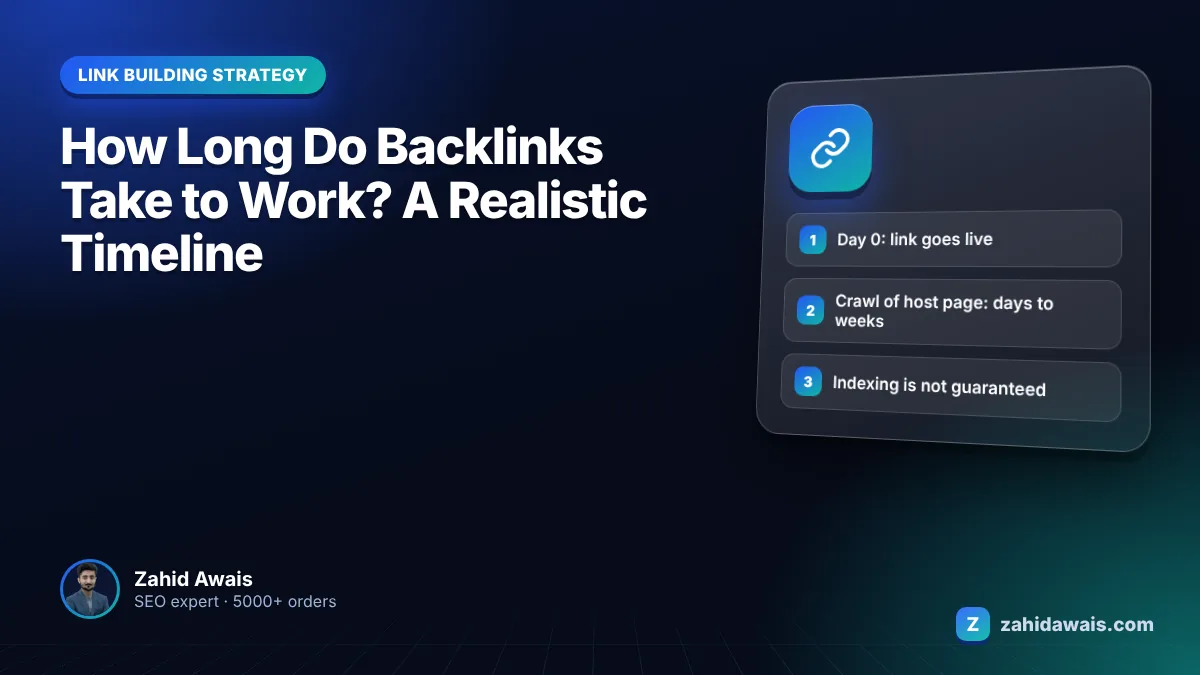
This article gives you a realistic answer to how long do backlinks take to work, broken into the stages a link goes through, the factors that speed it up or slow it down, and a simple way to judge results without panicking after week two.
For most sites, the answer to how long do backlinks take to work is roughly 4 to 12 weeks before you see a measurable ranking change, and sometimes longer. Google first has to crawl the linking page, index it, and then re-evaluate your page. Strong, relevant links on frequently crawled sites tend to show effects sooner.
Google recognizes a backlink only after it crawls the page that contains it, which can happen within a day on a busy news site or take several weeks on a small blog. There is no fixed delay. The link is simply invisible to Google until that linking page is fetched again.
Google explains in its guide to how Search works that it finds new pages by extracting links from pages it already knows. It also says plainly that it does not crawl every page it discovers, and that indexing is not guaranteed. So a link on a page that never gets indexed may never be counted at all.
In my orders I see a clear pattern. A guest post published on an active site with daily content is usually crawled within a few days. The same kind of article on a site that publishes once a month can sit unvisited for weeks.
No, backlinks do not work immediately, because discovery, indexing and ranking re-evaluation all happen on Google’s schedule, not on the day the post goes live. Even after the linking page is indexed, your own page needs to be recrawled and its position recalculated.
Google’s SEO Starter Guide says some changes may take effect in a few hours while others could take several months, and it suggests waiting a few weeks before judging the effect of your work. That is the most honest official guidance available, and it applies to links as much as to on-page edits.
Anyone who promises a ranking jump in 48 hours from a link package is guessing. Quick spikes that do happen are usually coincidence, a content update, or normal ranking fluctuation.
Most of the ranking movement I see from quality links appears between week 4 and month 3, with the full effect often clearer after 3 to 6 months. That range is from my own experience across client campaigns, not a Google figure, and your timeline depends on the factors below.
A link is one signal among many. If your page does not match search intent or is thinner than the pages already ranking, a link alone rarely lifts it. Links amplify a good page; they do not rescue a weak one.
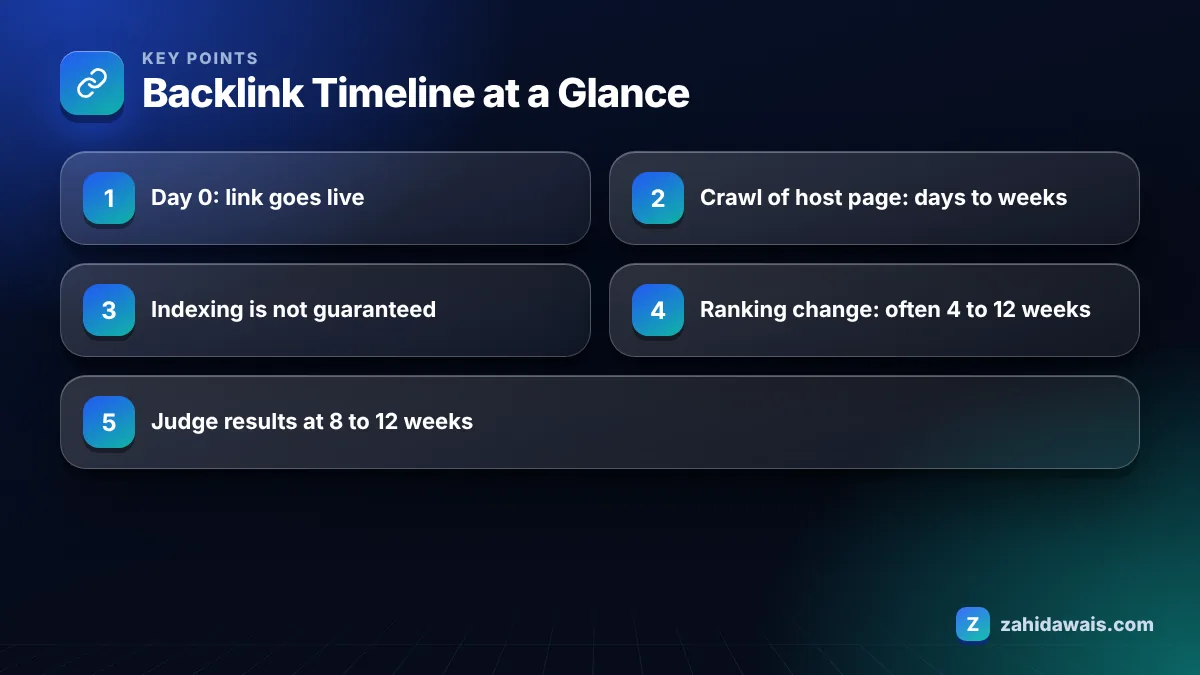
This reference table summarizes what typically happens at each stage.
| Stage | What happens | Typical time | What you can check |
|---|---|---|---|
| Publication | Link goes live on the host page | Day 0 | Link is a normal <a href> element, page is public |
| Crawl of linking page | Googlebot fetches the host page | 1 day to several weeks | Host site posting frequency, internal links to the post |
| Indexing of linking page | Host page enters Google’s index | Days to weeks, not guaranteed | Search the exact post title in Google |
| Re-evaluation of your page | Your page is recrawled and reassessed | Weeks | Search Console Links report, URL Inspection |
| Visible ranking change | Position shifts for target keywords | Often 4 to 12 weeks | Rank tracker trend over 30 days, not daily moves |
Backlinks work faster when the linking page is crawled often, sits close to the host site’s homepage, and is topically related to your page. They work slower when the host page is buried, orphaned or on a low quality site Google rarely visits.
Paid placements also need rel=”sponsored” or nofollow under Google’s spam policies, and Google says links marked with these attributes will generally not be followed. So treat the timeline above as a general pattern for editorial links rather than a promise for every placement. A marked link can still send referral visitors and build brand familiarity, which is worth something on its own.
One more factor people forget is patience on the host side. Some publishers update or reorganize old posts, which can change how deep your link sits on their site. Checking your placements every few months keeps the timeline honest.
Here is a worked example with illustrative numbers. A small service site has a page sitting at position 18 for its main keyword. On day 0, three relevant guest posts go live on active blogs in the same niche. By day 6, two of the posts show up when their titles are searched in Google; the third takes until day 24. Around week 3 the page starts moving between positions 14 and 16. By week 8 it settles at position 9, after the owner also improves the page’s intro and adds a comparison table. By week 12 it holds positions 7 to 9. The lesson: the first two links were counted weeks before the ranking moved, and the content fix mattered as much as the links.
Judge a link campaign after about 8 to 12 weeks, comparing average position and impressions for the target page against the period before the links went live. Daily rank checks in the first fortnight create noise and lead to bad decisions.
If you want a deeper framework for choosing links, my link building guide covers selection criteria in detail. For budgeting a campaign that runs long enough to show results, see this breakdown of real link building costs.
If you prefer to hand it over, my link building service focuses on relevant, actively crawled sites with clear disclosure of how each link is marked. No one can honestly guarantee a ranking or a date, but you can stack the odds by choosing pages Google actually visits.
It can be discovered within a week if the linking page is on a frequently crawled site, but visible ranking changes usually take longer. Google needs to crawl, index and re-evaluate both pages, so most people should expect several weeks before judging the effect.
The linking page may not be indexed yet, the link may not be crawlable, or your page may be too weak for the keyword. Check indexing of the host page, confirm the link is a normal anchor element, and compare your content with the pages ranking above you.
Google says links marked nofollow or sponsored will generally not be followed, so do not expect the same ranking effect. They can still bring referral traffic and visibility. Paid links should carry one of these attributes under Google’s spam policies, whatever the timeline.
In practice, yes. Google discovers links by crawling pages, and a page that is never crawled or indexed gives Google little reason to use its links. That is why choosing host sites that Google visits regularly matters so much.
Choose host sites that publish often and link new posts from their homepage or categories. Ask publishers to add internal links to older posts. Avoid indexing services that spam URLs, since they can attract the wrong kind of attention and rarely fix the underlying quality problem.
Short fluctuations happen as Google re-evaluates pages, and they are not always caused by the new links. Look at 30 day averages rather than daily positions. If a drop persists for weeks, review link quality and whether any paid links were left unmarked.
Facts checked against these official pages. Read how I check facts in my editorial policy.
A new site needs a few trusted links, not a big package. This month by month plan shows what to build and when.
Read article
A link on a page Google has not indexed does little for you. Here is why linking pages go unindexed and the safe ways to help Google find them.
Read article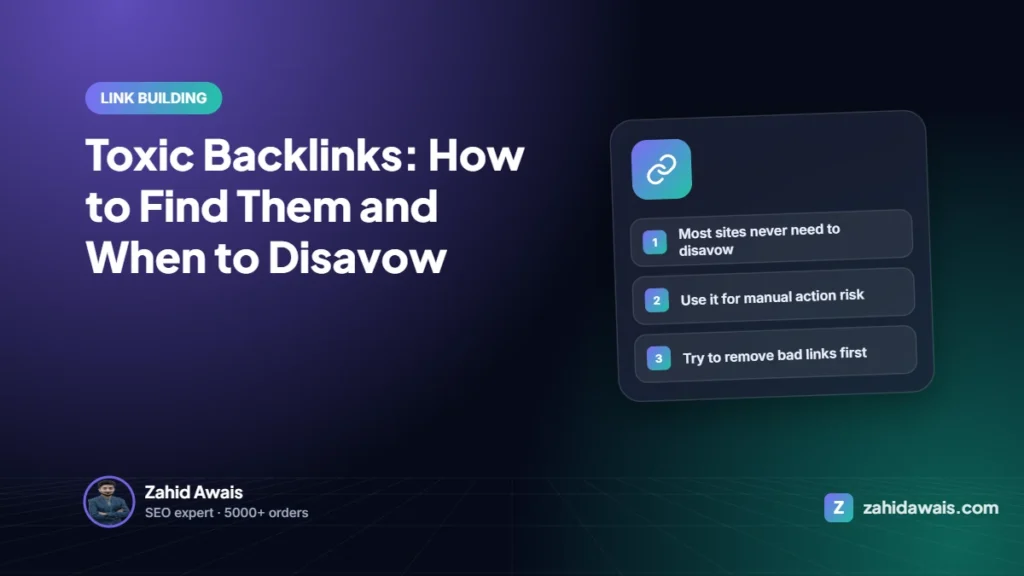
Most sites never need the disavow tool. Here is how to spot genuinely harmful links, when Google says disavowing makes sense, and how to build the file correctly.
Read articleSend your website and I will reply with a free audit.