Content SEO and writing
Does Passive Voice Hurt SEO? What Google Says and When to Fix It
Does passive voice hurt SEO? Google has no passive voice rule, but unclear sentences hurt readers. Learn when to rewrite, when to…
Read articleA manual SERP overlap method to group keywords into pages, so you write one strong page per intent instead of many competing ones.
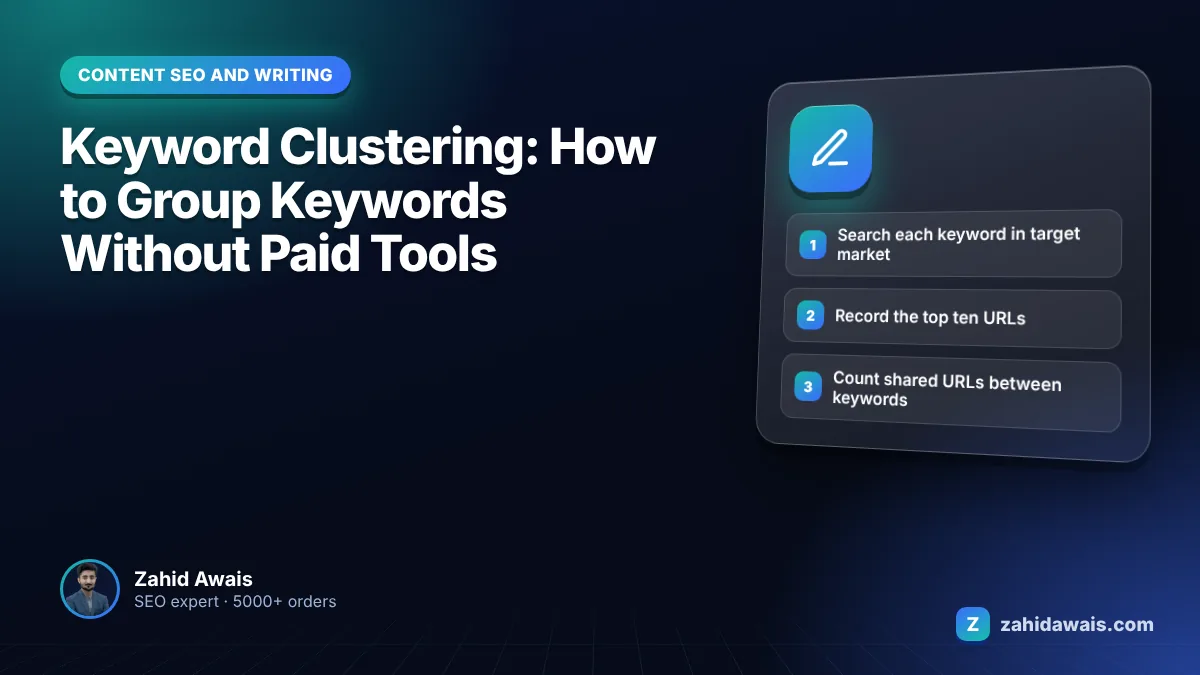
This guide teaches you keyword clustering with a manual method that needs only a browser and a spreadsheet, so you can decide which keywords share one page and which need their own.
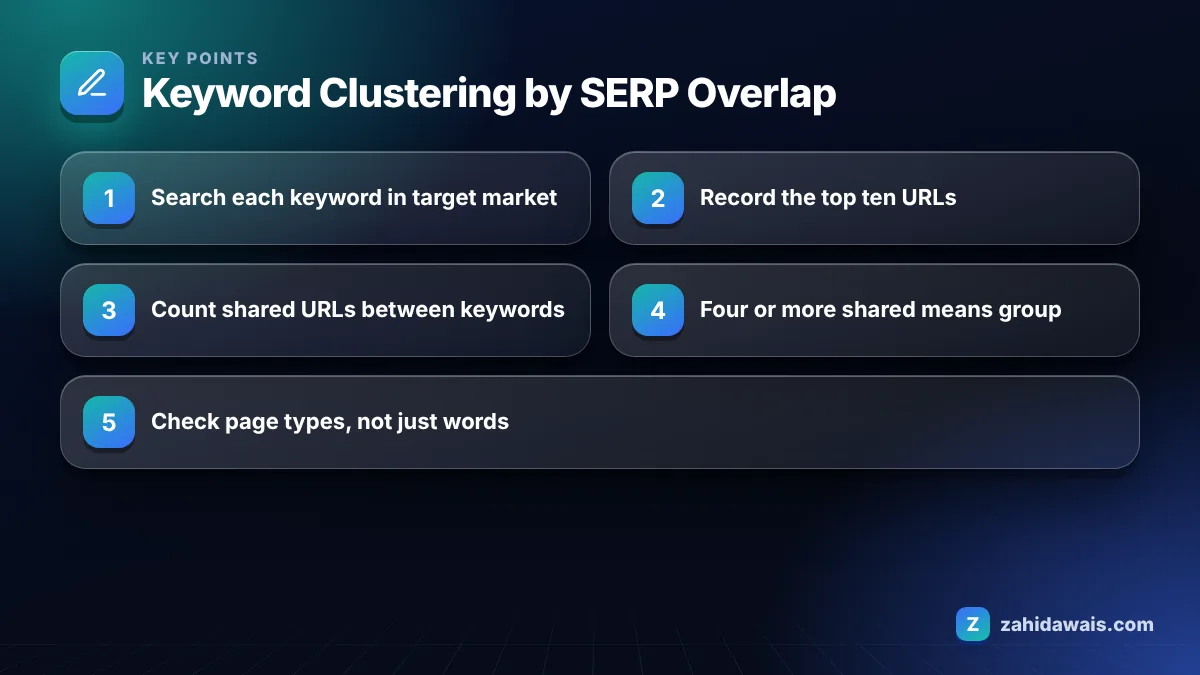
Keyword clustering means grouping keywords that can be answered by the same page. The reliable way to do it is SERP overlap: search each keyword, compare the top ten results, and put keywords together when they share several of the same ranking URLs. Keywords with different results need separate pages, even if the words look similar.
Keyword clustering is the process of grouping related search terms so each group is targeted by one page. It matters because writing a separate page for every variation creates thin, overlapping pages that compete with each other, while forcing unrelated keywords onto one page leaves searchers unsatisfied.
Google’s SEO Starter Guide notes that people search for the same thing with different words and that Google’s language matching is sophisticated, so you do not need a page for every phrasing. Clustering turns that idea into a plan: one page per distinct need, with all the ways people describe that need covered naturally inside it.
You cluster keywords manually by comparing their search results and grouping the ones that show mostly the same pages. Google already decided which pages satisfy each query, so overlapping results tell you the queries share an intent.
Search results vary by location, language and device, as Google’s guide to how Search works explains, so always check from the market you are targeting. A UK and a US result page for the same keyword can differ enough to change a cluster.
The most common clustering mistake is grouping by wording instead of by results. “Carpet cleaning solution” and “carpet cleaning service” share three words but have completely different intents. Other common errors:
As a working rule, keywords that share four or more of the same top ten URLs usually belong on one page, and keywords sharing zero to two usually need separate pages. This threshold is my practical rule, not a Google number, and borderline cases need judgement.
| Shared top 10 URLs | What it usually means | Action |
|---|---|---|
| 6 to 10 | Same intent, different wording | Same page, use as a variation |
| 4 to 5 | Same intent with a different angle | Same page, give it its own subheading |
| 3 | Related but possibly distinct | Check page types; group only if formats match |
| 0 to 2 | Different intent | Separate page, link the two pages together |
Look at page types as well as URLs. If one keyword shows guides and the other shows product pages, they need different pages even if a few URLs overlap.
For borderline scores, open the top three results for both keywords and read their headings. If the same outline would satisfy both searches, group them. If one search clearly wants a comparison and the other wants instructions, split them. Ten minutes of reading saves you from writing a page that half fits two intents and fully fits neither.
Keyword clustering decides which keywords go on one page, while topic clusters decide how several pages connect around a broader subject. Keyword clustering happens first and works at page level. Topic clusters work at site level.
A topic cluster is a pillar page plus supporting pages linked together. Each of those pages is the result of a keyword cluster. If you skip keyword clustering, your topic cluster often ends up with two supporting pages targeting the same need, which splits links and confuses readers. If you want a refresher on terms like pillar page or cannibalisation, my SEO glossary covers them.
A cluster should contain as many keywords as share the same intent, which can be two or thirty. There is no target size. Small clusters are normal for specific questions, and broad commercial terms often gather many variations.
What matters is that the page can answer every keyword in the cluster without becoming unfocused. If a page starts needing sections that would only interest one subgroup of searchers, that subgroup probably deserves its own page, linked from the main one.
A quick test I use: write the cluster’s main keyword as the H1, then list the other keywords as possible subheadings. If every subheading fits comfortably under that H1 and a reader searching any of them would be happy landing there, the cluster works. If one subheading feels like a detour, move that keyword out. In my content orders, clusters for informational guides usually end up with a handful of close variations plus several question style keywords that become H2s, while local service clusters stay small and tight.
A carpet cleaning business gave me 12 keywords: carpet cleaning cost, how much is carpet cleaning, carpet cleaning prices per room, average cost to clean carpets, how to clean carpet at home, DIY carpet cleaning, best carpet cleaning solution, homemade carpet cleaner, carpet cleaning near me, professional carpet cleaners, carpet stain removal, how to get red wine out of carpet.
The SERP overlap check produced five clusters. Cost (four keywords) shared six to eight URLs with each other, so they became one pricing page with a table by room. DIY cleaning and homemade cleaner shared five URLs and became one how-to guide, while “best carpet cleaning solution” showed product reviews, so it got its own page. “Near me” and “professional carpet cleaners” showed local results and maps, so they belonged on the service page. Stain removal and red wine shared only two URLs; red wine got its own short guide linked from a general stain page.
Twelve keywords became six pages instead of twelve, and every page had a clear job.
If you would like your keyword list clustered and turned into a content plan, that is part of my on-page SEO service. You can also check drafts against their cluster with the free SEO tools on this site.
Keyword clustering is grouping search terms that can be satisfied by the same page. Each group, or cluster, is targeted by one page, with the main keyword as its focus and the rest covered naturally. It prevents duplicate pages and makes content planning clearer.
No. Tools speed up the process for large lists, but the manual SERP overlap method gives reliable results for a few dozen keywords. You search each keyword, record the top ten results and group keywords that share several of the same URLs.
SERP overlap is the number of identical URLs that appear in the search results for two different keywords. High overlap suggests Google sees the queries as having the same intent, so one page can serve both. Low overlap suggests separate pages are needed.
Yes. A good page often ranks for dozens or hundreds of related queries because Google understands different phrasings of the same need. Clustering helps you identify which variations to cover on that page so it answers all of them well.
Keyword cannibalisation happens when two or more pages on the same site target the same intent and compete for the same queries. It can split links and confuse which page should rank. Clustering before writing prevents it, and merging overlapping pages fixes it.
Recheck important clusters once or twice a year, or whenever rankings change noticeably. Search results evolve as intent shifts, new page types appear and competitors publish. A cluster that shared one page last year may need splitting now.
Facts checked against these official pages. Read how I check facts in my editorial policy.
Does passive voice hurt SEO? Google has no passive voice rule, but unclear sentences hurt readers. Learn when to rewrite, when to…
Read article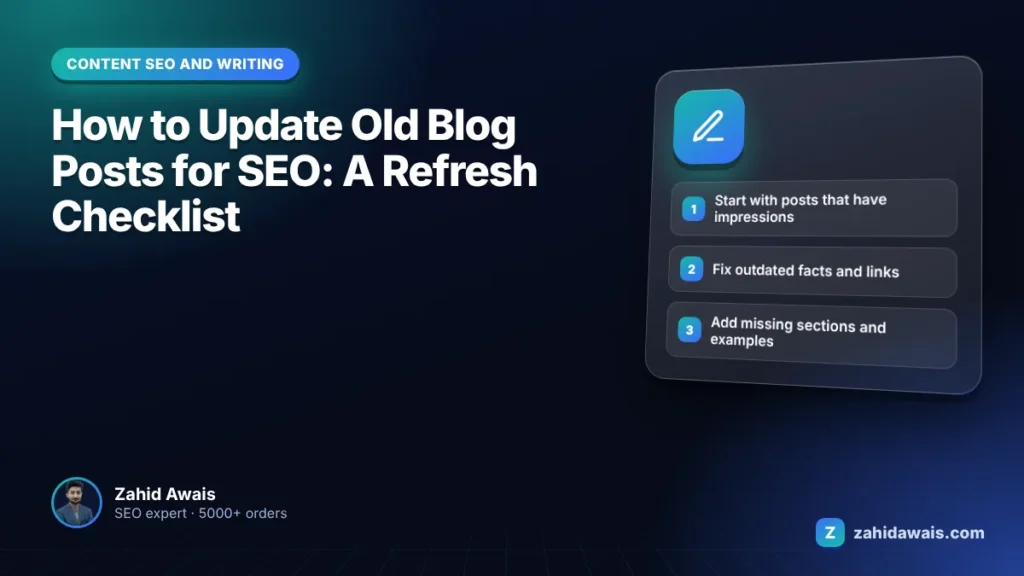
A practical refresh checklist for old posts, covering what to change, when to update the date and when a URL change is worth it.
Read article
Fifteen concrete ways to show experience, expertise, authority and trust, with before and after rewrites you can apply to any page today.
Read articleSend your website and I will reply with a free audit.